

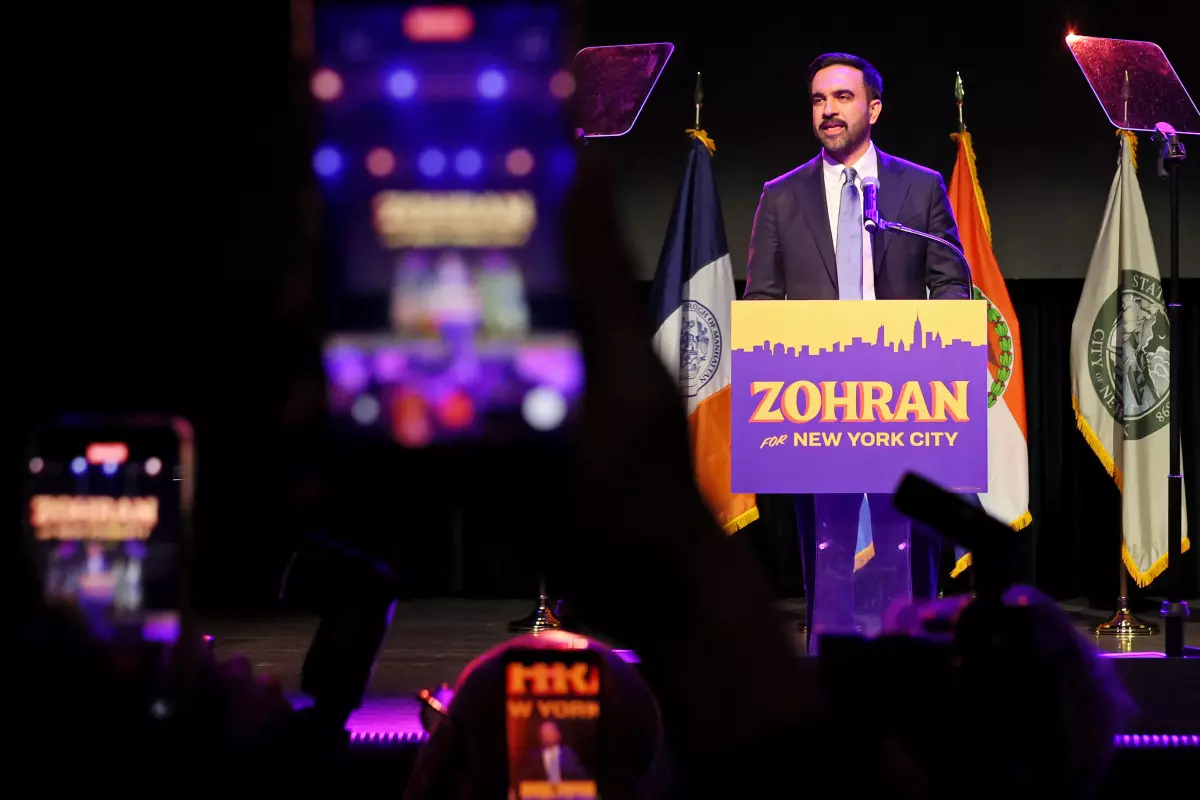
At 34, Zohran Mamdani has made history as New York City’s first Muslim and South Asian mayor, defeating political dynasties twice in an unprecedented campaign that centered on affordability and working-class concerns. His victory on November 4, 2025, marks a generational shift in American urban politics, challenging traditional power structures while promising transformative change for the nation’s largest city.
From Three Continents to Queens: A Global Upbringing
Zohran Kwame Mamdani was born on October 18, 1991, in Kampala, Uganda, the only child of renowned postcolonial scholar Mahmood Mamdani and Academy Award-nominated filmmaker Mira Nair. His middle name, Kwame, honors Kwame Nkrumah, Ghana’s first president, reflecting his parents’ pan-African consciousness and commitment to decolonization.
Mamdani’s early years were marked by constant movement: he lived in Kampala until age five, then moved to Cape Town, South Africa, where his father taught African studies at the University of Cape Town. When he was seven, the family relocated to New York City after his father joined Columbia University’s faculty in 1999, settling in Morningside Heights on the Upper West Side.
This transnational upbringing profoundly shaped Mamdani’s worldview. His father’s experiences—expelled from Uganda by Idi Amin in 1972 due to his Indian ethnicity, later stripped of citizenship by Milton Obote’s government—gave young Zohran an intimate understanding of displacement and the struggle for belonging. His mother’s films, particularly Mississippi Masala, which depicted interracial romance and was inspired by her relationship with Mahmood, became fixtures in their household, sparking conversations about identity, race, and justice.
The family’s arrival in New York just before September 11, 2001, marked another formative experience. In his victory speech, Mamdani spoke movingly of his aunt’s fear after 9/11, acknowledging how Islamophobia persists in American society. He has described his upbringing as “privileged,” saying, “I never had to want for something, and yet I knew that was not in any way the reality for most New Yorkers.”
The Making of a Democratic Socialist
Mamdani attended the prestigious Bronx High School of Science, where he co-founded the school’s first cricket team and earned a reputation for being sent to detention “one too many times.” He then went to Bowdoin College in Maine, graduating in 2014 with a degree in Africana studies after co-founding the school’s chapter of Students for Justice in Palestine.
Before entering politics, Mamdani worked as a foreclosure prevention and housing counselor in Queens, assisting lower-income immigrant homeowners facing eviction notices. This work proved transformative, crystallizing his understanding of systemic inequality and motivating his political career. In 2014, he joined Change Corps, a community organizing training program, though he resigned after six months, believing he was about to be fired for organizing a union within the program itself—an early demonstration of his willingness to challenge established institutions.
He was naturalized as a U.S. citizen in 2018, the same year he managed Ross Barkan’s New York State Senate campaign. In 2020, Mamdani won a seat in the New York State Assembly representing a district in Queens, running as a democratic socialist endorsed by the Democratic Socialists of America. As an assemblyman, he sponsored 20 bills—three of which became law—and helped launch a successful fare-free bus pilot program. He even participated in a hunger strike alongside taxi drivers, helping them achieve more than $450 million in transformative debt relief.
The Campaign That Shook the Establishment
On October 23, 2024, Mamdani announced his candidacy for mayor with a platform focused squarely on affordability: free city buses, universal child care, city-operated grocery stores, a rent freeze on rent-stabilized units, 200,000 new affordable housing units, and a $30 minimum wage by 2030. To fund these initiatives, he proposed raising taxes on corporations and individuals earning above $1 million annually.
Few gave the relatively unknown assemblyman a chance against Andrew Cuomo, the former governor attempting a political comeback. Traditional power brokers, including real estate and business sectors concerned with Mamdani’s democratic socialist identity, banded together in support of Cuomo and donated millions of dollars to anti-Mamdani super PACs. More than $40 million was raised to oppose his candidacy and support Cuomo. But Mamdani’s campaign resonated. His relentless focus on affordability, combined with his savvy use of social media and multilingual outreach, mobilized a diverse coalition. On bitterly cold nights, he would stand near Wall Street asking passersby whether they’d rather pay $10 or $8 for halal food, using street vendor economics to illustrate how arcane permit systems inflate costs for working people. He created videos in Hindi and Urdu, complete with Bollywood references, that spread across WhatsApp family threads and text chains throughout South Asian communities.
In the closing days of the campaign, Mamdani was omnipresent: attending church services in the morning, calling into radio shows at midday, stopping into ethnic supermarkets in the outer boroughs, popping up on influencer live streams, joining a Union Square freestyle rap battle, and capping off his Saturdays with whirlwind tours of the city’s nightclub scene. He visited 55 mosques and attended Friday prayers, vowing simply “to be a Muslim man in New York City.”
In June 2025, Mamdani defeated Cuomo in the Democratic primary by 12 percentage points—a stunning upset that sent shockwaves through the political establishment. When Cuomo mounted an independent campaign for the general election, President Donald Trump threatened to withdraw federal funding from New York City should Mamdani be elected, and made a last-minute endorsement of Cuomo the night before the election.
On November 4, 2025, Mamdani won decisively, defeating Cuomo. More than 2 million votes were cast—the first time that threshold had been reached since 1969, with early voting turnout setting records. Exit polls showed young voters favoring Mamdani overwhelmingly, with voters under 45 supporting him by significant margins.
A Politics of Possibility
Mamdani’s political philosophy represents a distinct break from neoliberal consensus politics. In his victory speech, he quoted Eugene Debs, the early 20th-century socialist: “I can see the dawn of a better day for humanity.” He positioned himself in direct opposition to Trump, declaring: “In this moment of political darkness, New York will be the light.”
Mamdani framed his campaign as not merely defeating Trump, but stopping “the next one” by building a politics that responds to oligarchy and authoritarianism through material improvements in people’s lives. He promised his supporters that “no more will New York be a city where you can traffic in Islamophobia and win an election,” and vowed that “New York will remain a city of immigrants, a city powered by immigrants, and as of tonight, led by an immigrant.”
City Comptroller Brad Lander captured Mamdani’s appeal: “What Zohran is showing is that it’s worth putting up big bold ideas for change, standing up and fighting for them. Yes, he’s a democratic socialist, but he had a bold vision for the future of the city and that excited people.”
Zohran Mamdani will assume office on January 1, 2026, as the youngest New York City mayor since 1892, and the city’s first Muslim mayor. His victory represents more than symbolic firsts—it signals a potential realignment in Democratic politics where bold progressive visions centered on material concerns can mobilize multiracial, multigenerational coalitions. Whether Mamdani can translate his campaign promises into governance remains to be seen, but for now, New York has chosen hope, and the world is watching.