

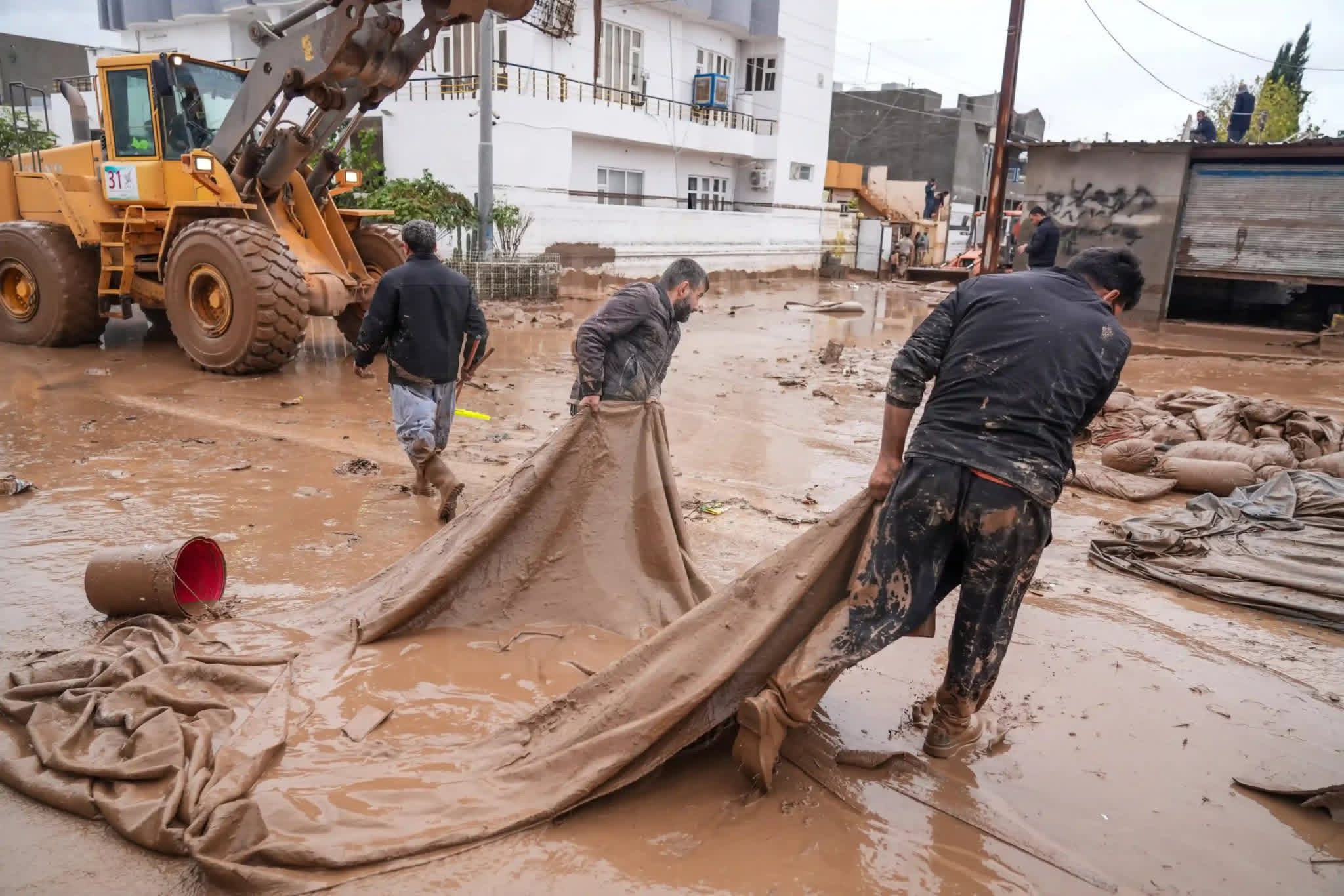
December 8-10, 2024— An unprecedented deluge of torrential rain has devastated Chamchamal district in Iraq’s Kurdistan Region, claiming at least three lives across Sulaimani province, injuring 14 others, and leaving a trail of destruction that has shaken this community to its core. What began as heavy rainfall on Sunday, December 8, escalated into a catastrophic flash flood event that has displaced hundreds of families and overwhelmed local infrastructure.
The Human Toll: Lives Lost, Communities Shattered
The floodwaters claimed two lives in Chamchamal, with victims dying by electrocution, collapsing walls, or being swept away by surging waters. An additional death was reported in nearby Kalar district, bringing the regional death toll to three. Fourteen people sustained injuries requiring hospitalization, and one person remained missing as of Thursday.
On Tuesday, December 9, Mayor Ramk Ramazan announced in a press conference that the flooding had resulted in deaths and injuries as rescue operations continued through treacherous conditions. Eyewitnesses describe scenes of chaos as families scrambled to reach higher ground while floodwaters rose with terrifying speed.
A City Underwater: The Unprecedented Scale of Destruction
According to the Joint Crisis Coordination Center (JCC), the floods that struck from December 8 to 10 damaged more than 1,600 homes across Sulaimani province, with Chamchamal district absorbing the worst impact. More than 1,000 homes in Chamchamal alone sustained damage or were destroyed, along with 150 commercial properties. An additional 200 vehicles were damaged or swept away across the affected areas.
The devastation was fueled by historic rainfall levels: 127.1 millimeters of rain fell on Chamchamal in a single day on Tuesday, wreaking havoc on residential and public infrastructure. Floodwaters breached more than 100 shops and warehouses in the district.
The damage extends far beyond private property:
– Over 1,000 homes damaged in Chamchamal district alone
– 150 commercial properties battered by floodwaters
– 200 vehicles damaged across the region
– 25 parks destroyed, including five major public spaces
– Four bridges collapsed or damaged within district borders
– Complete power outage across Chamchamal district
– Internet connectivity disrupted throughout the area
Cultural Heritage in Ruins: The Library Tragedy
Among the most heartbreaking losses is the near-total destruction of Chamchamal’s Public Library, established in 1976. The 48-year-old institution, located in a low-lying area, suffered extensive damage with rare and historical books destroyed—some preserved for nearly five decades.
Library director Hersh Abdulrahman mourned the loss: the destroyed materials included invaluable historical, scientific, and medical works that are extremely rare and very difficult to replace. The library had served as a key educational and cultural institution for generations of Chamchamal residents.
Education in Crisis: Nine Schools Damaged, Qandil School Devastated
The flood’s impact on education has been severe and far-reaching. Nine schools across Chamchamal district sustained damage, with midterm exams postponed until early January. Abdullah Hama, Director of Education in Chamchamal, declared an official holiday for Thursday, December 11, to ensure student safety.
Perhaps no image has captured the devastation more powerfully than the videos emerging from Qandil School in the Takiya subdistrict near Chamchamal. Footage shows the school extensively destroyed, with desks, books, and educational materials submerged in murky water. The scenes are exhausting to watch—a stark reminder that this disaster has robbed children not just of their present safety, but of their educational future.
Government Facilities Paralyzed
Five government offices in Chamchamal sustained flood damage, severely disrupting public services:
– Property registrar office
– Passport office
– Culture department
– Police headquarters
– District administration offices
The meteorological station in Chamchamal itself was damaged, hampering weather monitoring capabilities during the crisis.
Infrastructure Collapse: Roads, Bridges, and Essential Services
The flooding triggered widespread infrastructure failures that isolated communities and severed vital connections. The main arterial roads linking Sulaimani to Chamchamal and Kirkuk to Chamchamal were forced to close, trapping hundreds of travelers at inspection checkpoints.
Water supplies to Chamchamal and nearby Shuresh were completely halted after pipelines sustained damage. Water turbidity levels in the Little Zab River exceeded 1,000 nephelometric turbidity units (NTU)—far above the threshold of less than 5 NTU required for safe drinking water. Water treatment projects in Qaladze, Dukan, Taqtaq, and Koya were unable to adequately filter water, creating acute problems for drinking water access across multiple cities.
Meanwhile, south of Sulaimani, all three dams in the Garmiyan Administration—the Awaspir, Bawashaswar, and Turajar dams—overflowed. The Awaspi dam alone holds 20 million cubic meters of water. Following the overflow, authorities warned Kalar residents about imminent major flooding threats, urging those near streams to evacuate immediately.
The Most Vulnerable Hit Hardest
The neighborhoods most severely affected are home to some of Chamchamal’s poorest residents—families who were already struggling before the floods, living day to day with limited resources. Large numbers of livestock, including horses, cows, and poultry, were also lost, devastating livelihoods dependent on agriculture.
In nearby agricultural areas, the economic toll has been staggering. In Erbil’s Taqtaq district alone, over 800,000 fish were lost from destroyed fish ponds, and nearly 400 fish ponds in the Shwan sub-district were destroyed along with dozens of agricultural equipment pieces.
“These people had very little to begin with,” explained a local aid worker. “Now they have nothing. They need immediate assistance—food, clean water, shelter, medical care. And they’ll need long-term support to rebuild their lives.”
Leadership Response: Deputy PM Talabani Takes Direct Action
Qubad Talabani, Deputy Prime Minister of the Kurdistan Region, personally visited flood-stricken Chamchamal on Wednesday, December 11, to meet with victims and assess their needs firsthand. His presence brought comfort to residents who felt their suffering was being acknowledged at the highest levels of government. During his visit, Talabani announced several critical initiatives:
– Formation of a humanitarian response unit to provide immediate aid, coordinate relief efforts, and restore services
– Establishment of an investigation committee to examine potential negligence and prevent future disasters
– Creation of a fundraising committee calling on philanthropists, business leaders, and the public to contribute
– Commitment to reimburse citizens who suffered material losses
– Plans to provide alternative water sources until damaged systems are cleaned and safe
Talabani also instructed local officials to listen to citizen criticism with open hearts and never file complaints against frustrated residents expressing their concerns.
A Community Responds: Historic Mobilization of Aid
In the face of tragedy, the response has been swift, heartfelt, and unprecedented in scale. Before formal appeals had fully taken shape, residents across all urban centers in the Kurdistan Region launched aid campaigns for Chamchamal’s flood victims. According to Atta Mohammed, head of a service and reconstruction commission, the following supplies have already been distributed to 600 families:
– 1,700 food baskets
– 3,200 blankets
– 600 mattresses
– 4,000 meters of carpet
– 900 kerosene heaters
– 2,000 kerosene containers
– 10,000 sets of drinking water
Baghdad Takes Action: Federal Government Mobilizes Emergency Response
Iraqi Prime Minister Mohammed Shia’ al-Sudani ordered urgent emergency aid on Wednesday, December 11, demonstrating federal commitment to supporting the Kurdistan Region through this crisis. According to his media office, al-Sudani issued multiple directives:
– Emergency funding allocation: Instructed the Finance Ministry to establish an emergency fund to meet all relief needs
– Disaster management activation: Tasked the National Center for Emergency, Crisis, and Disaster Management to provide necessary assistance and support
– Evacuation operations: Ordered deployment of aircraft from the Army Aviation Command for rescue and evacuation flights once weather conditions improve
– Infrastructure repair: Directed authorities to work on reopening roads, repairing damaged bridges, and providing support to facilitate resident movement
The Security Media Cell, affiliated with the Iraqi Joint Operations Command, announced the establishment of an advanced command center between Kirkuk and Salahuddin provinces to coordinate relief efforts through the Crisis and Disaster Management Center.
This inter-governmental cooperation signals recognition that the disaster requires resources beyond what the Kurdistan Regional Government can provide alone. The federal government’s swift response demonstrates unity in addressing this humanitarian emergency.
An Urgent Call to the International Community
Local officials, and humanitarian organizations, and are calling on international aid organizations to intervene with urgency. The United Nations, Red Cross, Red Crescent, and other international NGOs have been urged to provide emergency assistance to what is being described as one of the worst natural disasters to hit the Kurdistan Region in recent years.
Iraq has been identified as the fifth-most vulnerable country to climate change globally, affected by soaring temperatures, insufficient rainfall, intensified droughts, water scarcity, and flooding. The International Organization for Migration (IOM) has recorded more than 130,000 individuals displaced due to water scarcity across 12 Iraqi governorates, highlighting the country’s broader vulnerability to climate-related disasters.
The crisis in Chamchamal represents not just a local emergency but a manifestation of Iraq’s climate vulnerabilities. Flash floods have become a recurring threat due to aging drainage systems, rapid urban growth, and stressed river basins that leave communities exposed to extreme weather linked to climate change.
“This is beyond our capacity,” admitted one government official. “We need the international community to stand with Chamchamal. These are among the most vulnerable populations in Iraq, and they cannot recover from this alone.” Specifically, the region urgently needs:
– Emergency housing solutions for displaced families living in temporary shelters
– Medical supplies and personnel to treat the injured and prevent disease outbreaks from contaminated water
– Clean water and sanitation systems to prevent a public health crisis as treatment facilities remain offline
– Food security programs for families who have lost everything, including livestock and agricultural assets
– Educational resources to rebuild schools, replace destroyed materials, and resume learning for thousands of students
– Long-term reconstruction funding to rebuild homes, repair infrastructure, and restore public facilities
– Climate adaptation support to help communities prepare for increasingly frequent extreme weather events
Despite the impressive local and regional response, aid workers emphasize that the scale of need far exceeds current resources. While initial assistance has reached many families, sustained international support will be crucial in the weeks and months ahead.
Looking Ahead: A Long Road to Recovery
As the floodwaters slowly recede and meteorological forecasts indicate rainfall will continue through Sunday, December 14—though less intense than earlier in the week—the true extent of the damage is becoming clear. This is not a crisis that will be resolved in days or weeks. Recovery will take months, perhaps years, and will require sustained commitment from all levels of government, civil society, and the international community.
The response has already demonstrated the resilience and solidarity of Kurdistan’s people. From Darbandikhan’s 100 million dinar donation to the 60 volunteers of the Kurdistan Foundation cleaning mud-filled homes, from President Barzani’s order mobilizing the BCF within two hours to Deputy PM Talabani’s on-site leadership, the region has shown what unified action looks like.
Yet challenges remain immense. With electricity still not fully restored in some areas, drinking water systems compromised, bridges collapsed, and winter approaching, the most vulnerable families face harsh conditions. The destruction of Qandil School and eight other educational facilities means thousands of children have had their education disrupted at a critical time.
The people of Chamchamal are resilient, but they cannot do this alone. Their city has been shaken, but not broken. With adequate support—from Erbil, Baghdad, and the international community—Chamchamal can rebuild stronger, more prepared, and more united than before.
For now, the focus remains on immediate survival needs: shelter, food, clean water, and medical care. But the vision must extend beyond survival to true recovery and renewal, including:
– Reconstructing homes and public buildings with flood-resistant designs
– Upgrading drainage and sewerage systems to handle extreme rainfall
– Restoring educational facilities and replacing destroyed materials
– Rebuilding livelihoods for families who lost livestock and businesses
– Implementing early warning systems and disaster preparedness programs
– Addressing the root causes of vulnerability through climate adaptation
As one aid worker noted, reflecting on the outpouring of support: “What these comrades have done today is a source of pride for us. The crisis is very, very large, but so is our determination to overcome it together.”