

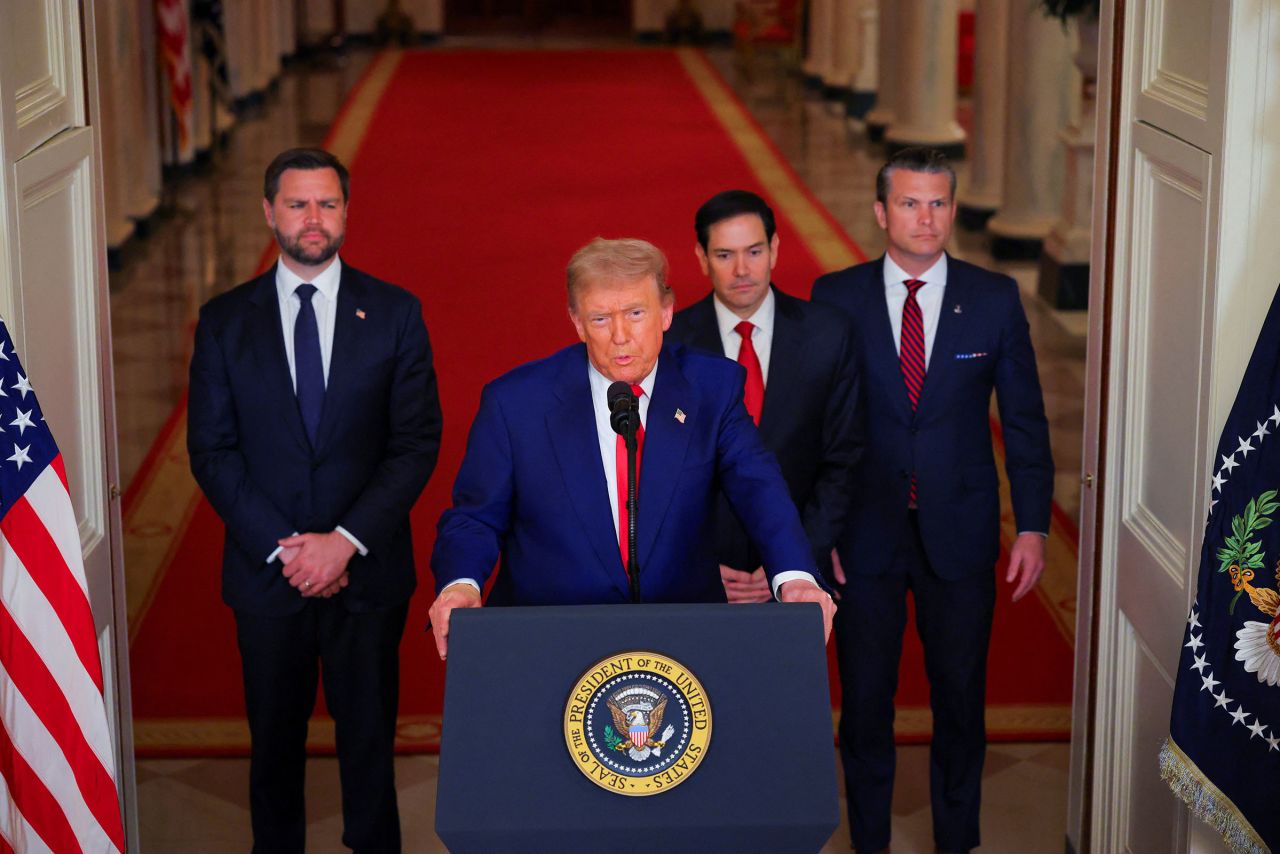
The United States launched unprecedented strikes on three Iranian nuclear facilities Sunday, with President Donald Trump announcing that sites at Fordow, Natanz and Isfahan were targeted. The dramatic escalation marks America’s direct entry into the Israel-Iran conflict, triggering immediate retaliation from Tehran and prompting emergency international meetings. Iran responded with missile barrages against Israeli cities, causing widespread damage and casualties, while diplomatic leaders worldwide called for urgent de-escalation.
Devastating Impact on Tel Aviv and Israeli Cities
Two senior Defense Department officials confirmed to CBS News that three American B-2 bombers were used to strike Fordo early Sunday local time, with each of those B-2s armed with 2 U.S.-produced “bunker-buster” bombs in what Trump called a “spectacular military success.” However, Iran’s immediate retaliation brought the war directly to Israeli civilian areas.
An Iranian ballistic missile created catastrophic damage in northern Tel Aviv, leaving a gaping hole in a three- or four-story apartment building. The missile completely destroyed the building’s top floor, tore through concrete walls, and shattered every window in the structure. Furniture was scattered throughout the destroyed apartments, with debris from mattresses and other belongings strewn across the surrounding area where trees were shredded by the blast.
Heavy equipment moved in Sunday morning to clear rubble and begin cleanup operations as rescue and recovery teams worked throughout the impact zone. The scene represented the most significant damage to Tel Aviv’s residential areas since the conflict began.
Beyond Tel Aviv, Israeli emergency services reported responding to at least 10 different impact sites across the country following Iran’s retaliatory missile barrage. The strikes caused what emergency responders described as “large-scale destruction” in multiple locations. Buildings were severely damaged, with some completely collapsing, according to Magen David Adom emergency services. At least 11 people were wounded in the attacks, though no deaths were immediately reported.
Warning sirens echoed across Israel and neighboring Jordan as missile streaks filled the sky over Jerusalem. The attacks marked Iran’s first missile launches toward Israel since the US confirmed its nuclear facility strikes, representing a dramatic escalation in the regional conflict.
Trump’s Nuclear Ultimatum and Iran’s Defiant Response
Speaking from the White House Saturday evening, President Trump delivered a stark ultimatum to Iran: “make peace” or face additional attacks on targets that “will be far greater and a lot easier.” Trump called the operation a “spectacular military success” and claimed Iran’s key uranium enrichment facilities were “completely and totally obliterated”.
However, Trump’s definition of “peace” remains unclear. His demands have evolved from seeking a nuclear deal to calling for Iran’s “unconditional surrender” on social media. The president had given himself a two-week deadline to decide on military action, but struck well before that timeframe following the escalation of Israeli-Iranian exchanges.
Iran’s response was immediate and defiant. The country’s Foreign Ministry declared that the US had begun a “dangerous war against Iran,” calling the strikes a violation of the UN charter and international law. Foreign Minister Abbas Araghchi warned the attacks would have “everlasting consequences” and that Iran “reserves all options to defend its sovereignty, interest, and people.”
Iranian officials downplayed the extent of damage to their nuclear facilities, particularly the heavily fortified Fordow site. Manan Raeisi, an Iranian lawmaker representing the holy city of Qom near Fordow, claimed the attack was “quite superficial” and had not seriously damaged the facility. He stated that most affected areas were above ground and could be fully restored, contradicting Trump’s claims of total obliteration.
International Nuclear Crisis Deepens
The strikes triggered immediate international alarm over nuclear safety and regional stability. Rafael Mariano Grossi, director general of the International Atomic Energy Agency (IAEA), called an emergency meeting for Monday, stating the “urgent situation in Iran” required immediate attention from the UN nuclear watchdog’s Board of Governors.
The IAEA confirmed that no increase in off-site radiation levels had been reported at the three targeted Iranian nuclear sites, providing initial reassurance about nuclear contamination risks. However, the agency’s neutral status came under question as Iranian officials accused it of being complicit in the US strikes, though no evidence was provided for these claims.
Video footage broadcast by Iranian state media and geolocated by CNN showed dark smoke rising from the direction of the Fordow nuclear facility. The underground complex, buried deep in several mountains near Qom, had been considered one of Iran’s most secure nuclear installations. Satellite imagery from before the strikes revealed apparent attempts to reinforce the facility’s entrances, with dump trucks and earthmoving equipment positioning dirt in front of tunnel openings.
NASA’s Fire Information for Resource Management System detected two heat signatures near Fordow early Sunday morning, with the first detected at 2:29 a.m. local time and the second at 2:54 a.m. Both detections occurred before Trump announced the strikes publicly.
Strategic Implications and Regional Reactions
The attacks represent a fundamental shift in US Middle East policy, with America now directly engaged in the Israel-Iran conflict despite Trump’s previous promises to avoid new Middle Eastern wars. The decision puts enormous pressure on Iran’s leadership to choose between diplomatic de-escalation and further military confrontation.
Analysts suggest Iran faces several difficult options. The country could return to nuclear negotiations, potentially agreeing to zero uranium enrichment as former Israeli Military Intelligence chief Amos Yadlin suggested. Alternatively, Iran might withdraw from the Nuclear Non-Proliferation Treaty, though experts note Iran lacks the immediate capability to build nuclear weapons.
More concerning for global stability, Iran could choose to close the Strait of Hormuz, a critical oil shipping route that could dramatically impact global energy prices and the world economy. Hossein Shariatmadari, editor-in-chief of the hardline Kayhan newspaper and identified as a representative of Supreme Leader Khamenei, already called for missile strikes and strait closure following the US attacks.
British Prime Minister Keir Starmer urged Iran to return to the negotiating table, stating that “Iran can never be allowed to develop a nuclear weapon and the US has taken action to alleviate that threat.” He called Iran’s nuclear program a “grave threat to international security” while calling for diplomatic solutions.
Iraq warned that the strikes constitute a “grave threat” to regional peace and security, with government spokesperson Basim Alawadi stating that continued attacks risk “dangerous escalation with consequences that extend beyond the borders of any single state.”
Israeli Leadership Celebrates “Historic” Moment
Israeli leaders unanimously praised Trump’s decision, with Prime Minister Benjamin Netanyahu calling it a “historic” action that “will change history.” President Isaac Herzog described the strikes as a “decisive moment” when “the principles of liberty, responsibility, and security have triumphed.”
Defense Minister Israel Katz said the strikes strengthened the US-Israel alliance “for the sake of peace and security for both nations and for the entire free world.” Israeli officials expressed hope that the action would advance efforts to secure the release of hostages held in Gaza.
However, Israel also responded with its own military action, launching new airstrikes on western Iran Sunday morning. The Israeli Defense Forces announced strikes on “military targets in western Iran” while also targeting missile launchers that had been prepared to fire toward Israeli territory.
The coordinated US-Israeli military pressure represents the most significant challenge to Iran’s nuclear program and regional influence since the 1979 Islamic Revolution. Israeli officials noted that only the US possessed bombs powerful enough to penetrate the heavily fortified Fordow facility, making American participation essential for targeting Iran’s most protected nuclear sites.
Diplomatic Crisis and Emergency Meetings
Iran immediately requested an emergency meeting of the UN Security Council, with Ambassador Amir Saeid Iravani calling the US attack a “grave threat against regional and international peace and security.” He urged the council to condemn the strikes and ensure accountability for what he termed an “unlawful act.”
The international nuclear monitoring system faces unprecedented challenges as Iran threatens withdrawal from the Non-Proliferation Treaty. Parliament Foreign Policy Committee Head Abbas Golroo stated that Iran has the legal right to withdraw from the NPT based on Article 10, which allows members to leave if they determine that “extraordinary events” have jeopardized their supreme interests.
The strikes occurred despite ongoing diplomatic efforts, with Iran accusing the US of betraying diplomacy “in the midst of a diplomatic process.” This reference likely relates to indirect negotiations that had been occurring through European intermediaries in recent weeks.
Military Assessment and Damage Control
Israeli intelligence officials told CNN it remained too early for reliable battle damage assessment of the US strikes. Officials indicated that accurate assessments would require daylight aerial reconnaissance and additional intelligence gathering, including communication intercepts, to determine the full extent of damage to Iran’s nuclear infrastructure.
The precision and scale of the American operation demonstrated significant military planning and intelligence coordination. The use of B-2 stealth bombers carrying massive ordnance penetrators specifically designed for underground facilities showed the mission’s technical complexity and strategic importance.
Iran’s ability to mount immediate missile retaliation despite the nuclear facility strikes suggests that its conventional military capabilities remain largely intact, setting the stage for potential further escalation.
Global Economic and Security Implications
The conflict’s expansion raises immediate concerns about global energy markets and shipping security. Iran’s threats to close the Strait of Hormuz could affect roughly 20% of global oil traffic, potentially driving energy prices higher and impacting worldwide economic stability.
The strikes also mark a significant precedent for military action against nuclear facilities, raising questions about international law and the future of nuclear non-proliferation efforts. The international community now faces the challenge of preventing further escalation while addressing legitimate concerns about Iran’s nuclear program and regional security.
As emergency meetings convene at the UN and other international bodies, the world watches to see whether diplomatic efforts can prevent the current crisis from expanding into a broader regional war that could have global consequences. The coming days will likely determine whether Trump’s “peace through strength” approach succeeds in containing Iran’s nuclear ambitions or triggers an even more dangerous confrontation in the volatile Middle East.