

Mohab Adel
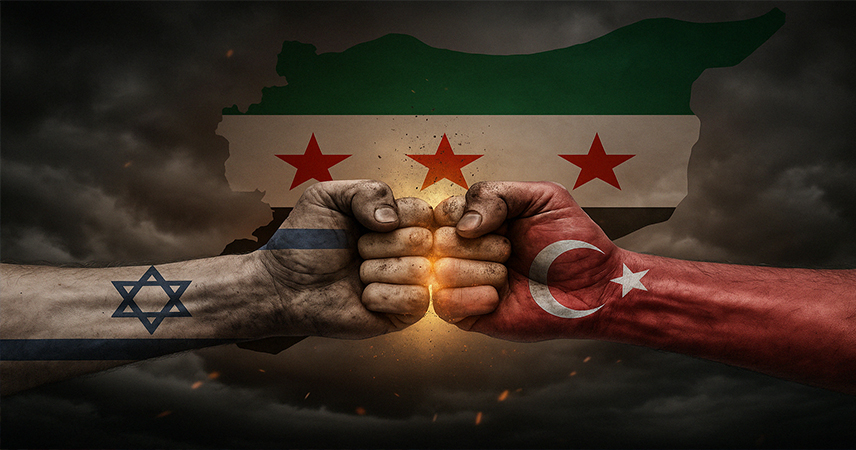
Turkey-Israel relations have been characterized by fluctuations and oscillations since Turkey’s recognition of Israel in 1949 as the first Muslim-majority state to do so, oscillating between pragmatic alliance and ideological division. This has become particularly evident in recent years through their continuous interactions and subsequent disagreements following Israel’s assault on the Gaza Strip. Many believed these tensions occurred within the framework of ideological division. However, with the major transformations in the regional political geography following the collapse of Syria’s ruling regime under President Bashar al-Assad, changes emerged in the balance of power favoring both Tel Aviv and Ankara. Once again, the possibility of dialogue between the two sides based on mutual interests has been raised. This generates the question: What are the specific features and patterns of these evolving changes between them? Moreover, what are the opportunities and drivers of cooperation and competition between their respective regional projects? This leads us to envision the potential scenarios that may unfold in future stages, in light of developments in the international and regional arena.
First: The Framework and Context of Bilateral Relations
Turkey and Israel share a long and complex relational history that has shaped their interactions between ideological conflict and a level of pragmatism. Ankara has pursued this approach from its initial recognition of Israel until now, presenting itself as an important ally to Tel Aviv amid the isolation it faced from its Arab surroundings. However, during the Cold War period, Turkey maintained a delicate balance in its relations between Arab states and Israel, exemplified by its recognition of the Palestinian state in 1988 despite Israel’s intense conflict with the Palestinians. Nevertheless, mutual visits and cooperation in the early 1990s demonstrated that their relationship transcended the Arab-Israeli conflict. During this period, Turkey established deep diplomatic relations with Israel and concluded several important agreements in 1996, most notably defense cooperation and free trade agreements. This formalized cooperation in military, diplomatic, economic, and intelligence domains. Within this framework, trade exchange indicators between the two countries witnessed significant growth, with bilateral trade volume exceeding one billion dollars by 2000, compared to only $304 million in 1994. Currently, the total volume of bilateral trade and tourism is estimated at $9.5 billion.
At the end of the first decade of the twenty-first century, Turkey-Israel tensions began escalating when the Israeli-Palestinian peace process failed and the Second Intifada erupted, complicating their relations. This intensified particularly after the Justice and Development Party (AKP) under Recep Tayyip Erdoğan came to power, with Turkey’s positions toward Israel becoming harsher under the shadow of ideological factors related to the Palestinian issue as part of Turkish discourse, leading to increased criticism of Israel. Turkey’s condemnations during 2008-2009 of the Israeli-Palestinian conflict are marked as the beginning of a new phase of tensions, followed by the Davos Congress crisis in 2009 and Israel’s attack on the Turkish Mavi Marmara ship as part of the Gaza flotilla in 2010, which resulted in the deaths of nine Turkish citizens. This incident led to a crisis involving the downgrading of Turkey’s diplomatic relations to the level of second secretary and the suspension of military agreements. Within this framework, reconciliation efforts to improve relations in 2016 failed. Simultaneously, U.S. President Donald Trump’s recognition of Jerusalem as Israel’s capital in December 2017 led to further diplomatic friction. Despite all this, the economic crisis that befell Ankara in 2022, its efforts to resolve problems with neighboring states through rapprochement with Middle Eastern and North African countries, in addition to strategic interests with Tel Aviv in confronting Iran, led to the complete restoration of diplomatic relations between Turkey and Israel and the return of their ambassadors. Shortly before the events of October 7, specifically on September 20, 2023, during the United Nations General Assembly meetings, Turkish President Recep Tayyip Erdoğan attempted to strengthen and normalize relations between Ankara and Tel Aviv by welcoming Israeli Prime Minister Benjamin Netanyahu at the “Turkish House” in New York and discussing the strengthening of cooperation in energy, technology, artificial intelligence, and cybersecurity.
Here, we can note that despite the instability in bilateral relations over the past two decades, several factors and variables continue to influence the dynamics of their relationship, most prominently:
Turkey’s Internal and Political Variables
Internal changes in Turkey direct Turkey’s external behavior toward Tel Aviv. This became fully apparent with the assumption of power by the religiously-backed Justice and Development Party under Recep Tayyip Erdoğan, who prominently features the Palestinian issue in his speeches to mobilize and energize his voter base. Despite using the image of a government defending Palestine against its enemies strongly within his Islamic base on one hand to confront internal challenges, observers on the other hand see Turkey’s president portraying Israel as a threat to national security within the framework of power dynamics in the Middle East, including threats emanating from Iran and the presence of Kurds in Syria, as one of the tools he resorts to in his political games to divert attention from internal challenges. Thirdly, it contributes to strengthening his (the Turkish president’s) legitimacy as a leader of the Ummah and the international Islamic community within the framework of religious and historical narratives to gather internal and regional support toward gradually achieving the dream of reviving what is called “Neo-Ottomanism.”
Within this framework, we can point to some other measures Ankara has taken toward Tel Aviv that do not align with what we previously discussed. For example, the results of Turkey’s municipal elections on March 31, 2024, represented a major defeat for the Turkish president’s popular standing. This, in addition to the defeat against the Republican People’s Party in major cities like Istanbul and Ankara, as well as losing several surrounding areas to the Islamist opposition, led some analysts to suggest that some supporters of the Turkish president turned to other Islamist political parties, such as the New Welfare Party, due to Erdoğan’s presence in maintaining trade relations with Israel. Before unilaterally halting trade in April 2024 and then completely severing trade relations with Israel in May 2024, with the aim of not leaving this tool in the hands of competitors from Islamist parties, these decisions were therefore not only connected to the ideological aspect of supporting Palestinians but were directed toward Turkey’s domestic politics. Also, regarding the escalation of Turkish President Recep Tayyip Erdoğan’s rhetoric against Tel Aviv following threats on May 28, 2024, in Turkey’s dealings in “Nagorno-Karabakh and Libya,” calling attention to Israel’s lack of hesitation in opening a new front against Turkey after Gaza and Lebanon, and demonstrating that the Kurdistan Workers’ Party has connections with Israel—this reflected on Turkey’s internal political scene when slogans equating the Kurdistan Workers’ Party with Israel were raised at Diyarbakır demonstrations organized to support Palestine.
The Framework of Interest and Ideology
Within the framework of political and economic costs that the Turkish president must pay, especially in the poor economic situation domestically, the Turkish regime insisted on preserving trade relations and direct economic interests instead of severing relations with the State of Israel. Erdoğan adopted a contradictory policy consisting of maintaining relations at the ambassadorial level with Israel while simultaneously strengthening close relations with Hamas and allowing the hosting of its members in Turkey.
With the escalation of the October 7 events, some measures against Israel began to be adopted, such as the suspension of all direct Turkish Airlines flights to Israel on October 10, 2023. However, according to some reports, it preserved long-standing trade relations with Tel Aviv in the sectors of energy, steel, textiles, and technology, including materials used in Israeli military equipment, just as it preserved the transfer of Azerbaijani oil to Israel passing through its territory. Nevertheless, it was forced on April 9, 2024, to decide to ban trade in 54 strategic products including cement and iron, then it escalated to stopping all trade with Israel completely on May 2, 2024. However, according to journalistic investigations by “Metin Cihan” and others, these decisions were not implemented as such, when they revealed that trade between Israel and Turkey was not completely halted and they exposed that some sources indicate that Erdoğan’s son-in-law was involved in trading with Israel after October 7. Within this framework, several reports have indicated the continued arrival of Turkish goods to Israel under the pretext that they were sent to Palestine, through finding various solutions for conducting business from prohibited and different ports. In this step, Palestinian companies in the West Bank acted as “formal forwarders of goods,” whereby these companies receive some money for their work, then the goods are transferred to Israeli companies that actually share trade partnerships with Turkish companies. According to figures from the Turkish Exporters Assembly, export rates to Palestine increased significantly compared to the previous year. Thus, geopolitical moves are managed in a way that minimizes their direct effects, alongside the pragmatic approach of the Turkish regime, which sees itself preserving its position of supporting Palestinians to satisfy its political bases while preventing any escalation against the government. This approach has become established as a method of managing relations between the two sides, with occasional tensions between the two countries, but their economic relations have conversely developed. Despite the Turkish president’s announcements of suspending “military and economic relations” with Israel after every crisis, economic relations between the two sides have developed over the past two decades. The trade balance has consistently been in Turkey’s favor.
From here, we can say: The political discourse of the leaders of both sides sometimes aims to achieve internal political gains, where the expansion of economic interests is seen as a prerequisite. This is the dynamic of Israeli-Turkish relations, which prioritizes economic interests over political factors.
Tel Aviv’s Centrality in U.S. Middle East Strategy
In light of Turkish leadership’s increased awareness of Tel Aviv’s centrality in U.S. strategy in the Middle East, it has encouraged relations between the two sides in recent years, under the shadow of the necessity of improving relations with U.S. administrations.
With the new U.S. administration coming to power under the presidency of Donald Trump as the first president to impose five different sanctions on the Turkish government and having close relations with Tel Aviv, especially in light of the establishment of his new administration staff, most of whom are known as strong supporters of Israel, it is therefore predicted that Ankara will reduce its conflicts with Tel Aviv as a way to overcome its conflicts with Washington due to its rapprochement with Russia and the purchase of the S-400 system, which led to U.S. sanctions being imposed on it and exclusion from obtaining F-35 aircraft, as well as exclusion from purchasing any U.S. military technology including F-16 aircraft. However, this issue was resolved in January 2024 in exchange for Ankara’s consent to the membership of “Sweden and Finland” in NATO.
This step may lead to progress and rapprochement with the United States, as Omer Celik, spokesperson for the Justice and Development Party, indicated that the Turkish government is working on drafting a plan to strengthen relations with new American counterparts, especially after those nominated for key positions in the U.S. government, whom the Turkish president viewed as his adversaries. For example, Tulsi Gabbard, the new director of U.S. National Intelligence, is one of those with sharp criticism of Erdoğan’s Turkey. In a statement before assuming her position, Gabbard accused Turkey of “supporting jihadists” and called Erdoğan “the most terrifying dictatorial man in the world,” emphasizing that she does not see the Turkish president as a friend. Also, U.S. Secretary of State Marco Rubio had previously criticized Erdoğan on several occasions for his policies toward the Kurds in northern Syria and Turkey’s poor record in the areas of expression and human rights.
Turkey’s Role Versus Iran’s Role
The changes that occurred within Syria after the collapse of the ruling regime of Syrian President Bashar al-Assad raised the possibility of U.S. reliance on Turkey’s role as a Sunni substitute for Iran’s role in order to fill the void it left in Syria, which has strong connections to armed organizations and becomes the guardian of Washington and Tel Aviv’s interests, especially in light of Turkish pragmatism and the pragmatic need to strengthen relations with the new U.S. administration in order to arrange a movement specific to the Kurdish issue. Within this framework, the change in the Syrian arena map can be viewed as being in the interest of Ankara and Tel Aviv, as it is a gateway through which necessary coordination for these changes can be arranged and extended to coordination in their roles in other regions, most notably Central Asia and the Caucasus, particularly the Armenia-Azerbaijan conflict. In this way, Tel Aviv is trying to achieve tactical coordination with Ankara to counter Iranian hegemony within the framework of a blue alliance (Israeli-Turkish-Azerbaijani), based on Turkey’s interest in Ankara’s geopolitical desires in the region within the framework of the “Neo-Ottomanism” vision by opening the “Zangezur” corridor, which not only connects Azerbaijan to Nakhchivan through Armenian territory but also opens a new route for Turkey to expand toward Central Asian states and reach those Turkic-speaking regions rich in natural resources. This may secure Tel Aviv’s cooperation in tolerating Turkey’s presence in Syria and reducing its effects away from Israel’s vital space in the Middle East.
Proximity of Common Threat Understanding
The existence of external threats and enemies for both Tel Aviv and Ankara has played a role in the absence of direct geostrategic conflict between them, which is one of the drivers of strengthening their relations in recent years. After the Cold War, their mutual opposition to Syria’s previous regime brought them closer together. Also, Iranian threats and the strengthening of its hegemony in the region brought about indirect cooperation between the two sides, even during periods of conflict between them. This shows why Turkey chose neutrality toward targeting Iranian positions and Hezbollah.
In mid-2024, Turkish Foreign Minister Hakan Fidan expressed hope that Israel’s efforts to weaken Iran and Hezbollah would lead to the creation of a power vacuum in Syria, which would indirectly benefit Turkey’s regional interests. Within this framework, some reports have been published discussing Turkish-Israeli coordination under U.S. supervision to overthrow the Syrian regime, especially in light of Israeli statements that were encouraging before the events of the fall of former Syrian President Bashar al-Assad, as it allowed the strengthening of Iranian military force presence and expansion in Syria.
Second: The Limits of Competition and Cooperation Between the Two Sides
The collapse of the Syrian regime is considered a unique turning point in regional political geography, leading to fundamental changes in the relationship between Turkey and Israel, especially in light of changes in the regional balance of power between them, which may bring about challenges and new assessments of their relations. Here we present the opportunities for cooperation between them alongside the drivers of conflict and disagreement.
- Opportunities and Drivers of Cooperation Between Them
- Coordination of Their Roles in the Syrian Arena
In light of the assurances that Ankara is trying to give the international community and Tel Aviv regarding its control of armed groups, some of which are affiliated with Turkey, such as the “Syrian National Army,” which expelled the Kurdish People’s Protection Units from “Tal Rifaat” in northern Aleppo in the advances, Turkish military officials announced control of the city of “Manbij,” which the Kurds had previously controlled. This is in addition to other organizations, including “Hay’at Tahrir al-Sham,” which has strong ties to Turkey. These assurances were reflected in the statements of military leaders who took control of Syria, for example, Ahmed al-Sharaa (Abu Mohammed al-Jolani), leader of Hay’at Tahrir al-Sham, clarified regarding conflict with Israel, saying: “We do not want conflict with Israel and other countries, and Syria will not be used to target other countries. Syrians are tired and want nothing but to live in peace.”
This step coincided with Turkey’s request to Israel to agree to provide advance information on its strikes on Syria, which will affect the change in the new regional balance of power—a major step in the chain of regional structuring, in terms of replacing Russia’s role with Turkey and expanding Turkish military presence in Syria. This is the situation viewed within Israel as a positive reflection of Turkey’s position, as an initiative of goodwill to move away from collision with Tel Aviv, and behind it the new U.S. administration. It is in Israel’s interest to negotiate with the Turks to clarify their positions so that unexpected incidents do not occur.
This request came after Israel conducted an intense bombing process on Syrian army military positions and destroyed approximately 80% of its capabilities. However, on the other hand, some Israeli experts interpreted this Turkish request as imposing a new situation for Turkey’s hegemony map in Syria. Israeli observers concluded that “Syria has become a successor province of the Ottoman state.” Jolani is considered “the ruler of the new Ottoman Turkey in Syria.”
- Pressure on Hamas Movement
Tel Aviv may view coordination between them in Syria as being in the interest of both sides on some other issues, whereby Ankara puts more pressure on Hamas leaders in order to show more flexibility in the ceasefire agreement efforts between them, especially when Ankara knows it needs agreement to reduce its internal pressures, in light of its turn to Tel Aviv to reduce their conflicts within the framework of a new roadmap for improving relations with the new U.S. administration. In return, Tel Aviv, at Ankara’s request, intervenes with the new U.S. administration to coordinate on the Kurdish issue and take into account Turkey’s concerns, thwarting any efforts for Kurdish autonomy on Turkey’s borders. This is in addition to Turkey playing a role in the reconstruction process of the Gaza Strip, which may take several long years.
- Benefiting from Turkey’s Role in U.S. Strategy in the Region
In light of the developments of Turkey’s regional role in this last decade—in terms of strengthening presence in many regional files from Libya to Syria, in addition to its moves in the African continent and the Red Sea, hegemony in the Middle East, in addition to its efforts to resolve problems with regional countries in the previous period—it has led to the imposition of its presence as an important number in the new regional equations, which the new U.S. administration may work on in current developments. From here, Washington may view the benefits of Ankara’s role in coordinating its role with Tel Aviv, in return giving Turkey some “political and economic” interests that it needs to strengthen the foundations of its domestic governance.
- Drivers of Conflict and Competition
- Opposition in Their Understanding of Syria’s Future
Turkey intends for Syria to remain a unified state with a ruling regime that has strong ties to Ankara, due to several factors, most importantly avoiding the scenario of Syria’s fragmentation and the competition of regional powers to gain governance in Syria, such as what the Kurdish People’s Protection Units affiliated with the Turkish Kurdistan Workers’ Party demand in northeastern Syria. Another aspect relates to avoiding a new wave of refugee migration due to instability to Turkey, just as a stable transitional period can allow Turkey to provide economic assistance to Syria to facilitate the return of refugees. In contrast, Israel does not want a unified Syria, speaking of the concept of “nation-state” as “state of components” with assurance of protecting buffer zones to provide security against Hay’at Tahrir al-Sham and other dominant sides. This is what Ankara opposes, whether the establishment of a Kurdish state under the hegemony of the Kurdistan Workers’ Party, or if this division does not lead to the creation of a Kurdish state but becomes an obstacle to Turkey’s successes in Syria. Therefore, Ankara is trying to control a united Syria through Hay’at Tahrir al-Sham and ensure its strategic interests. This may lead to increased tensions if Hay’at Tahrir al-Sham challenges Israel’s new hegemony in Syria through occupying more territory, or if it tries to weaken it, especially in light of the new reality that has emerged, making both states neighbors by actual fact. With the reactivation of Turkish intelligence, military, and civilian activities in areas controlled by Hay’at Tahrir al-Sham, Turkey’s presence near Israel’s borders may lead to the emergence of new points of conflict. This was reflected in subsequent days when Turkey sharply condemned Israeli movements in the occupied areas. Erdoğan accused Israel of “revealing its occupation mentality,” while Israel accused Turkey of being “the last state that can talk about occupation in Syria.” These accusations increased when the Turkish president, while presenting a speech to the parliamentary bloc of the ruling Justice and Development Party on January 14, 2025, said: “Israel must gradually withdraw from Syrian territory.” In response, the Israeli Foreign Ministry indicated in a statement that “it would be better for the Turkish president to stay away from unnecessary threats,” adding: “The occupying and hostile side in Syria, northern Cyprus, Libya, and other regions of the Middle East is Turkey itself.”
From here, the change in balances in Syria can be viewed as potentially being a driver of conflict more than cooperation between Turkey and Israel, in light of the possibility of creating geopolitical competition between their respective regional roles, in a way that leads to escalating greater risks in the Middle East.
- The Risks of the Political Islam Project Led by Ankara in the Region
Tel Aviv views Syria’s radical armed organizations as having strong ties to Ankara and representing danger and concern for changing Iran’s Shiite hegemony project to a political Islam hegemony project led by Ankara. This is the point of ideological political regime agreement with the Muslim Brotherhood, which holds the ideology of opposing Israel and their presence in the region. This concern is shared with Arab countries, especially in light of Turkish president’s expressions within the framework of what is called “Neo-Ottomanism,” when he clearly said in following Syrian events: “Every event in our region, especially Syria, reminds us that Turkey is greater; the Turkish Ummah cannot deviate from its path.” Within this same framework, Erdoğan linked this fate of new Turkey to the continuation of the Ottoman legacy position as global Islamic leadership.
This threat may become a driver of conflict with Tel Aviv and a number of Arab states with Ankara. This is what Washington and Tel Aviv can use to accelerate the expansion of regional alliances with regional countries through stimulating the path of the Abraham Accords, alongside several other goals to confront these threats on those common regional risks in the region on which this agreement was built to confront Iranian threats.
- The Kurdish Issue as a Central Point of Conflict
The Kurdish issue is one of the contentious issues between them that may lead to concern and collision between Ankara and Tel Aviv, especially in light of Turkey’s efforts to end the Kurdish issue along its borders and create a buffer zone of no less than 30 km, in order to ensure the defeat of the formation of any Kurdish self-administration. Despite U.S. presence in northern Syria and providing some form of protection to Kurdish forces, this becomes a challenge to Turkey’s vision with Washington and Tel Aviv, especially when Israeli Foreign Minister Gideon Sa’ar emphasized that Israel views the Kurds as its ally, as a balance card against armed organizations in the region on one hand. On the other hand, as a guarantee against the complexity and risks of Iranian-affiliated armed militias in Iraq. Thirdly, as a negotiation and pressure card against Turkish interference. Within this framework, Tel Aviv is trying to obtain guarantees from the new U.S. administration despite the Trump administration’s desire to withdraw from the Syrian Democratic Forces (SDF), alongside cooperation with senior Republican members of the U.S. Congress who have good expertise regarding this issue and have a firm position toward guaranteeing not abandoning the Kurds in the main strategic areas known as “Rojava” in eastern Syria.
- Geopolitical Competition in the Middle East
In light of Turkey’s known plan called the Blue Homeland (Mavi Vatan), which Turkish Admiral Cem Gürdeniz presented in 2006, Ankara is working to strengthen its regional presence in neighboring countries. This reflects its movements in the Mediterranean and Aegean seas, and other movements in Syria and the Red Sea, in order to strengthen economic independence and the energy sector, according to the security concept Turkey has adopted. Its maritime borders are its weakest areas on one hand, and on the other hand, an opportunity for expansion and economic independence. This understanding is rooted in Ottoman history, which has given the Turkish president support to begin the project of strengthening and building naval power. This direction increases the possibility of collision with Tel Aviv in a region that has vital importance for providing gas sources, in addition to efforts to find a regional role against Ankara in the energy sector, which it does in coordination with Cyprus and Greece, which have unstable relations with Ankara, through creating the “EastMed” gas pipeline, which is exported to Europe through Cyprus. In Turkish media institutions, this cooperation between Israel, Cyprus, and Greece is called the “axis of war.” At this moment, Greece-Turkey conflicts continue, especially in the shadow of the progress of Greek-Israeli security cooperation, whereby Greek Defense Minister Nikos Dendias presented a comprehensive plan to parliament in January for creating an air defense system that can cover all Greek territory, at a cost of 2 billion euros with Israel’s cooperation. On December 23, 2024, Energy Minister Eli Cohen arrived in Greece to visit the “Energean” company and signed an agreement to expand cooperation between the two countries in the energy sector in general and natural gas in particular. This is in addition to discussing strengthening infrastructure for goods and energy in a way that connects Asia and Europe through the Gulf states, Israel, and Greece. Within this framework, Turkey views the strengthening of Israeli-Greek relations as direct war against it and a common threat against it.
Turkish media tools have launched a media attack against the strengthening of cooperation between Greece and Israel, as the newspaper “Takvim” called the plan an “anti-Turkey defense alliance,” while the newspaper “Yeni Şafak,” which is linked to Erdoğan’s administration, indicated that Greece is trying to strengthen its capabilities out of fear of Turkey’s power. Just as the newspaper “Sabah” continued discussing the plan to reorganize Greek military forces and quoted a statement by Erdoğan, who in the past raised the risk that “Israel targets Turkish territory after Palestine and Lebanon.”
Within this framework, it is necessary to point to Ankara’s announcement of the possibility of an agreement to create a special economic zone with the new Syrian government, in the same way it did in Libya through the 2019 maritime agreement with Libya’s Government of National Accord, through which Ankara’s position in the eastern Mediterranean was established and regional dynamics were redrawn in its favor. This is what it is trying to do in Syria, as an interconnected foundation in geostrategic policy in the Mediterranean, whereby strengthening measures in one arena affects hegemony in another arena. However, this may lead to stirring conflict with its European partners, such as Greece, Cyprus, and other European powers, viewing these agreements as an illegal step that leads to instability. This extends to regional polarization and the intensification of conflicts over energy and sovereignty. It may also lead to rupture with Tel Aviv, which views Turkey’s hegemony strengthening movements with suspicion and fear, especially in those geopolitical areas that have great importance for Tel Aviv’s economic and security interests. From here, these givens, while they can become drivers of conflict and competition between Tel Aviv and Ankara, may also be a factor that makes Tel Aviv accept Turkish presence in Syria within the framework of the necessity of coordination between them, while Tel Aviv can use the Kurdish card in Syria to balance Turkish presence in the Middle East. This explains Turkey’s rapid moves to strengthen its cards to reduce Tel Aviv’s threats with Washington’s support in these files, by adopting the approach of converting what Ankara has prepared into another file to establish its interests.
- Retreat of the Common Iranian Threat
The changes that occurred in the new hegemony map in the region, with Iran’s retreat as a common threat and strong driver of cooperation between Tel Aviv and Ankara, in addition to Benjamin Netanyahu continuing to adopt a firm position against Tehran with the support of the new Trump administration, while the direct threat of Iran’s proxies has widely retreated. Similarly, with the continuation of Turkish-Iranian competition in Iraq, the Caucasus, the absence of Bashar al-Assad, and the weakening of Hezbollah, it makes other parties more worthy of management from Ankara’s perspective. Therefore, these changes in the region’s hegemony map have reduced Israel’s reliance on Turkey as before. However, this does not lead to ending coordination on those important issues that the new situation has brought about in Syria, in accelerating the normalization of Israel’s relations with Arab countries within the framework of the Abraham Accords, which may include Saudi Arabia entering the agreement within the framework of Tel Aviv’s expansion of its regional alliances and these countries’ fear of the expansion of the new Islamic project in Syria under Turkey’s supervision. Arab countries can be neutral or with Tel Aviv in any new conflict against Ankara and Damascus.
Third: Expected Scenarios
What is currently occurring in the directions of relations between Ankara and Tel Aviv in light of Syrian arena developments is subject to several movements, as a result of the uncertainty that has cast a shadow over the regional and international scene, due to the future directions of the new U.S. administration. The most prominent of these are the following:
- Scenario of Mutually Beneficial Relations
The possibility of this scenario occurring increases due to Ankara’s pragmatic understanding in dealing with Tel Aviv and its reflection in their trade relations despite their conflicts, alongside confirming assurances from Syrian armed groups to Tel Aviv, in addition to Turkey’s request for advance coordination between Ankara and Tel Aviv regarding military actions to avoid collision.
These above positive indicators can be interpreted as Tel Aviv’s understanding of Turkish President Recep Tayyip Erdoğan’s harsh statements in the context of electoral warfare and Turkey’s internal propaganda, not an ideological position against Israel. Also in this scenario, due to the fait accompli that Ankara has imposed in its regional moves, it can be a driver for strengthening Western policymakers’ recognition of the centrality of its policies in the Middle East. From here, Washington finds itself forced to deal with Ankara and show some flexibility in the political and economic sphere in favor of Turkey in order for the latter to provide some guarantees to protect Israel and U.S. interests in those areas controlled by Turkish-affiliated organizations in Syria. With this scenario, Ankara can preserve the gains it has achieved and stay away from the risk of a collision scenario with Tel Aviv and Washington, especially in the shadow of the absence of Turkey’s internal flexibility to undertake any political maneuver that would lead to imposing further economic hardship on it.
From here, if the balance of Erdoğan’s positions domestically and diplomatically is very important in Turkey-Israel relations, as well as Netanyahu’s need to preserve security cooperation in a complex region, it makes Erdoğan play on the line between satisfying his popular base and going with realistic policy. This is in addition to the fact that changes in the new U.S. administration’s foreign policy may create a role in redefining the strategy and regional alliances of both sides.
- Scenario of Collision and Geopolitical Competition
This scenario is one of the expected scenarios in light of the escalation of contentious points we previously mentioned, especially if Tel Aviv tries to impose its vision for its regional hegemony in dealing with files, which is reducing Ankara’s regional presence, and may lead to changes in the dynamics of its relations with Tel Aviv and adopting the path of its interests in drafting its behaviors and trying to preserve its gains at this stage and confronting Israeli presence through using its tools in the geopolitical project related to political Islamic organizations to pressure Tel Aviv. This scenario is full of the risk of collision with Washington, in addition to marginalization by some Arab states in the region (Abraham Accords states) against Ankara, as its project is against the region’s interests, just as Turkey’s internal situation does not allow the political system to make some political maneuvers.
Finally, we can say that the major transformation in regional geography due to the collapse of Syria’s ruling regime under the presidency of Bashar al-Assad led to a change in the balance of power map in favor of Tel Aviv and Ankara, alongside supporting changes in the dynamics of bilateral relations, within the framework of drivers of cooperation and conflict as indicated. This can strongly affect the balance of their relations—which in the past were subject to a situation of interest and ideological conflict—especially in the shadow of new variables that have made them neighboring states by actual fact. Therefore, the escalation of Turkish intelligence, military, and civilian operational activities in areas controlled by Hay’at Tahrir al-Sham on Israel’s borders, along with Ankara’s moves to strengthen political hegemony in important areas of the eastern Mediterranean, may become a cause for igniting new conflict points. These are the issues that can cause Tel Aviv’s hesitation in viewing Turkey’s hegemonic expansion and as an obstacle to the Israeli military line in the region. However, according to expertise in Turkey’s precedent within the framework of the pragmatic approach to managing its relations with Tel Aviv and limiting the threat of the Kurdish card by Tel Aviv and Washington, on the other hand, ensuring some political and economic gains that lead to strengthening the maneuver margin of the Turkish system in confronting the effects of the economic crisis and internal pressures—this can explain Turkey’s efforts at the present moment to strengthen its cards in moves and exchanges to preserve its gains against the new elected U.S. administration as an advocate of Israel’s interests.
Source: Al-Ahram Center for Political and Strategic Studies
- Originally published in Future Studies Magazine Research Section by the Center for Future Studies and translated by Nawroz Mohammed for Kfuture.Media.