

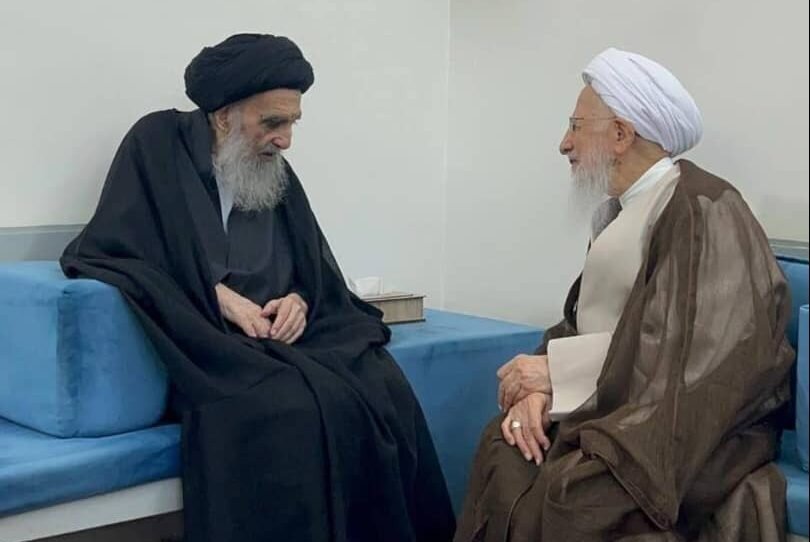
The phase of Sistani’s Marja’iyya, spanning approximately three decades, is crucial and pivotal in Najaf’s modern history. During his time, Shiites in Iraq re-emerged from the periphery to the political and governing stage (2003). With the advanced age of Najaf’s supreme Marja’ (94 years) and the absence of a clear and evident successor to date, numerous questions and doubts surround the manner of his replacement. This study delves into the concept and position of the Marja’iyya and its functions, as well as the post-Ayatollah Sistani era, in light of available data and the current state of the Najaf seminary, which is the holy capital of Shi’ism globally.
Concept and Position of Marja’iyya
Marja’iyya is the source of “taqlid” (emulation) for Shia followers. It is a position that represents the highest Shia legitimate authority, holding the interpretation of Sharia texts. It oversees the collection and distribution of religious taxes (zakat and khums) and manages the seminary and educational institutions of the Shia sect. It directs Shia ceremonies and rituals and controls the religious community through fatwas. “Marja’iyya” functions as a hypothetical religious institution, managing the affairs of Shia followers, who number around 200 million worldwide. Above this institution is the personality of the “Supreme Marja’,” whose circumstances, conditions, and large number of followers make him the foremost Marja’. This position is available only to very well-known and eminent jurisprudents, and not all Marja’s attain it. This is because a “Supreme Marja’,” in addition to sectarian expertise, requires an extensive economic network and social infrastructure through seminary figures, businessmen, and social, political, and media authorities within and outside Shia communities.
History of the Emergence of Marja’iyya
In the Shia denomination, the Marja’iyya emerged to fill the void of the twelfth Imam, the last in the chain of Shia Imamat (the awaited Mahdi), who, according to the beliefs of this denomination, is currently in occultation. Until this hidden Imam reappears, Shia followers are obligated to refer to jurisprudents who hold the rank of “Mujtahid” in deriving Sharia rulings, or those authorized to issue fatwas and whose rank is “Allamah” and “Ayatollah,” to manage their religious affairs. In Shia doctrinal sources, “Imam Mahdi” is the final leader and guide in the chain of Imamat. His occultation has two phases: one temporary and minor (al-Ghayba al-Sughra), and the other prolonged and until the end of the world (al-Ghayba al-Kubra). During the minor occultation, Shia followers referred to four individuals who claimed to be agents and representatives of “Imam Mahdi,” known as “the Four Ambassadors.” These four individuals: (Uthman Saeed al-Amri, Muhammad Uthman Saeed al-Amri, al-Hussein Ruh al-Nawbakhti, and Ali Muhammad al-Samari), served as the Marja’ for followers of the Shia denomination for nearly seventy years. With the death of the last of these four (329 AH/941 AD), the phase of direct representatives of “Imam Mahdi” ended. This marked the beginning of a new phase, the emergence of the Marja’iyya within the Shia world, who are agents and representatives of the Imam of the Age (al-Mahdi) in place of the previous representatives. This phase continues until “Imam Mahdi” himself returns to earth at the end of the world to “establish justice,” which will coincide with the end of the world according to religious belief, known as “the Resurrection.”
Authority and Sphere of Influence of the Marja’
The authority and influence of the Shia Marja’ are not confined to a specific geography or country. Followers of the Marja’s views extend beyond the borders of their original country. For example, “Ayatollah Sistani,” who is the supreme Marja’ of Shiites in Iraq, is of Iranian origin, yet his center of activity is the city of Najaf. He has many followers in the Gulf countries, India, Pakistan, and among Shiites in the diaspora. The same applies to “Ayatollah Ali Khamenei,” who, despite the controversy surrounding his competence and sectarian rank, has followers whose religious views transcend borders. However, this opportunity is not available to all Shia Marja’s. Among the large number of those holding the rank of “Mujtahid” in Shia seminaries, the prominent Marja’s are those whose circumstances allow them to have supporters and a position, and who possess a broad, cross-border religious and social network. What helps them gain many followers is the nature of the Shia denomination, which makes following the Marja’ and emulating his fatwas a duty and an obligation. According to Shia narrations, anyone who deviates from “emulating the Marja'” has challenged the judgment of God.
Conditions for Marja’iyya
The jurisprudents who are granted the title of Marja’ and whom people follow for religious emulation in the Shia denomination must meet several conditions, including: being Twelver Shiites, male (meaning women cannot be Marja’s), justice (which is a hypothetical condition), reaching the rank of “Ijithad” (which is the striving and ability to derive Sharia rulings), along with the condition of being the most learned (al-A’lamiyyah) in religious rulings. However, because determining “the just” and “the most learned” lacks concrete criteria and is open to wide disagreement, there is always divergence among Shia followers in identifying them. This is one of the reasons for their dispersion among several different Marja’iyyas, each claiming to be “the most learned,” with groups of people following their preferred Marja’s, deeming them the most learned and just. Alongside the well-known Marja’s, there are always other minor and moderate Marja’s, as the Shia denomination allows for a plurality of Marja’s, and the door of “Ijithad” is open. Any jurisprudent who feels capable has the right to issue fatwas. People follow those whom they believe meet the conditions of Marja’iyya. Shiites consider this plurality of Marja’iyya a sign of the vitality of their denomination, which has fostered competition and diversity. They also believe that if there were only one Marja’ after “Imam Mahdi,” there would be a risk of deviation and alteration of the denomination, but under plurality, that danger is absent.
Immunity of Marja’s
Although in the Shia denomination, Marja’s are not infallible like the twelve Imams and can make mistakes, in all cases, openly criticizing and attacking them is not a legitimate or permissible act, unless the criticisms meet several conditions: objectivity, legitimacy, and the competence and qualification of the critic, such that they possess a certain level of understanding in the legitimate matters of the Shia denomination. In addition to these, the criticism must be directed at the Marja’s performance, not their fatwa, because according to Shia sources, criticizing fatwas and evaluating their content is the work of jurisprudents, not critics and observers. Accordingly, Marja’s enjoy a kind of immunity, and criticizing them is not an easy task.
Marja’iyya of Najaf
The history of the formation of Najaf’s seminary and its Marja’ is intertwined with the history of the Shia denomination. This is because, in addition to the city being the capital of “Imam Ali’s” rule (35-40 AH/656-661 AD), it is close to the holiest Shia sites in Iraq, which are the resting places of the Imams and their descendants. Most of the historical events that form the fabric of the Shia denomination also occurred in Iraq. However, specifically, the history of Najaf’s seminary dates back to the 5th century AH/11th century AD, because most Shia leaders moved their base to Najaf due to the dominance of the Sunni Seljuk Turks in the capital, Baghdad. This group of jurisprudents, led by Shaykh al-Ta’ifa “Abu Ja’far al-Tusi” (385-460 AH/995-1067 AD), made the sanctuary of Imam Ali’s tomb their religious leadership capital. According to narrations, in 449 AH/1057 AD, due to sectarian tensions in Baghdad, “Abu Ja’far al-Tusi’s” house was looted and his books burned. He then sought refuge in the shrine of “Imam Ali” in Najaf and opened a school, becoming a destination for students of Islamic sciences of the Shia denomination ever since.
The attention given to Najaf is a natural outcome of the Shiites’ perception of the city’s importance, as, according to their narrations, Najaf holds a very significant position, to the extent that those buried in its cemetery are exempt from accountability. Generally, Najaf can be considered the capital of the Shia Marja’iyya. In the history of the Shia denomination, approximately 80% of Marja’s originated from Najaf, and the vast majority of Shia jurisprudential, theological, and doctrinal works were formulated in this city or produced by religious scholars who graduated from Najaf.
In the twentieth century, besides “Hussein al-Tabataba’i al-Borujerdi,” who was the absolute and unchallenged Marja’ of Shiites for 15 years in Qom (died: 1961), the most prominent other Shia Marja’s who represented the Shia sect exclusively were in Najaf, and their historical order is as follows: “Abu al-Hassan al-Musawi al-Isfahani” (1936-1946), “Muhsin al-Hakim” (1960-1970), “Abu al-Qasim al-Khoei” (1970-1992).
Marja’iyya of Sistani
“Ayatollah Sistani” is authorized by “Ayatollah Hussein al-Hilli” (died: 1974), and he is also a student and successor to the most prominent Shia Marja’ “Ayatollah Abul-Qasim al-Khoei,” who passed away in Najaf in 1992 at the age of 92. “Ayatollah Khoei” was the teacher of many Shia religious scholars and a rival of “Khomeini,” the supreme leader of the Iranian revolution, in Marja’iyya and Shia leadership. “Khoei” personally signed and handwrote an authorization for “absolute ijithad” to “Sistani” before his death. This, along with his other authorization (from al-Hilli), played a role in his advancement over his peers and those who competed with him for the position of Marja’iyya. This is because after “Khoei” in the 1990s, there were other Marja’s of equal standing with “Sistani” in the Najaf arena, and one of them, named “Ayatollah Abdul A’la al-Sabziwari,” succeeded him, but he also passed away a few months after “Khoei’s” death (1993). After him, several individuals were active in Najaf’s religious sphere and rivaled “Sistani,” including: “Murtadha Borujerdi” (assassinated: 1998), “Mirza Ali Gharawi” (assassinated: 1998), “Muhammad Sadiq al-Sadr” (assassinated: 1999). The assassination of these individuals under the Ba’ath regime created an opportunity for “Sistani” to take over Najaf’s religious leadership, and after the fall of Ba’ath (2003), he became the supreme leader of Shiites and a guide for this component in the restructuring of the state.
Returning to his biography, it appears that Sistani was born in August 1930 in Mashhad, but his family worked as judges in Sistan, Iran, and resided there. Additionally, they traveled between Iraq and Iran for education. After his grandfather returned to Iran from Iraq in 1900, his grandson Ali Sistani (Ali bin Muhammad bin Baqir) returned to Iraq in 1950 and settled permanently in Najaf. His lineage on both sides is traced back to the Household of the Prophet (Ahl al-Bayt), which is a cross-border identity. There is not much information available regarding Sistani’s health. What is known is that in 2004, he underwent successful heart valve surgery at “Hatfield” Hospital in London. In 2020, he had joint surgery on his leg at a private hospital affiliated with his own institutions in Karbala. According to the latest photograph released in June 2024, signs of weakness and old age are clearly visible on his face and body. The same was felt a month earlier when he appeared in a video with his agent, which is normal for his age.
Other Marja’s in Najaf
In Najaf, the Supreme Marja’ is “Ayatollah Sistani,” who holds the rank of “Udhma.” Besides him, “Ayatollah Bashir Najafi” from Pakistan and “Ayatollah Muhammad Ishaq Fayyadh” from Afghanistan have followers. Beyond them, there are several minor Marja’s, such as: “Mahmoud al-Sarkhi,” “Muhammad Ya’qubi,” “Uday al-A’sam,” and “Fadhil al-Maliki.” These others are not recognized by all Marja’s and each has a small number of followers. Some other Iraqi Marja’s reside in Qom, such as: “Muhammad Taqi al-Mudarrisi,” “Sadiq al-Shirazi.” They mostly have supporters within a specific segment, the Shirazi school, who focus more on rituals and have religious media and businessmen around them. However, they are not very popular and have more followers among Shia elites and extremists. Their relations with the authorities in Iran and Iraq are not good.
Sistani’s Family and Network of Assistants
In addition to his two sons, “Muhammad Ridha” and “Muhammad Baqir,” who appear at public events, Sistani has two well-known sons-in-law who are religious scholars. His sons-in-law act as his agents. The first resides in Qom, named “Jawad al-Shahristani,” and the second, “Murtadha al-Kashmiri,” is Sistani’s representative among European Shiites. Due to Sistani having a network of representatives in various cities and regions, and his age and health not allowing him to directly oversee them, the prevailing belief is that his sons, especially “Muhammad Ridha,” and his sons-in-law, especially “Shahristani,” carry out these numerous duties. “Muhammad Ridha” acts as his father’s office manager and is the confidant and gatekeeper of his room; everything that comes to the Supreme Marja’s attention and hearing passes through his filter. There is much discussion about the influence of his Iranian son-in-law (Jawad Shahristani), especially since he oversees Sistani’s office and activities in Qom. A prevailing belief also suggests that “Jawad al-Shahristani” played a key role in bringing “Sistani” to his current position in the field of Marja’iyya through extensive activities, institutions, and movements among the seminary groups in Qom, which is a cradle for religious students, especially since “Shahristani” comes from a well-known religious family and has been unconstrained in his work.
Areas of Sistani’s Marja’iyya Work
Although it is commonly believed that Sistani does not follow “Wilayat al-Faqih” in the Iranian style and supports the dominance of popular authority (Shura), he supports the expansion of the jurisprudent’s authority when circumstances allow. In practice, his Marja’iyya has undertaken a large number of duties and activities similar to a comprehensive institution, including:
- Forming a Fatwa Committee: Composed of Sistani’s prominent students to answer people’s questions and letters according to the Supreme Marja’s methodology and in light of his writings, lessons, and books.
- Providing Support for Religious Schools: Supplying salaries, materials, necessities, and dormitories for 300 religious schools in Iran, especially in Qom where 35,000 students study in Sistani’s seminaries, 10,000 in Mashhad, and 4,000 in Isfahan, in addition to many other seminaries and schools in other Iranian cities.
- Organizing Courses and Sending Preachers: Holding courses and sending preachers to various Iranian cities on different occasions.
- Assisting Shia Missionary Activities: Supporting Shia missionary activities in several countries, including: Syria, Lebanon, Pakistan, India, Afghanistan.
- Supporting and Funding Shia Cultural Centers: Providing aid and funding for Shia cultural centers and bases in regions such as Asia, Africa, and Europe.
- Overseeing Hajj Missions and Missionary Activities: Supervising Hajj missions and missionary activities among Shia Hajj caravans, and establishing relations with other Shia activists, groups, and organizations participating in Hajj and visiting their leaders.
- Sending Shia Preachers: Dispatching Shia preachers during the months of Muharram and Ramadan to Iran, Arab countries, African countries, the Caucasus, Southeast Asia, Australia, Scandinavian countries, America, and several other regions.
- Preparing Educational Materials: Producing cassettes, magazines, books, and missionary programs for students.
- Assisting the Needy: Providing aid to the poor and those in need, medical assistance for needy patients, aid to the poor during Ramadan, aid to young people for marriage, and aid to refugees and displaced persons.
- Supporting Husayn’s Pilgrimage Caravans: Backing and assisting Husayn’s pilgrimage caravans, along with aid for victims of natural disasters such as floods and earthquakes.
Mechanism for Appointing Sistani’s Successor
According to the customs and traditions of the Najaf seminary, which is over a thousand years old, theoretically, after the death of the Supreme Marja’, “the most learned and devoted” Ayatollah holding the title of “al-Udhma” becomes the spokesperson and Supreme Marja’ of the Shiites. However, identifying “the most learned” and “the just” among a group of turbaned scholars holding the rank of “Ayatollah” is not an easy task, as there is no specific council or committee to carry out this duty, unlike in Iran, which has a special council called the “Assembly of Experts of Leadership.” Iran’s council is elected every 8 years, and its primary task is to identify and elect the leader. It consists of 88 prominent jurisprudents and religious scholars who are part of the “Islamic Republic of Iran” system.
As mentioned, because the identification of “the just” and “the most learned” and the criteria for that identification are not concrete and are open to much disagreement, in addition to the theoretical conditions, practically, the existence of a social and economic infrastructure and a broad network of connections and followers plays a role in settling rivalries, and this has a precedent in the history of the Marja’iyya.
Time Required to Appoint a Successor
There is a prevailing belief that Sistani is the last charismatic traditional Shia Marja’ in Najaf, and his succession will not be easy or quick, and will be time-consuming. Accordingly, after Sistani’s death or incapacitation, the Shia religious authority will face a severe temporary crisis, and it is possible that this authority (Marja’iyya) will not remain centralized in its current form due to the multitude of Shia forces and the difficulty of the rivalries. In this context, a review of the history of previous Marja’s clarifies some aspects. “Muhsin al-Hakim” took three years to settle his supreme Marja’iyya in competition with “Abdul Hadi al-Shirazi.” After him, “Khoei” preceded “Mahmoud Shahroudi” by four years. As for Sistani, he was in competition with several other Marja’s of his standing, including “Muhammad Sadiq al-Sadr,” for six years.
List of Marja’s Ready to Succeed
In Najaf, besides Sistani, there are currently two other prominent Shia Marja’s: “Muhammad Ishaq Fayyadh” (Afghan) and “Bashir Najafi” (Pakistani). However, both are close to Sistani’s age, and it would be difficult for them to succeed him due to their age. At the same time, ignoring them in the succession rivalries is also difficult because they are among the grand Marja’s. “Ishaq Fayyadh” was born in 1930, and “Bashir Najafi” was born in 1942. Both of them do not have a wide base of supporters, but their title and position in the hierarchy of the Shia seminary are at the top. Among these two, “Bashir Najafi” has strong ties with the Popular Mobilization Forces (Hashd al-Sha’abi) and refers to them as “holy.” Unlike Sistani, he welcomes politicians and meets with them. As for Ishaq Fayyadh, he is close to the Sadrists and has good relations with politicians, but unlike “Bashir Najafi,” he does not have strong ties with the Popular Mobilization Forces.
Beyond these two traditional Marja’s, identifying candidates and nominees for Sistani’s succession is difficult because nearly 40 jurisprudents and religious scholars in Najaf’s seminary teach “Al-Bahth al-Kharij,” which is equivalent to a doctorate in academic state universities. Graduates of these courses hold the rank of Ijithad and are not obligated to emulate another Marja’. Among these seminary teachers, the names of some jurisprudents have emerged who may enter the competition as hypothetical successors in the post-Sistani phase. These include:
- Muhammad Baqir al-Erawani: This jurisprudent was born in Najaf in 1949 into a religious family whose lineage traces back to Eravan, Armenia. He was trained by grand jurisprudents in Najaf and is currently a teacher of “Al-Bahth al-Kharij” in the Najaf seminary, which is equivalent to a doctoral stage. One of the indications of “Erawani’s” work for Sistani’s succession is the opening of his office (barani), where Shia jurisprudents discuss various jurisprudential topics, and he receives his special guests there. In addition, “Erawani” teaches nearly 600 Shia seminarians in the “Bahth al-Kharij” stage (doctorate) in the shrine of Imam Ali, and he is also known for his eloquence. All these steps are taken openly and under the silence of Sistani’s office, which can be interpreted as not opposing “Erawani’s” rising star. Some views suggest he has a strong chance to play a role in the position of Marja’iyya, but he also faces obstacles, including: his family’s lineage not tracing back to the Prophet’s Household, and the influence of armed groups affiliated with Iran, who have strong positions, influence, and financial resources and may not support him.
- Sheikh Hadi Al-Radhi: Born in Najaf in 1949, he was a prominent student of renowned Marja’s such as “Ayatollah Khoei” and “Ayatollah Muhammad Baqir al-Sadr.” During the Ba’ath era, he was exiled to Iran, returning to Iraq after 2003. He is now one of the prominent teachers in the Najaf seminary. He has emphasized that confining religious leadership to a few Shia families is a kind of fantasy and not legitimate.
- Sheikh Hassan al-Jawahiri: A well-known Najafi Shia jurisprudent and leader. His lineage traces back to “Jabal Amel” in Lebanon. He was a student of both renowned Marja’s “Khoei” and “Baqir al-Sadr.” In Iran, he studied under prominent Marja’s “Wahiduddin Khorasani” and “Kazim Ha’iri” and has several jurisprudential writings. He is currently a teacher in the Najaf seminary.
- Muhammad Ridha Sistani: Inheritance and the placement of a son in his father’s place is not a common tradition for the succession of Shia Marja’s, and there is no precedent for this. However, given that “Muhammad Ridha” is the eldest son of the current Supreme Marja’ and works as his father’s office manager, he may play a fundamental role in decisions and in appointing the new successor Marja’, especially since “Muhammad Ridha” holds the rank of Marja’ and is a teacher in the seminary.
Among the descendants of the late Marja’ “Muhsin al-Hakim,” there are several seminary teachers, such as “Muhammad Ja’far al-Hakim,” who may enter the competition for “Sistani’s” succession. However, the lack of precedent for the hereditary succession of Marja’iyya may also be an obstacle for them.
Sadr’s Role and Influence
Despite the historical tension and poor relationship between “Sistani’s” Marja’iyya and “Sadr,” and an unpleasant history of conflict between “Sistani” and the “Sadr” family, relations between the two sides have improved in recent years, with special handshakes and greetings exchanged at public events. Annually, Sadr attends mourning ceremonies and events at “Sistani’s” residence several times, indicating that the tension and discord between the two religious families have entered a phase of coexistence and openness towards each other in recent years. Despite this, it is expected that Sadr’s threats will emerge in the post-Sistani phase, and his successor will face many challenges from “Muqtada al-Sadr,” because Sistani’s religious legacy will be divided, and Sadr will try to have a special status. Sadr, along with other Shia forces, will try to play a major role, especially since he is under 50 years old and has a wide popular and social base. He has also sometimes indicated his desire to have a religious role and pays salaries to religious students who study in schools close to him. However, it is important to note that Sadr does not have the rank of Ayatollah to succeed Sistani. Furthermore, the Sadrist school (al-Marja’iyya al-Natiqa – Speaking Marja’iyya) is different from the Sistani school (al-Marja’iyya al-Samita – Silent Marja’iyya), and Sadr will not be a successor, but he may compete to attract more followers after “Sistani.”
Khamenei and Iran After Sistani
The two great rivals in the Shia world are Ayatollahs “Sistani” and “Khamenei.” The death of either before the other will leave a huge void, and in the event of “Sistani’s” death, Iran may try to exploit that void greatly and turn it to its advantage. Because “Khamenei” has extensive experience in political dealings and resources at his disposal, he has the ability to influence the course of Sistani’s succession, especially through the Popular Mobilization Forces, some of whom are loyal forces. In the past, Iran had prepared some individuals to succeed “Sistani,” such as “Sheikh Mehdi Asafi” and “Mahmoud Shahroudi,” but their deaths preceded Sistani’s, and the Iranian plan did not succeed. There is also a risk that after Sistani, Iran will try to marginalize Najaf and benefit from the void after “Sistani” to strengthen the Qom seminary or support a Najafi to succeed “Sistani” who is a friend of Iran and the leader of the revolution. In all cases, the direct appointment of a personality close to Iran would mean the destruction of Iraqi Shiism and is not very plausible, and it goes against the history of the Najaf seminary.
Security Implications After Sistani
The Popular Mobilization Forces attribute the legitimacy of their work, movement, and activities to Sistani’s “Jihad al-Kifa’i” fatwa, which he issued in June 2014 from the pulpit of the Husayni shrine in Karbala to prevent ISIS from advancing towards Baghdad after Mosul and Tikrit. In the fatwa, “Sistani” encouraged people to join the ranks of the army and police for defense, and subsequently, thousands of people went to training camps and battlefronts. In 2020, four armed groups of Hashd (al-Abbas, Imam Ali, Ali al-Akbar, Ansar al-Marja’iyya), bearing numbers (2, 11, 26, 44) and affiliated with the Atabat (shrine administrations) of Najaf and Karbala, announced their separation from the Popular Mobilization Forces and have since been known as “Hashd al-Atabat.” This step was interpreted as an attempt to separate and pull the rug out from under the feet of groups affiliated with Iran. At some points, representatives of Hashd al-Atabat have condemned Shia armed groups for killing protesters and misusing public funds. In the latest development of this rivalry, “Muhammad Ridha Sistani” last year (2023), on the anniversary of the victory over ISIS, stated that the credit for the victory over ISIS belongs to “the martyrs and the disabled.” This was interpreted as a response and reaction to the Shia armed groups who often mention the role of “Qasem Soleimani” and “Abu Mahdi al-Muhandis” and present them as the leaders of the victory. This is another indication of tension and conflict, and it is not precisely known in what direction this rivalry and competition will go after Sistani, and it remains an open question.
Hypothetical Scenarios and Options
The data regarding the post-Sistani phase point to several realities, including:
- Difficulty of Precise Prediction: Precisely predicting the outcome of the situation in the post-“Sistani” Marja’iyya phase is difficult. The reason for this is the complexity surrounding the process, which is a mixture of intertwined religious, political, and economic factors, and the conflicting interests of regional and international actors.
- Unique Post-Sistani Phase: The post-Sistani phase will be different, and a supreme Marja’ of his stature and level will not emerge quickly. The ancient Najaf school will enter a sensitive process to appoint a successor from among the peers and students of the previous Marja’.
- Period of Instability: After Sistani, Najaf and the Shia world will enter a period of instability and ambiguity. However, this does not mean the collapse of the Najaf Shia religious institution, which has continuously produced religious leaders, Ayatollahs, and Marja’s for Shia followers for a thousand years.
- Timeframe for Successor Appointment: Creating a successor figure for Sistani could take from a few weeks to several years. The transition process, besides the sectarian sphere, is based on several other factors, the most prominent of which are: the stance of Shia political forces, capital, media and advertising, tribal support for Shiites, and, more importantly, the stance of Sistani’s current network of agents in cities and countries, and his two sons, and his network of agents is close to 600 people.
- Originally published in Publishing Section by the Center for Future Studies and translated by Nawroz Mohammed for Kfuture.Media.