

Prepared by: Dr. Zhilwan Latif Yar-Ahmad
The Middle East is undergoing a new phase of geo-economic and strategic competition, in which major overland and maritime transport infrastructure projects are being deployed as primary instruments for reshaping the balance of power. Drawing on data and analyses from international institutions, this report examines three key strategic corridors: Iraq’s Development Road, China’s Belt and Road Initiative (BRI), and the proposed David’s Corridor. The report’s central focus is the position of Iraq and the Kurdistan Region of Iraq (KRI) within these projects—particularly the deliberate exclusion of the Kurdistan Region from the Development Road and the implications of that exclusion for the Region’s economic and political future. The report underscores that these corridors are not merely commercial arteries but rather drivers of profound political, economic, and cultural transformation. It concludes by presenting divergent future scenarios for the region.
Iraq as the Focal Point of Strategic Corridor Competition
By virtue of its exceptional geographic position—connecting the Gulf states and Asia to Turkey and Europe—Iraq has historically served as a defining nexus for major global strategic initiatives. After several decades of political instability and internal conflict, Iraq is now endeavouring to re-establish itself as a powerful and influential global transit hub, an ambition that has found concrete expression in the ambitious Development Road project. This project, together with competing initiatives such as IMEC and the BRI, signals that geo-economics has become the primary instrument of geopolitics in the region. This report provides a detailed analysis of these projects and their implications for the future of Iraq and the Kurdistan Region of Iraq, with particular attention to the questions bearing on the Kurdistan Region’s position within this strategic configuration.
The Geo-Economic Significance of Strategic Trade Routes
Several major trade corridors are currently active in the Middle East, each possessing distinct political, economic, and cultural characteristics, and each exerting a profound influence on the various sub-regions of the Middle East. The three most consequential are outlined below.
1. The Development Road — Iraq-Turkey Overland Canal
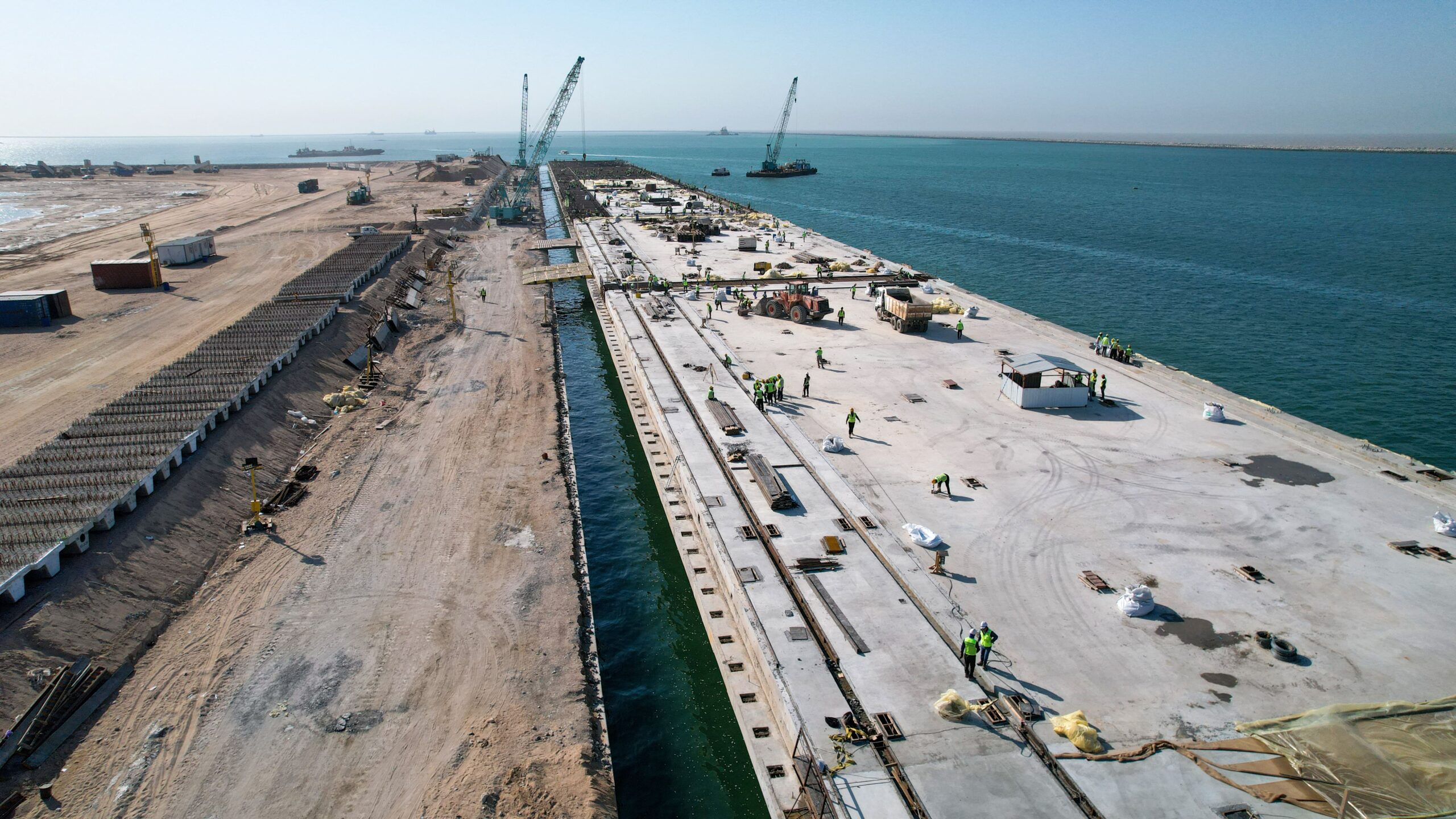
The Development Road, initially estimated at a cost of USD 17 billion, is a multi-modal infrastructure project comprising the construction of a high-speed railway line and a parallel expressway extending 1,200 kilometres. The corridor originates at the Grand Faw Port in southern Iraq—regarded as one of the largest ports in the Middle East and capable of accommodating the world’s largest vessels. The route traverses central Iraq and terminates at the Fishkhabur/Ovakoy border crossing on the Turkish frontier, from which it connects to Turkey’s transportation network and onward to Europe. The principal parties to this project are Iraq and Turkey, with financial and strategic support from Gulf states including Qatar and the United Arab Emirates.
Characteristics and Significance of the Development Road
Economic Dimension. The Development Road is viewed strategically as a potential alternative to the Suez Canal, particularly with regard to reducing the transit time of goods between Asia and Europe. According to economic analyses published by The National News, this corridor could reduce transit time by approximately 15 days. According to a report by Iraqi News, the Iraqi government projects that the project will have an annual dry-cargo transport capacity of 22 million tonnes in its first phase, and will in the long term create 1.6 million jobs and attract USD 150 billion in investment to industrial zones along the route. These figures—sourced from Iraqi government studies—point to a fundamental transformation in the structure of the Iraqi economy, shifting it from a single-commodity (oil-dependent) economy toward a diversified, multi-sector services economy.
Political Dimension. The project serves as an instrument for strengthening Iraq’s economic sovereignty and elevating its geopolitical standing in the region, deepening its strategic partnership with Turkey and conferring upon it a unique strategic significance as one of the region’s key and influential actors. At the same time, the project is viewed as a response to the India-Middle East-Europe Economic Corridor (IMEC), which is supported by the United States and India and which bypasses Turkey. For Turkey, the Development Road provides assurance against marginalisation from the global trade map. On the other hand, the project has generated tensions with Iran, which is excluded from it, and which may seek—through its allies in Iraq—to create obstacles for the project.
Cultural Dimension. The project is not limited to the movement of goods; it also incorporates a passenger rail component, which facilitates tourism and cultural exchange between the Gulf states, Iraq, Turkey, and Europe. This cultural interconnectivity may have a positive impact on mutual understanding among the peoples of the region. At the same time, it introduces risks of destabilising social interaction and the spillover of political and security tensions across borders—hence the project requires regional security coordination to ensure the safety of the railway and expressway through unstable zones.
2. The Belt and Road Initiative (BRI)
China’s Belt and Road Initiative (BRI), a global project of the People’s Republic of China, has identified Iraq as a strategic node in the Middle East. China has been investing significantly in Iraq since 2015; according to a report by Fair Observer—which represents an institution close to the Chinese government—the volume of BRI-framework investments has exceeded USD 10 billion, concentrated primarily in the energy and infrastructure sectors.
The significance of the BRI for Iraq and the Kurdistan Region lies in its provision of a financial and political alternative to direct Western influence: China is perceived as a neutral actor in Iraq’s domestic political disputes—not a hegemonic power, but one concerned exclusively with its economic interests. For the Kurdistan Region, the BRI could serve as a gateway to major investment in economic infrastructure, trade, and industry, particularly if the Region can position itself as a logistical hub for the flow of Chinese goods toward Syria and the Mediterranean.
3. David’s Corridor — A Covert Geopolitical Route
David’s Corridor is not a formal commercial project in the conventional sense; it is discussed more as a geopolitical concept in strategic analyses. This corridor has been proposed as an Israeli project aimed at establishing an overland route from the occupied Golan Heights through southern Syrian territory and the Tanf area, extending to the Kurdistan Region of Iraq.
The strategic significance of this corridor lies in the predominance of its political and military dimensions over its economic ones. According to analyses by The Cradle Institute, the primary objective of this route is to forge a “regional alliance” with non-state national entities such as the Kurds and the Druze, and to encircle adversaries such as Iran and the Shia Crescent. Although this project has not been implemented in practice, the reference to the Kurdistan Region as the terminal point of the corridor underscores the strategic importance of the Kurdistan Region of Iraq in regional power equations, and indicates that the Region is perceived as a geopolitical asset in the competition among regional and international great powers.
Iraq and the Kurdistan Region in the New Strategic Landscape
The question of Iraq’s and the Kurdistan Region’s position as a geopolitically significant and distinctive area within these strategic corridors is a central one that demands rigorous analysis. Several dimensions can be examined:
1. Iraq: From Natural Geography to Active Strategy
Iraq enjoys a geopolitical advantage that has been exploited almost automatically. According to a report by the Arab Center DC, the Iraqi government under Prime Minister Mohammed Shia’ Al-Sudani is now seeking to convert this natural advantage into an active, deliberate strategy. This transformation is being pursued through the Development Road project, which aims to shift Iraq from a single-commodity oil exporter into a primary logistics and commercial hub. This endeavour is supported by international institutions: according to a report by the Middle East Council on Global Affairs, the World Bank allocated USD 930 million in 2025 for the renovation and expansion of Iraq’s railway infrastructure—part of Iraq’s broader efforts to strengthen its transportation infrastructure. Furthermore, according to a UNDP report, the Iraqi government, within the framework of its National Development Plan (2024–2028) and Iraq Vision 2030, has emphasised private-sector development and economic diversification, with the Development Road viewed as the primary driver of this strategic transformation. Nonetheless, the Arab Center DC notes that the project faces major obstacles, including corruption, low institutional efficiency, and a lack of transparency in Iraqi institutions—factors that could jeopardise the project’s success. Security risk constitutes another major obstacle, particularly in areas close to the route that require regional security coordination to ensure the safety of the railway and expressway.
According to a research report from the Gulf Studies Center at Qatar University, the project is viewed from a geopolitical perspective as a “geopolitical investment” in which Turkey and the Gulf states participate in order to establish a counterbalance to Iranian influence. According to analyses by the Middle East Council on Global Affairs, “the Development Road is an Iraq-centric project that emphasises Iraq’s geographic position as a primary transit country and infrastructure hub to strengthen its strategic and economic standing.”
This active strategy is grounded in the imperatives of “economic diversification” and reducing dependence on oil revenues. The participation of the Gulf states and Turkey in the project signals that Iraq has succeeded in translating this strategy into an effective regional reality.
2. The Kurdistan Region: Geopolitical Advantage and Self-Governance Strategy
The Kurdistan Region of Iraq, by virtue of its extensive borders with Turkey and Iran, has historically functioned as an important “commercial gateway” for Iraq. Economically, the Region has naturally benefited from this advantage, particularly through its border crossings which have become a primary source of imports into Iraq. Citing data from the US COMTRADE report for 2024 and Shafaq News, the Kurdistan Region’s share of total Turkey-Iraq trade volume (which has reached USD 13.4 billion) ranges between 20% and 25%.
The Kurdistan Region has nonetheless sought proactively to formulate its own strategic plan to capitalise on this position. According to an analytical report by UNDP, the Kurdistan Region Government’s Vision 2030 aims to transform the Region into a major industrial and commercial centre in the region. Among the KRG’s principal strategies is the development of the tourism sector, with an aim of reaching approximately 20 million visitors by 2030. According to data from media964, more than USD 7 billion has been invested in tourism projects over the past five years. This strategy also emphasises agricultural and industrial sector development in order to transform the Kurdistan Region from an importer to an exporter.
According to a report by the Peregraf website, the Kurdistan Region has also proposed a shorter alternative alignment for the Development Road—the Mosul-Dohuk-Turkey route, which is 32 kilometres shorter than the Baghdad-proposed alignment—reflecting an active effort to participate in this strategic project. However, as Newlines Magazine notes, internal disagreements among competing political parties have caused infrastructure and development projects in the Kurdistan Region of Iraq to proceed in an incomplete and haphazard manner, which negatively impacts the Region’s capacity to secure a strategic position within these corridors. In response to its exclusion from the Development Road, and according to a Chatham House report, the Kurdistan Region has sought to identify “alternative routes,” including strengthening its ties with Iran and opening new border crossings, while continuing to export oil and gas to Turkey as a strategic card to preserve its position.
The Development Road and the Kurdistan Region: A Critical Issue
One of the most sensitive questions is whether the Development Road, which passes through the Kurdistan Region of Iraq, is genuinely beneficial to the Region—and what the implications of its exclusion from the route will be for the Region’s future. Several strategic points merit examinations in addressing these questions:
1. The Kurdistan Region’s Exclusion: A Technical Pretext or a Political Decision?
The official alignment of the Development Road conspicuously bypasses the Kurdistan Region of Iraq, routing instead through the Ninawa and Tal Afar areas toward the Turkish border. According to a report by the Carnegie Endowment for International Peace, the Iraqi government has offered technical and economic justifications for this decision, arguing that passing through the Region’s mountainous terrain would require an additional USD 3 billion in cost and two additional years of construction time.
However, analyses from academic institutions and the Peregraf website reject this justification and emphasise the political dimension of the decision. The Carnegie Endowment for International Peace, in a detailed analysis, notes that the exclusion of the Region from this project is “an unambiguous political manoeuvre.” The Washington Institute for Near East Policy provides a more penetrating analysis, noting that “the counter-PKK operation and the Development Road in Iraq are two sides of the same coin.” According to this analysis, the route has been designed in a manner that bypasses the Kurdistan Region and severs overland connectivity between PKK-affiliated forces in the Iraqi-Turkish border areas. This indicates that the decision is not solely connected to the Erbil-Baghdad dispute, but relates to Turkey’s regional security strategy, in which Baghdad is a partner. This security dimension—corroborated by Luminint—indicates that the project faces significant security risks, particularly in unstable areas such as Ninawa and Anbar, which necessitate security cooperation between Erbil and Baghdad despite ongoing political disputes.
According to Carnegie researchers, this decision is viewed as “political retribution” for the 2017 independence referendum and as an attempt to reduce the Kurdistan Region of Iraq’s international standing—constituting part of Baghdad’s broader strategy of the “de-development” of the Kurdistan Region, aimed at weakening the Region’s economic authority, particularly following the Federal Court’s rulings on oil and gas.
From this perspective, the question is not merely about a geographic alignment, but about the distribution of economic and political power between Erbil and Baghdad. It is therefore noteworthy that, according to the same report, the Kurdistan Region’s Minister of Transport and Communication has clearly stated that “there can be no Development Road in Iraq without Kurdistan”—an indication of the Region’s awareness of the risks posed by this exclusion.
2. Does the Development Road Benefit the Kurdistan Region?
The Development Road offers no direct benefit to the Kurdistan Region; on the contrary, it creates risks of weakening the Region’s economic position. However, there are several indirect benefits. The most significant risks and opportunities associated with the project are as follows:
- Erosion of Border Crossing Importance: The establishment of a fast, modern corridor from the south to Turkey is likely to lead traders and companies to bypass the Kurdistan Region’s routes, significantly reducing the Region’s customs revenues and diminishing the importance of its border crossings such as Ibrahim Khalil and Parviz Khan.
- Exclusion from Major Investment: The Kurdistan Region of Iraq will be excluded from the USD 150 billion in investment projected to flow into the industrial zones along the route. This will give rise to growing economic inequality between different regions of Iraq.
Among the most significant indirect benefits of the project for the Kurdistan Region of Iraq is Iraq’s overall economic growth: the success of the project will drive general economic growth in Iraq, which will indirectly benefit the Region through increased budgetary allocations and overall revenues.
- Relations with Turkey: Turkey, as a principal actor in the project, maintains strong ties with the Region. For the security of the route in the border areas, Turkey will require the Region’s cooperation—which could serve as a pressure point for the Region to secure its share of the project.
3. Does the Kurdistan Region Remain Strategically Relevant?
Although the Development Road bypasses the Kurdistan Region, this does not mean that the Region will lose its strategic relevance, for the Region’s strategic and geo-economic significance rests on several other factors:
- Geopolitical Significance of the Border with Iran: The Region is not only Iraq’s sole overland gateway; it is a primary gateway for trade with both Iran and Turkey.
- Energy Resources: The Region possesses major oil and gas reserves, which could in the long term position it as a primary gas exporter to Turkey and Europe.
- The BRI: Through its relationship with China, the Kurdistan Region of Iraq can position itself as part of the BRI corridor and attract major investment into its infrastructure.
On the basis of the foregoing, it may be concluded that the Region’s importance does not diminish; rather, the nature of that importance changes. Instead of serving as the primary conduit for north-south goods transit, the Region becomes a “regional energy and commercial centre” developing through its own strategy (Vision 2030). The Washington Institute notes that the Kurdistan Region can position itself as a “substitute energy hub” for Europe—particularly through its gas export projects—deploying this as a strategic card against pressures from Baghdad and Turkey. This indicates that the Region possesses an alternative “geo-economic power resource” that preserves its relevance.
Conclusions and Future Scenarios
Strategic corridors in the Middle East are not merely economic projects; they are drivers of profound political and economic transformation that reshape the map of the region—and accordingly, ongoing political and economic changes can be anticipated from them, including the following:
In the domain of economic transformations, the success of the Development Road will give rise to a “Corridor Economy” in Iraq—meaning that areas adjacent to the route (Basra, Baghdad, Mosul) will experience rapid growth, while other regions, such as the Kurdistan Region of Iraq, will need to identify substitute strategies. This will alter the distribution of wealth and economic power within Iraq.
In the sphere of political transformations, the project will strengthen Iraq’s relations with Turkey and the Gulf states, altering the balance of power in the region. Conversely, it will intensify tensions between Iraq and Iran, as Iran views this route as a competitor designed to reduce Iranian economic influence in Iraq. Within Iraq itself, the project will become a new flashpoint of contention between the Federal Government and the Kurdistan Region, potentially generating fresh political crises.
Future Scenarios: Internal Competition or Regional Complementarity?
Two primary scenarios may be projected for the future of these corridors and their impact on Iraq and the Kurdistan Region:
Scenario One: Internal Conflict and Regional Isolation (The Internal Conflict Scenario). Under this scenario, the Development Road is successfully completed, but Baghdad continues its policy of marginalising and isolating the Kurdistan Region of Iraq. As a result, the Kurdistan Region suffers a deeper economic crisis due to declining customs revenues and exclusion from major investment flows. This ultimately leads to an escalation of political and national disputes between Erbil and Baghdad, and may trigger security instability in the disputed areas through which the route passes. This scenario poses a risk to the project’s long-term sustainability, since without comprehensive security throughout northern Iraq, the project cannot be fully successful.
Scenario Two: Regional Complementarity and a Multi-Corridor Strategy (The Multi-Corridor Strategy). Under this scenario, Baghdad and Erbil are compelled to reach an agreement allowing the Kurdistan Region to participate—directly or indirectly—in the Development Road project, for instance through the construction of a branch line or the utilisation of the Kurdistan Region of Iraq’s infrastructure. Simultaneously, the Region becomes a “substitute commercial hub” through its BRI relationship with China and its Vision 2030 strategy. Iraq consequently emerges as a multi-corridor centre in which the Development Road and the BRI converge, with the Kurdistan Region capitalising on its geographic advantage and becoming a connecting point for the various corridors—thereby driving economic growth and strengthening its political standing. This scenario requires domestic political stability and regional cooperation to be realised.
Final Remarks
In light of the two scenarios above, it becomes apparent that the success of the Development Road project and its implications for Iraq and the Kurdistan Region depend on whether the Iraqi government can move beyond the “logic of political retribution” and prioritise long-term national interests. The exclusion of the Kurdistan Region from the project may currently be perceived in Baghdad as a political victory; however, in the long run it creates risks for the project’s sustainability and for Iraq’s national cohesion. The Kurdistan Region, for its part, must proactively develop its own strategy to preserve its relevance in this new configuration—whether through constructive engagement with the Federal Government, deepening its energy partnerships with Turkey and Europe, or positioning itself as an integral component of the BRI framework. The strategic corridors of the Middle East are in motion; the question is not whether the Kurdistan Region will be affected, but how effectively it chooses to respond.