

Dildar Bajari | Ahmed Sirwani
Abstract
The call made by Devlet Bahçeli for the announcement of the PKK’s dissolution and disarmament marked the beginning of Turkey’s “Terror-Free Turkey” (Terörsüz Türkiye) project, which Erdoğan introduced at the beginning of last year. If Turkey and Erdoğan’s objective in the “Terror-Free Turkey” project is to achieve a stronger state with greater influence in the Middle East and globally in the second century of the Republic, while simultaneously providing prosperity for Turkish citizens that makes them forget the economic crisis of recent years and once again gives the Republican Alliance (AKP and MHP) a parliamentary majority in elections—potentially increasing support for DEM Party and maintaining Erdoğan’s worthiness for the presidency—then undoubtedly Kurdish demands, beyond providing fundamental rights of identity, mother tongue, education, and cultural development within northern Kurdistan and Turkey, must also include Kurdish demands for Ankara’s lenient and friendly treatment of other parts of Kurdistan, particularly Western Kurdistan (Rojava).
This research, while presenting the stages of initiation and progress of the peace process in Turkey, sheds light on the process from the perspective of the Turkish state within the framework of the “Terror-Free Turkey” project and the demands and requirements of Kurds and the PKK in exchange for the dissolution of this party and abandonment of armed struggle. An analysis of the statement from the PKK’s dissolution congress has also been presented.
For a deeper understanding of the peace process in Turkey, it is necessary to be aware of the steps that have been taken over the past forty years by Turkish officials, the PKK, and external parties toward the peace process and resolving the Kurdish issue in Turkey. On October 1, 2024, at the ceremony opening the new session of the Turkish Parliament, Recep Tayyip Erdoğan, the president of that country, in a speech discussed the complex and volatile situation of the world and the Middle East and referred to the security and military threats facing Turkey. After the meeting, Devlet Bahçeli, the leader of the Nationalist Movement Party (MHP), approached the co-chairs of the Peoples’ Equality and Democracy Party (DEM Parti – Halkların Eşitlik ve Demokrasi Partisi) and shook hands with the co-chairs and several members of parliament from that party. On Tuesday, October 22, 2024, Bahçeli in a speech at a special meeting of the MHP faction in the Turkish Parliament announced: “Let the terrorist leader come to parliament, announce the dissolution of the terrorist group at a special meeting of the DEM Party faction, and declare that terrorism has ended. Then he can benefit from the right of hope as much as possible.” In this message, Bahçeli wants to say: Abdullah Öcalan, the leader of the Kurdistan Workers’ Party (PKK), should come to the Turkish Parliament and at a special meeting of DEM Party acknowledge the complete defeat of the PKK and declare that this “terrorist group” has ended. In return, according to Article 2 of Article 107 of the Turkish Law on the Execution of Sentences (İnfaz Kanunu), number 5275 from 2004, Öcalan can benefit from this right, which states that “anyone serving a severe life imprisonment sentence, after completing 24 years or 30 years of imprisonment, can submit a request to the relevant authority for judicial review of their case and issuance of a conditional release decision.” In this way, the door to conditional release (house arrest) or even complete release would be opened for Öcalan.
Despite the readiness of Öcalan and DEM Party, the state did not welcome Bahçeli’s initiative. Therefore, on Tuesday, November 26, 2024, Devlet Bahçeli in a speech at the MHP faction meeting in the Turkish Parliament retracted his previous call for Öcalan to come to parliament and announced: “Let the DEM Party co-chairs visit Öcalan in prison.” Tuncer Bakırhan and Tülay Hatimoğulları, the co-chairs of DEM Party, several hours after Bahçeli’s call, approached the Turkish Ministry of Justice and submitted their request for a meeting with Öcalan. In addition to the co-chairs, the majority of DEM Party leadership, parliamentarians, and figures of that party submitted their requests for meeting with Erdoğan. Finally, on December 28, 2024, Sırrı Süreyya Önder and Pervin Buldan visited İmralı and conducted a three-hour discussion with Öcalan. Önder and Buldan are two influential DEM Party parliamentarians who had prominent roles in the peace talks of 2012-2015.
On December 29, 2024, the delegation disseminated Abdullah Öcalan’s messages. In that message, Öcalan emphasized “strengthening Turkish-Kurdish brotherhood, political forces abandoning party and personal interests, the influential role of parliament, distancing from external solutions and relying on internal solutions for the Kurdish issue, supporting peace process efforts, democracy and brotherhood.”
At the beginning of 2025, the DEM Party/İmralı delegation made a series of visits to the President of the Turkish Parliament, leaders of all political parties that have parliamentarians in that country’s parliament, Selahattin Demirtaş (former co-chair of HDP), and several imprisoned Kurdish leaders. Although the İmralı delegation was received at the party leadership level by those parties that approved the visit, Erdoğan as AKP chairman did not receive them and delegated the meeting of his party and the İmralı delegation to Fuad Oktay. On the other hand, the İmralı delegation was not ready to visit the Free Cause Party (HÜDA PAR), which operates as a Kurdish Islamist party in Turkey and holds 4 seats in the Turkish Parliament.
On January 22, 2025, the DEM Party delegation visited İmralı again and conveyed the messages of Turkish political parties to Öcalan, while simultaneously receiving Öcalan’s views and perspectives regarding the positions of Turkish political parties. In that same meeting, Öcalan proposed that the DEM Party/İmralı delegation visit the Kurdistan Region of Iraq. In the latest visit, the İmralı delegation visited the Kurdistan Region from February 16-19 of this year and met with Nechirvan Barzani (President of the Region), Masrour Barzani (Prime Minister), Qubad Talabani (Deputy Prime Minister), Masoud Barzani (President of the Kurdistan Democratic Party), and Bafel Talabani (President of the Patriotic Union of Kurdistan). In these meetings, the İmralı delegation conveyed Öcalan’s message to each of these officials while simultaneously receiving the observations and messages of government and party officials of the Region regarding the new peace process in Turkey and the steps for its implementation. The İmralı delegation, on the sidelines of their visit to the Kurdistan Region, met with Salahaddin Bahaaeddin, Secretary-General of the Kurdistan Islamic Union, but this was not disseminated in media reports.
According to information, Öcalan’s messages were also conveyed to Qandil and Western Kurdistan through correspondence. According to the statements of both parties, they support the peace process and any call announced by Abdullah Öcalan. It is even anticipated that in the future, Kurds of Eastern Kurdistan will also be brought into the process.
On February 27, 2025, the DEM Party/İmralı delegation once again visited Abdullah Öcalan. In that visit, the delegation disseminated an important message from Öcalan. The imprisoned PKK leader in a message announced on February 27, 2025, in Istanbul by Sırrı Süreyya Önder, Ahmet Türk, and Pervin Buldan, called for “disarmament and dissolution of the PKK.” Öcalan in two and a half pages briefly presented the history of the PKK’s establishment and the different stages of his life and the necessity of ending his party.
On February 28, the PKK in a statement announced its commitment to Öcalan’s message and declared a decision of “ceasefire.” On April 10, 2025, Pervin Buldan and Sırrı Süreyya Önder, as members of the DEM Party/İmralı delegation, visited Recep Tayyip Erdoğan, President of Turkey. In that meeting, which was attended by İbrahim Kalın (President of Turkey’s National Intelligence Organization – MIT) and Efkan Ala (Deputy Chairman of AKP), discussions were held regarding the latest developments in the new peace process. The importance of this meeting was that it was a clear indication of the president’s support for the process, such that no words remained for those who believed Erdoğan was unaware of or not satisfied with the process.
On April 25, 2025, Abdullah Öcalan sent a 12,000-word letter from İmralı Prison to the PKK congress. In that letter, Öcalan detailed his perspective on the latest global and Middle Eastern changes, Turkey, and Kurdistan. The letter consisted of several sections: “Introduction, Nature and Understanding, Social Nature and Responsibility, The Environment of Common Society and State in the History of Society, Modernism, The Reality/De Facto of Kurds and Kurdistan, PKK and Dissolution, Perspective on the New Phase.”
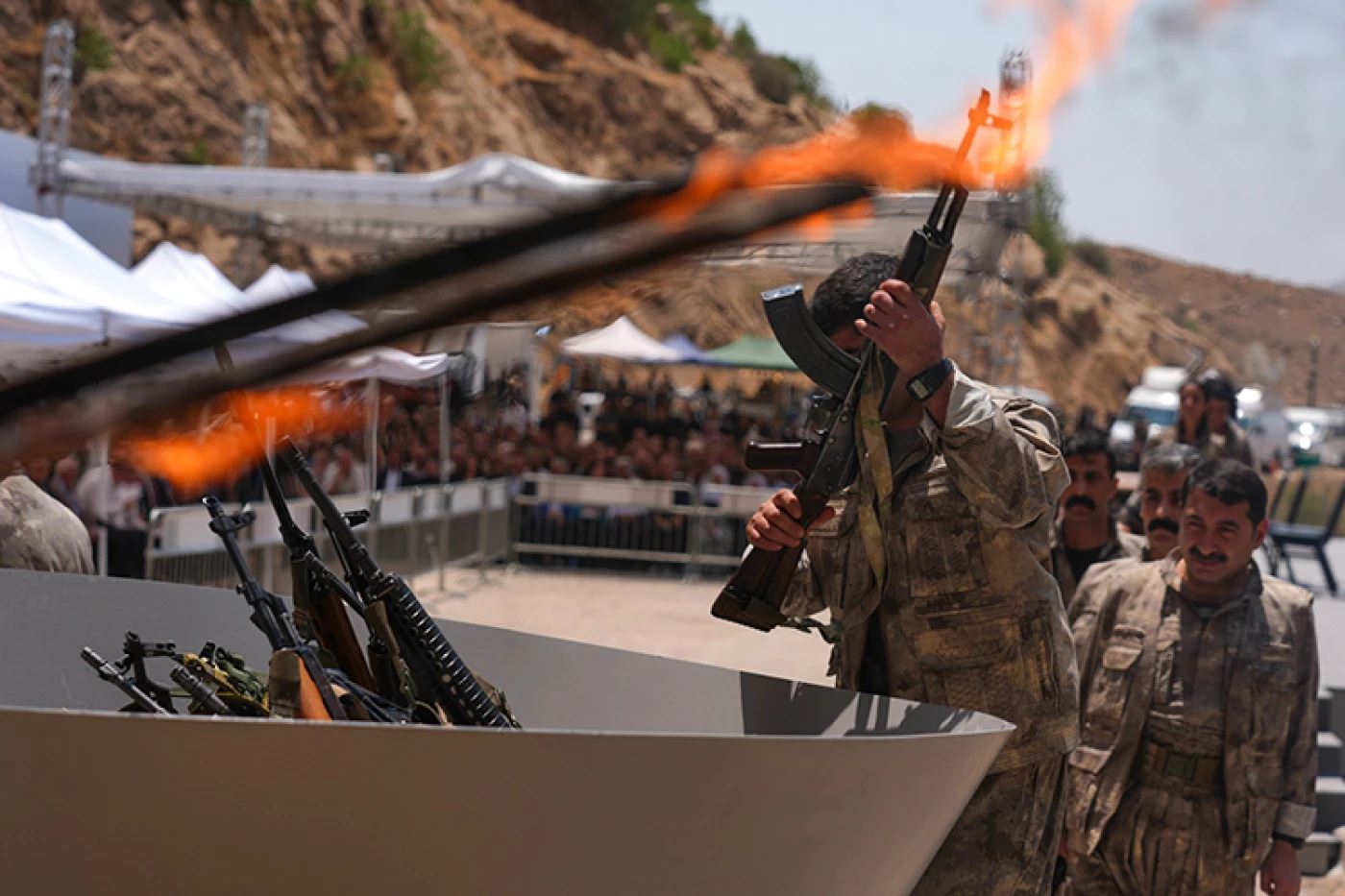
The Kurdistan Workers’ Party (PKK) held its 12th Extraordinary Congress from May 5-7, 2025, in two different areas in Qandil. At the congress, decisions were made to dissolve the organizational structures of this party, cease armed activities and disarm, and the PKK’s abstention from any armed activity was emphasized. However, the final statement of the congress was disseminated on May 12 of the same month. While no timeframe for disarmament has been specified, efforts are being made in the nearest period, which may extend until the end of this summer. According to information, PKK guerrillas will hand over their weapons in the areas of Amadiya and Kani Masi in Duhok, Koya in Erbil, and Ranya and Said Sadiq in Sulaymaniyah, near their bases and camps, to a special team from the United Nations and Turkish MIT. Other sources speak of handing over guerrilla weapons to a special committee formed from Baghdad and Erbil, which will take about three months, such that after receiving the weapons and reporting all received weapons and military equipment, they will be handed over to MIT and the Turkish government.
While the Turkish state is awaiting the practical step of implementing the decisions of the PKK’s 12th Extraordinary Congress, at the same time Kurds and Qandil officials are awaiting the initial and practical step from the Turkish government and AKP toward amending the constitution and providing Kurdish demands and rights in that constitution. For this purpose, the release of thousands of Kurdish political prisoners and detainees is considered the first step of this process.
Despite all this, DEM Party officials and Kurdish politicians in Turkey are doubtful about the state’s steps to resolve the Kurdish issue and have continually reiterated their concern about “the state waiting for events and the PKK’s steps to implement the dissolution decision without the state demonstrating progress toward resolving the Kurdish issue.”
The Dissolution Congress and a Statement Full of Implications
The Kurdistan Workers’ Party (PKK) held its 12th Extraordinary Congress from May 5-7, 2025, in two different areas. At the congress, decisions were made to dissolve the organizational structures of this party, cease armed activities and disarm, and the PKK’s abstention from any armed activity was emphasized.
This congress took place after a series of secret and public negotiations dating back to April 2024 and several calls and political meetings between Öcalan and the DEM Party/İmralı delegation and the majority of Turkish political parties, and finally Öcalan’s call on February 27 of this year for disarmament and dissolution of the PKK. Although the PKK congress was organized on May 5-7, the final statement of the congress was disseminated on May 12 of the same month. This, according to information, was due on one hand to the disagreement of PKK leaders and different factions over congress decisions and redrafting the final statement, and on the other hand to the disagreement between PKK officials and the Turkish state over the content of the statement and the use of vague phrases and multi-interpretive implications in the statement. On the other hand, holding the congress in two locations simultaneously, apart from security and safety arrangements, was also related to internal PKK disagreements.
The statement is filled with multi-interpretive phrases and implications about the decision to disarm and dissolve, the future of the PKK and Kurds in Turkey, and expectations from the government and state. From the very beginning of the statement, Öcalan’s call of February 27 is named as the beginning of the peace process in Turkey, not Bahçeli’s call of October 22, 2024. This, beyond emphasizing “the successful conduct of the congress” as an indication of the PKK’s strength, was presented “despite continuous attacks and sieges.”
Although the congress was held with the aim of the peace process and resolving the Kurdish issue in Turkey and Syria, the statement once again emphasized the “competition and hostility” of the Kurdistan Democratic Party toward the PKK. The PKK believes that its struggle has resulted in breaking the efforts of elimination and denial of Kurdish identity and has elevated the Kurdish issue to a level where it can be resolved through negotiation and democratic politics. Therefore, the statement indicates that “there is no necessity for the PKK to continue.”
According to the statement, the PKK has not completely decided to dissolve, but rather has decided to “dissolve its organizational structures and armed activities” and has announced its abstention from any armed activity. The statement indirectly discusses the betrayal of the victorious states of World War I and Mustafa Kemal Atatürk, who violated the Treaty of Lausanne and then rewrote the constitution of 1921 for the Turkish Republic. In 1924, those rights given to Kurds in the 1921 constitution were removed from the 1924 version. Therefore, the statement mentions that “the PKK was established in response to the Treaty of Lausanne and Turkey’s 1924 constitution and has worked for the freedom and liberty of the Kurdish people.” Therefore, the statement emphasizes that “under the shadow of a democratic Turkish Republic and return to pre-1924 constitutions and the Treaty of Lausanne and the principle of common homeland and democratic nation, the Kurdish issue will be resolved.”
Just as Öcalan emphasized in a letter sent to the PKK congress on April 25, “the influence of the socialist wave in creating the PKK’s ideology and later the defeat of that wave and the nation-state,” which ultimately made that form of state “a tool in the hands of the capitalist system for exploiting peoples,” similarly the congress statement indicates that the PKK “in its formation fell under the influence of the socialist wave and the creation of a nation-state, and in this regard initiated armed struggle as a solution and path of freedom and liberation.”
Nevertheless, the congress statement has emphasized the necessity and importance of the PKK’s formation, such that “the PKK’s organizational structures took shape when overt denial policies of Kurds and Turkification through massacre, genocide, and political restrictions were being implemented. The PKK since 1978 has strived for acceptance of Kurdish existence and establishing the Kurdish issue as Turkey’s primary issue, and in this step, despite many sacrifices, it has been successful, and finally the PKK has become a symbol of Kurdish resistance.”
The statement attributes the first effort of the Turkish state for the peace process and accepting Kurds as a nation and their issue as an issue in Turkey requiring fundamental solution to the era of Turgut Özal, while considering socialism and the deep state as reasons for thwarting that effort. As stated in the statement, “the PKK’s struggle finally reached the initial step of acceptance and Turgut Özal’s initiative in the 1990s and Öcalan’s response in 1993 through announcing a ceasefire, but the collapse of socialism and guerrilla encirclement and Özal and his team’s purge by the deep state thwarted the effort.”
In the statement, through using the phrase “resumption of war and elimination of Kurds increased guerrilla numbers and capacity,” PKK officials want to tell us: disarmament and dissolution do not mean weakness, but rather the relationship between pressures and guerrillas in terms of numbers is direct, meaning that when and where pressures on guerrillas increase, guerrilla numbers also increase. However, if this viewpoint was correct until the beginning of the twenty-first century, then operating with that perspective in the second quarter of the same century constitutes deceiving people. This is due to the wider spread of communication tools and people’s awareness of the internal situation of the PKK, apart from the continuous development and strengthening of Turkey’s defense and military system, which has resulted in the guerrillas being squeezed in a difficult mountainous area far from populated areas and Turkey’s borders.
In the statement, the PKK has equated the patriarchal system of society with the state’s ruling system and centralization, such that PKK officials express their perspective on state, society, and to some extent family through a phrase that consists of emphasizing “opposition to patriarchal and statist thought and support for feminist and democratic thought and decentralized system.” Therefore, they have called for societal leadership to be given to youth and women, “starting now to work for organizational work and defense of rights and achieved gains” and development of Kurdish democracy. This serves as an indication of creating a Kurdish democratic society in opposition to Turkish democratic society or state.
Although the phrase rebellion (İsyan) has been used in the Turkish text of the statement for Kurdish uprisings in a hundred years of Turkey, at the same time the PKK believes that considering the situation and outcome of those uprisings and the thousand-year relationship of Kurds and Turks and 52 years of armed struggle and resistance has shown that the Kurdish issue will be resolved in the shadow of common homeland and equality in citizenship rights. Therefore, the PKK believes that “in World War III and the Middle Eastern situation, redrafting Kurdish-Turkish relations is a reality that no one can escape from.” This very sentence is an indication of Turkey’s efforts to redraft its program and policy toward Kurds in all four parts of Kurdistan and the Middle East. This is the result of political, military, energy, economic, and commercial changes in the region.
Along with the call for support and necessary groundwork for implementing congress decisions, the PKK has also asked the government and ruling and opposition parties to support “the peace process and democratic society.” Nevertheless, it has placed great and historical responsibility on the shoulders of the Turkish Parliament and called it by its main name: the Grand National Assembly of Turkey.
In the statement, it indirectly asks powerful states not to obstruct the process, this for the sake of non-repetition of Kurdish massacres. Therefore, it asks international forces to “consider their responsibility regarding the policy of Kurdish massacres over the past hundred years and not obstruct democratic resolution.”
At the end of the statement, the phase of democratic socialist society (Demokratik Toplum Sosyalizmi) and the global democracy movement (küresel demokrasi hareketi) are mentioned, which will result in the emergence of an equal and democratic society globally, this in the shadow of “the peace process and democratic society and socialist struggle (Barış ve Demokratik Toplum süreci ve sosyalizm mücadelesi).”
At the end of the statement, several phrases and slogans have been used that are subject to interpretation. One of these is the phrase “Long live the brotherhood of Turkish and Kurdish peoples and the complete independence of Turkey (Yaşasın Türk ve Kürt Halklarının Kardeşliği ve Tam Bağımsız Türkiye!),” which has been proposed as a slogan of leftist forces.
Another slogan is: “The collapse of the socialist nation-state brings with it the success of the democratic socialist society.” Through using this slogan, the PKK on one hand wants to justify the collapse of that ideology it has relied on for nearly 40 years, and on the other hand indicates a new phase of political and civil struggle whose goal is to bring about “a democratic and socialist society,” meaning a mixture of the democratic-capitalist ideology of the Western bloc and the socialism of the Eastern bloc.
The last slogan of the statement consists of equating socialism with humanity, using the phrase “emphasizing humaneness is emphasizing socialism.” This means that despite Öcalan himself and other PKK officials’ acknowledgment of socialism’s failure, they still have not been able to free themselves from that ideology, and particularly in using the last sentence of the statement (Long live President Apo), they have demonstrated they still follow socialist thought, and like any other Kurdish party, the PKK has not been freed from personality cult and leader worship.
State Demands and Kurdish Conditions
What is happening under the names “peace process, resolving the Kurdish issue, Terror-Free Turkey, Turkey’s democratization process” is all for achieving a set of demands and rights for the Kurdish nation and the Turkish state. If the state’s demand consists of ending the PKK and achieving a strong Turkey without terrorism inside the country and its external borders and elimination of threats to the country’s national security, then Kurdish demand consists of recognition as a nation in Turkey and granting political, cultural, linguistic, and administrative rights in managing local areas and implementing a form of decentralization in Kurdish cities of Turkey.
Although Öcalan’s message of February 27 for PKK disarmament and his letter of April 25 to his party’s congress and the May 12 statement of the PKK’s disarmament and dissolution congress have emphasized achieving some Kurdish demands and rights, particularly those for which this party has struggled, nevertheless both Kurds and the PKK await achievement of other demands and rights, particularly related to identity, mother tongue, civil politics, culture, and limited self-administration. At the same time, Turkish citizens and domestic and international observers and some ruling and opposition officials also anticipate the achievement of some of those rights. This is in light of Middle Eastern changes and Turkey’s efforts to lead the region and become a dominant and influential force in the region, and simultaneously statements and steps by senior Turkish officials, particularly Recep Tayyip Erdoğan and Devlet Bahçeli. Öcalan’s request for meetings with Masoud Barzani, Bafel Talabani, Nechirvan Barzani, Mazloum Abdi, and Qubad Talabani, with high probability, beyond discussing the peace process, is for discussing Turkey’s role and that country’s readiness to support Kurds, in a way that strengthens Turkey’s position in the Middle East and reduces Kurdish inclination toward Iran, Arab countries, and the West.
Also, both Öcalan, Qandil, and DEM Party believe that this process requires negotiation and implementation of Kurdish demands by the state. Among the most important demands are Öcalan’s freedom (even if conditional), granting a defined identity to Kurds and education in Kurdish, as well as issuing a general amnesty that includes PKK guerrillas and enables them to return to their families. According to leaked information, the number of those individuals is approximately 7,500, apart from the fact that the situation of Western Kurdistan and the continuation of the cantons constitute a red line.
Although state and party institutions of the ruling power continuously emphasize the absence of any deal or negotiation between the state, Öcalan, and the PKK regarding the party’s dissolution in exchange for constitutional amendment and recognition of identity rights, mother tongue, and limited self-administration for Kurds. As the Disinformation Combat Center (Dezenformasyonla Mücadele Merkezi) affiliated with the Directorate of Communications of the Turkish Presidency stated in a statement on March 2, 2025, rejecting all those statements and information about “Öcalan’s agreement with the state for constitutional change in exchange for PKK dissolution.”
Both Bahçeli and Erdoğan have repeatedly emphasized that there are no negotiations between the state, İmralı, or Qandil, and the process consists only of Öcalan’s request for PKK disarmament and dissolution within the framework of “Terror-Free Turkey (Terörsüz Türkiye)” calls. As in his initiative, Devlet Bahçeli had requested “Öcalan to come to parliament and at the DEM Party faction meeting call for ending terrorism and PKK dissolution.” From this message, it appears the state shows itself much stronger than to enter into negotiations and place the PKK as a force opposite itself. As Turkish intelligence, security, and military officials emphasize, in the shadow of drone attacks and intelligence coordination between Ankara, Erbil, and Baghdad, the PKK’s defensive capability has weakened, and not only in northern and southern Kurdistan cities but also in Qandil, they cannot emerge from their caves and shelters.
Despite all this, AKP’s efforts and Erdoğan himself for writing a new constitution (Yeni Anayasa) is an undeniable reality. Also, local government system reform (Yerel Yönetim Reformu) and comprehensive changes in the law on implementation of justice (İnfaz Yasasında Kapsamlı Değişiklik) are the most important topics of meetings of officials and experts in law and constitution affiliated with AKP and the Turkish Ministry of Justice, throughout the summer recess.
Erdoğan’s continuous emphasis on local administration reform and the decentralized system has reached a level where in his speeches during his party’s faction meeting in the Turkish Parliament, he has stated that the central administration system and concentration of powers in Ankara and the ministries, while creating problems for implementing several projects and service works, has simultaneously placed much unnecessary burden on the ministries and central authority. Therefore, Erdoğan wants to provide a form of decentralization through reforming the central administration system, particularly for Kurdish areas.
Apart from these, the tenth judicial package (Onuncu Yargı Paketi) is mentioned, which is being worked on by the AKP and MHP factions and is currently before the Parliament’s Judiciary Committee. Although after amending several articles and provisions of the law, the ninth judicial package was disseminated in Turkey’s Official Gazette on November 14, 2024, and to some extent increased judicial authority for investigation, detention, and even sentencing of defendants, it is anticipated that in light of Turkey’s new situation, the tenth judicial package will limit judges’ authority for harsh treatment of defendants and suspects, particularly related to elderly prisoners, children, and the sick—facilitating up to the level of serving their prison term at their own homes.
Simultaneously, it is anticipated that amendments to the Turkish Penal Code (Türk Ceza Kanunu), Anti-Terrorism Law (Terörle Mücadele Kanunu), and “the issue of appointing trustees (Kayyum Meselesi)” will be made. In this framework, along with reducing sentences, the release of approximately 100,000 prisoners is anticipated, among them thousands imprisoned on “terrorism” charges, particularly elderly people, the sick, children, and women with young children. Even if not released immediately, they may serve their sentence term at their own homes.
After the project for constitutional amendment is prepared during the summer recess by AKP officials and experts and is anticipated to be presented to the Parliament Presidency in October of this year with the opening of the new legislative session of the Turkish Parliament, it will form the constitutional and legal framework of the “Terror-Free Turkey” project and provide the necessary ground for it.
The important point from the Kurdish perspective consists of the level of implementing Kurdish demands and providing their rights within the framework of the new constitution, decentralization reform, and changes in the law on implementation of justice. It is obvious that Erdoğan and AKP are not amending the constitution and changing laws solely for the sake of Kurds and PKK dissolution, but beyond that, Erdoğan wants to erase traces of military authority over the constitution written two years after the September 12, 1980 coup, and until now many articles of that constitution have not been amended. Particularly the first four articles related to defining the ruling system and the identity of the state and Turkish society, and determining the religion, ideology, and official language of the state and people of that country.
Another point that DEM Party particularly emphasizes is the formation of a Parliamentary Council (Meclis Komisyonu), such that the council is formed from the first person of parties in parliament or faction leaders and under the direct supervision of the Parliament Speaker. However, despite repeating this demand in DEM Party meetings and press conferences, until now no practical step has been taken, and perhaps its formation will occur at the beginning of Turkey’s new legislative session in October of this year. Along with all this, even ruling officials and even DEM Party speak of this process taking nearly two years.
Although making any change to those initial articles of the Turkish constitution will be in Kurdish interests, the changes may not be at the level Kurds expect, particularly regarding identity, official language, education in mother tongue, and self-administration.
At the same time, Devlet Bahçeli in a series of statements in the Türkgün newspaper has indicated amending Article 66 of the Turkish constitution in Kurdish and other minority interests in Turkey. According to that article, “every citizen living in Turkey is recognized as Turkish,” but Bahçeli in his statement on March 31 of this year emphasized that “every citizen living in the Turkish Republic has common duties and rights.” Many political experts and those in law and constitution believe that this phrase used by Bahçeli is an indication of amending Article 66 of the constitution, such that all Turkish citizens will no longer be counted as Turkish and a new national identity will be given to citizens of that country.
Despite all this, linking the issue of “terrorism” and the PKK to the Kurdish issue is considered a fundamental error, and some Kurdish observers, politicians, and academics in Turkey demand that the issue of PKK disarmament and dissolution not be mixed with resolving the Kurdish issue and achieving its rights in the new constitution and amending laws, because the Kurdish issue is a major national issue in Turkey requiring fundamental resolution, and the state cannot view resolving the Kurdish issue from the perspective of PKK dissolution and measure all Kurds by the PKK’s scale.
Despite all this, constitutional amendment and facilitation for Kurdish prisoners, DEM Party, and the PKK on the other hand create legal and political problems for AKP and the government. Particularly related to the situation of those convicted affiliated with the Fethullah Gülen group and the opposition front, because some of the penal amendments and facilitations may include those convicted due to the Fethullah Gülen group (FETÖ) case and the failed coup attempt of July 15, 2016, or those convicted for supporting the (Gezi Park) demonstrations and supporting the opposition front, apart from those generals and military officers currently imprisoned on charges of staging coups at various times.
Conclusion
The peace process in Turkey is being tested for the fourth time, this after Devlet Bahçeli’s initiative and Öcalan’s positive response and implementation of the aforementioned’s demands by the PKK for disarmament and dissolution. The PKK’s dissolution has put the ball back in Ankara’s court and Erdoğan himself, who stands before great historical responsibility. Here begins the difficult task of Turkey’s rulers to democratize Turkish society and the political arena, to abandon removing DEM Party and CHP mayors and appointing trustees in their place. Removing obstacles for DEM Party and CHP politicians for the 2028 parliamentary and presidential elections is a fundamental and preliminary condition for guaranteeing that democratic society that Öcalan calls for before PKK dissolution.
Despite the provision of some Kurdish rights, from the perspective of national identity, mother tongue, education, and cultural rights, Turkey needs fundamental legal, constitutional, and even social change, such that constitutional and legal amendments are brought down to the level of the masses, and particularly nationalist Turkish people are awakened to the reality of Kurdish existence in Turkey, and that social contract that emerges in the shadow of constitutional amendment is endorsed by the masses.
It is also the duty of Kurdish representatives and officials in Turkey not to impose demands unsuitable to this era regarding statehood, education in mother tongue, and self-administration as conditions on the Turkish state, and to refrain from using sensitive racist and nationalist inappropriate phrases such that they contain symbols and indications of separatism and partition of Turkish territory.