

By Hawraman Fariq
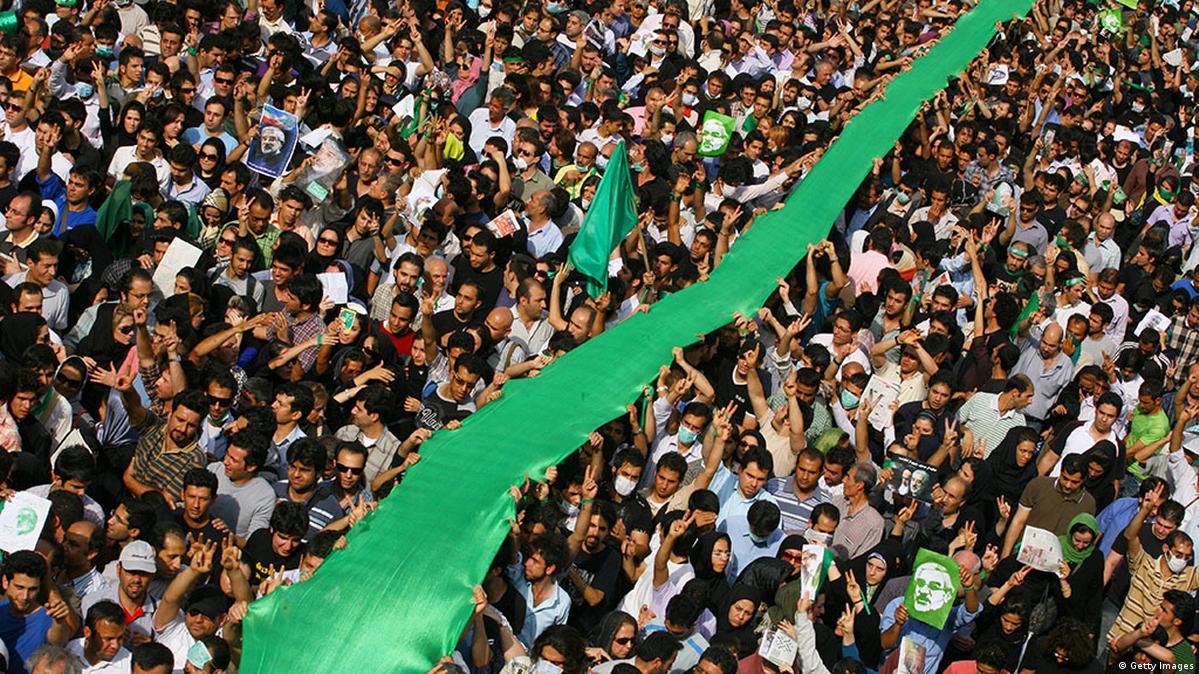
The Iranian Green Movement is considered one of the most significant protest and socio-political movements in Iran’s contemporary history. The movement emerged following protests against the results of the 1388 Solar Hijri calendar (2009) elections. The slogan of this movement from the outset was “Where is my vote?” Demonstrators demanded a recount of their votes at that time, and the Iranian regime suppressed the movement with all its might. This movement had a profound impact on Iranian society.
The movement had three distinct characteristics, which were:
It began as a protest against manipulation and fraud in the elections, but later developed a clear discourse founded upon human rights, civil liberties, and democratic principles.
The second characteristic was that three prominent leaders led it, the most prominent of whom was Mir-Hossein Mousavi, a confidant of Ayatollah Khomeini, the second Prime Minister after the 1979 Iranian Revolution, and presidential candidate for 1388 Solar Hijri. Also Mohammad Khatami and Mehdi Karroubi, each of whom has remained under house arrest in some form from that time until now. However, there is a strong opinion that believes the absence of strong leadership was itself one of the factors in the failure of the Green Movement. Neither Mousavi nor anyone else was at the level of leadership that movement required.
Third, the utilization of contemporary technology, which manifested itself in the widespread use of the internet and social networks for organizing and transmitting the messages of demonstrators. The movement’s color became green, and Mousavi’s supporters wore green flags, scarves, bags, and clothing.
The Roots of the Green Movement
Perhaps the roots of the Green Movement are deeper than the protests that arose in response to the election results. The very fact that the authorities wanted to unilaterally manipulate the election results in favor of Mahmoud Ahmadinejad and to the detriment of Mir-Hossein Mousavi contains some origins for understanding the situation. Interpretations of the Green Movement are varied. In this brief discussion, I will attempt to introduce this concept from two perspectives: first, the reform movement—which as a concept I have briefly written about in Issue 13 of the Iranian Studies Journal—and second, from the perspective of analyzing Mir-Hossein Mousavi’s discourse and relying on an article entitled “The Events of the 1388 Elections from the Perspective of Frame Analysis.”
The Impasse of Reform
From the perspective of the conflict between fundamentalists and reformists, during Mohammad Khatami’s era, which was the first major reform phase, there was an effort to bring people closer to the regime’s institutions. In that phase, a limited relationship existed with intellectuals who were fundamentally non-religious and some of the regime’s intellectual and political cadres who understood the social tensions and the regime’s movement toward impasse. However, with Ahmadinejad’s arrival, this sense of the authorities’ impasse reached its peak, and with the emergence of the Green Movement, the need for explicit reform among the reformists (Second of Khordad movement) became the demand of that movement. Therefore, some of them were imprisoned in this pursuit, and some fled. During Nejad’s era, Khatami’s reforms were halted. In contrast, a different kind of reform from the perspective of the Supreme Leader began, which aimed to strengthen the regime’s apparatus in foreign and domestic policy and to return to the populist position of the Islamic Revolution. However, his reforms brought failure. From the Supreme Leader to ordinary people who had voted for him turned away from him, and it was difficult for him to compete with a strong candidate. This unbearable situation prepared fertile ground for the emergence of any kind of protest.
Presidential Elections
To better clarify the ground for the movement’s emergence, we can return to the time when the election was held. Because ultimately in elections, competing parties present the existing situation for criticism and present their project for change in that situation. Through their discourse, voters understand the problems and crises and vote for that candidate to bring about change. We can also, through the main discourses of the movement’s leader—who himself until that moment was one of the regime’s pillars and could very well lift the veil from hidden realities—put our finger on the causes and objectives of the movement and classify Mir-Hossein Mousavi’s main discourses into three phases: pre-election, the propaganda period until the election, and the post-election phase.
Let us begin with the fact that Mousavi announced that he had nominated himself for the presidential position for the following reasons. The first reason in the first phase of Mousavi’s discourse is reflected in this way. He began from the outset with the economic crisis and the unbearable living conditions of the people, especially the poor and middle classes. He referred to the importance of strengthening the national economy and not suppressing the import of foreign goods. He used the concept of “the shrinking of the poor’s table” and criticized the government’s poor management in this regard. Then, at the first press conference, he discussed the corruption of the foundations in the decision-making system and the presentation of false and excessive statistics. In this phase, he began at the Nazi Abad Mosque.
In that same phase, he addressed the youth class and emphasized the necessity of freedom of expression and ending the classification and marginalization of university students. From here, he moved his election campaign into the universities. Particularly from Mashhad University, he gradually placed his framework within the basket of reformists. At that time, his opponents, who were the Basij members within the universities, criticized him.
The second phase begins from the debates until the election. Specifically, on 13 Khordad 1388 (June 3, 2009), when transformation within Mousavi’s frameworks could already be sensed. For the first time, the concept of moral and material poverty was confronted with the regime, and in contrast, adherence to moral values in governance and ending superstition and the presentation of false statistics became the pretext for attacking the then-president and the regime’s comprehensive support. From that time, he accused the Iranian authorities of lying to the people. From that day, his street campaigns echoed the slogan “lying is forbidden.” Gradually, the rifts within the authorities increased and manifested themselves through official media support for Ahmadinejad. Mousavi’s supporters increasingly demanded the rights of youth and women from him.
The third phase, after the election and the protest against vote fraud. From that time, Mousavi and the movement demanded the people’s legitimate right to protest, the people’s legal rights, the necessity of the people’s persistence in resistance, the freedom of political prisoners, and the lifting of media restrictions. Mir-Hossein became the first person to strongly criticize political dictatorship and demanded adherence to the constitution. His campaigns raised the slogan of the great lie. The situation remained complex for nearly eight months and ended with the termination of the movement. The movement’s leaders were placed under house arrest, and the situation of that country from that time until the Jina Movement and now continues with unbearable economic, political, and social conditions, and with the activation of European sanctions mechanisms against that country, it is not unlikely that social movements and mass protests will emerge again under different names.