
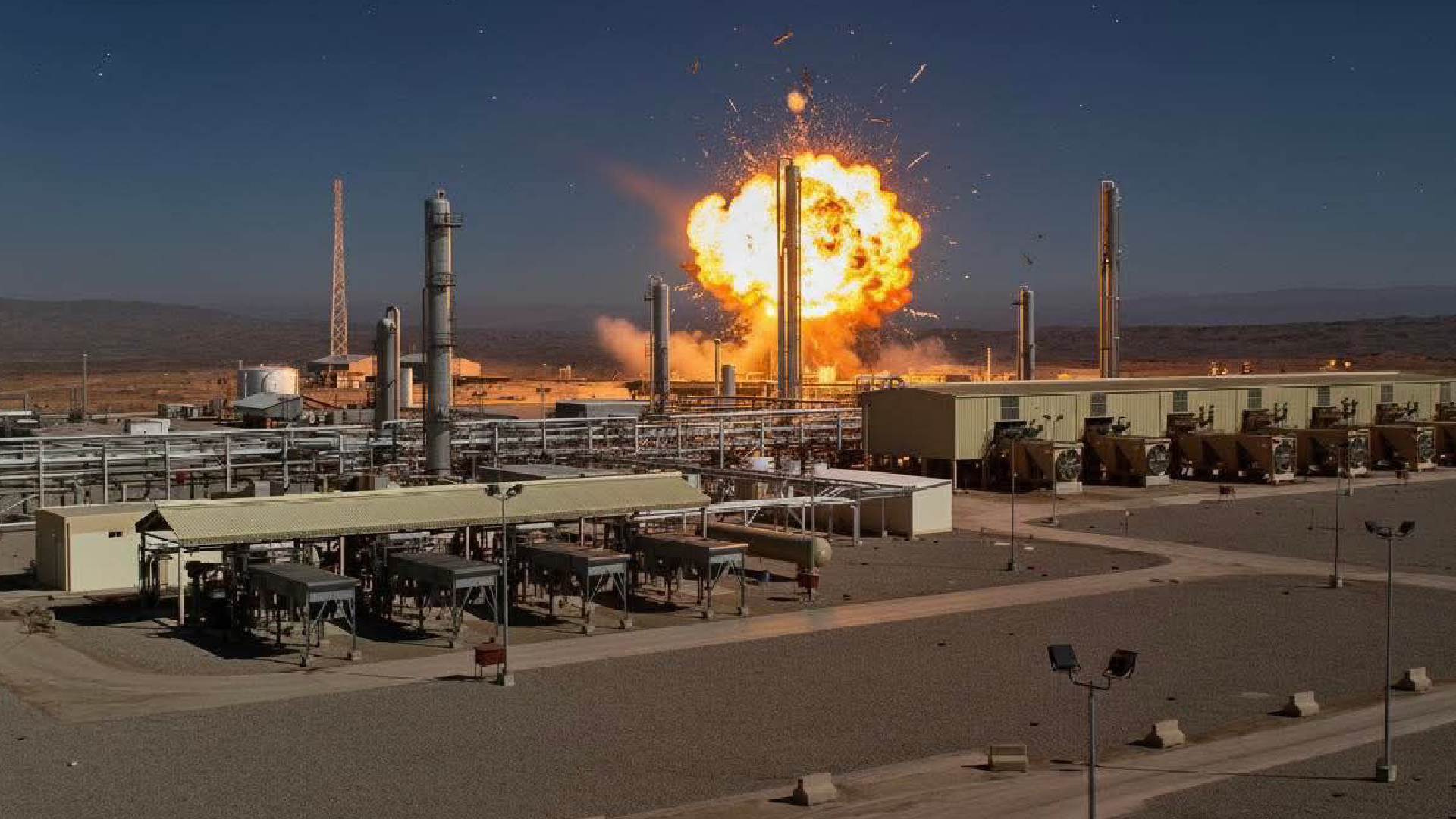
The increase in natural gas production capacity at the Khor Mor gas field to 750 million cubic feet per day represents a historic change and can be viewed as the expansion of a strategic and highly valuable project.
Plans for subsequent phases indicate that production volume from this field will reach one billion cubic meters, while natural gas management plans will become much more extensive in the future, as the Chemchemal natural gas field has come very close to commencing production, and reserves discovered in the Miran gas field have been estimated at approximately 8 trillion cubic feet.
Beyond these three substantial fields, there is potential for commencing production from the Topkhana-Kurdamir, Bnabawe, and Khurmala fields in the future.
Overall, the volume of reserves and political readiness indicate that the Kurdistan Region will have the capacity to produce energy exceeding its own needs in the future.
The experience of managing crude oil and natural gas between Iraq and the Kurdistan Region differs significantly. Similarly, the Iraqi government’s experience in managing crude oil differs considerably from its management of natural gas. Iraq has nearly a century of experience with crude oil, and following the liberation process, it rapidly advanced in terms of crude oil contracts; its management capacity, increased production rates, and contract types have developed well.
However, regarding natural gas, Iraq is in the initial stages of the process and still purchases portions of gas and electricity from neighbouring countries, particularly Iran and Turkey. Iraq pays Iran approximately 3.5 to 5 billion US dollars annually for natural gas purchases alone, and approximately 700 million to 1 billion additional dollars to the same country for electricity purchases.
In contrast, the Kurdistan Region has approached complete self-sufficiency in natural gas.
Regarding electricity energy provision, the Kurdistan Region has developed well. Reliance on natural gas for electricity energy provision is approximately 80-85%, while dependence on hydroelectric production is less than 5%.
Moreover, in recent years, Kurdistan has given specific attention to energy production from renewable energy sources (solar power). All of these factors have enabled the implementation of the “Roonaki” (Illumination) project, in which approximately 4.5 million residential electricity subscribers have participated to date.
This is in addition to the fact that most electricity production and transmission networks have been renovated and new stations with modern technology have been constructed.
All of this occurs while Iraq remains in a dire state of electricity energy management. Forty percent of electricity production in the country is lost, partly due to old and deteriorated electricity networks and partly due to electricity consumption that is not registered in the Ministry of Electricity records.
This coincides with what many serious reports indicate, including the US Congressional Research Service (CRS) report and major journalistic reports, that Iraq has allocated approximately 80 to 100 billion US dollars between 2003 and the present for advancing the electricity sector.
The Roonaki project in the Kurdistan Region and the provision of electricity for twenty-four hours throughout day and night represents a historic step that century-old Iraq itself has never witnessed. The best condition for Iraq in electricity provision capacity was in 1989 and 1990 before the invasion of Kuwait, when electricity production capacity was approximately 89%. However, after the Kuwait war, that country’s infrastructure was destroyed and electricity production capacity declined to approximately 20%.
All of this coincides with emerging dangers, such that natural gas and oil industry management by the Kurdistan Regional Government is highly at risk.
Recent events may serve as a warning bell for the loosening of control over natural gas management from the Regional Government, which may resemble recent oil management events.
Everyone remembers that before the agreement between both governments and oil production companies in Kurdistan, several drone attacks were carried out on oil fields and the entire process was jeopardized, until the matter reached the point where sales and export management was surrendered to the Iraqi SOMO company.
Currently, the Regional Government effectively has no remaining role in oil management. The role and control of sales, revenue, relations with markets, and allocation of financial entitlements to production companies lie with Iraq. This treatment regarding oil does not align with the principles of production sharing contracts and more closely resembles technical service contracts.
Consequently, the Iraqi model now dominates the management of Kurdistan’s oil, and everything that has been accomplished constitutes the establishment of Iraq’s demands in the budget law of the past three years.
Ultimately, these recent events and Iraq’s political reality reveal evident dangers within them. In response, the Kurdistan Regional Government must prepare itself for a struggle over natural gas control with Iraq.
To date, the natural gas matter remains under the management model of the Kurdistan Regional Government. The question is: Will the Iraqi government allow this matter to remain as it currently is? Can Iraq tolerate the Kurdistan Region having twenty-four-hour electricity, while citizens of Basra, Mosul, and Najaf have only four hours of electricity in summer?!
Translated by Nawroz Mohammed for Kfuture.Media.