

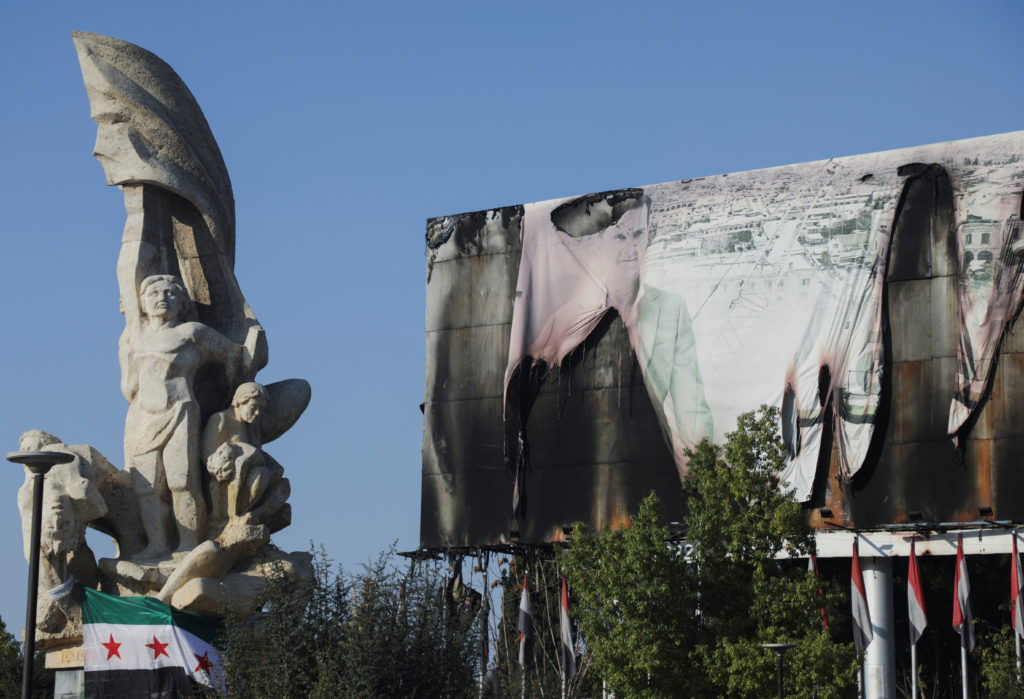
In a historic turn of events, Syrian opposition fighters announced the liberation of Damascus on Sunday, signaling the fall of President Bashar al-Assad’s regime after decades of authoritarian rule. Opposition forces, who entered the capital with minimal resistance, declared an end to the Assad dynasty while urging unity and restraint. The dramatic developments, including the release of prisoners and the capture of strategic sites, have sparked celebrations across Syria, marking a pivotal moment in the nation’s turbulent history.
The Fall of Assad and Liberation of Damascus
The announcement of Damascus’s liberation came amidst a flurry of dramatic events. Opposition fighters proclaimed victory live on Syrian state television, asserting that President Bashar al-Assad had fled the capital to an undisclosed location. A representative of the opposition fighters read a declaration: “The tyrant Assad has been toppled. The city of Damascus has been liberated, and all prisoners have been freed.” The statement called on citizens and fighters alike to safeguard public property, emphasizing the need to preserve Syria’s infrastructure.
One of the most symbolic moments was the opposition’s seizure of the Mezzeh Air Base, a facility instrumental in the Assad regime’s military campaigns. Video footage circulated by the opposition showcased their fighters at the base, marking a significant victory against one of the government’s strongholds. This victory followed a swift and coordinated advance into the capital, signaling the regime’s diminishing control.
Hadi al-Bahra, leader of the Syrian National Coalition, expressed hope for a new chapter in Syria’s history, declaring Damascus “free of Assad.” His call for Syrians abroad to return and rebuild the nation echoed the sentiment of renewal shared by opposition leaders.
A Nation Celebrates Amid Historic Change
Scenes of jubilation erupted in Damascus and beyond. Residents chanted “Freedom! Freedom!” while others flooded the streets in celebration. Omar Horanieh, a Damascus resident, described the moment opposition fighters entered the city: “There were loud blasts and gunfire, and then the fighters arrived. Everyone shouted, ‘God is the greatest.’”
Celebrations spread quickly to cities like Aleppo, where citizens toppled statues of Hafez al-Assad, the late father of Bashar, symbolizing the end of a dynasty that ruled Syria for over five decades. Along the border with Lebanon and in coastal areas such as Latakia, similar scenes unfolded.
In Sednaya, north of Damascus, fighters freed prisoners, replicating efforts seen during their rapid advances in other regions. Soldiers loyal to the regime reportedly abandoned their posts, surrendering without resistance. This pattern of minimal confrontation was echoed in Homs, a strategically vital city that had long connected Damascus to Assad’s coastal strongholds. With its capture, opposition forces severed critical supply and communication lines, hastening the regime’s collapse.
Calls for Unity and Institutional Stability
As the dust settled on Damascus, opposition leaders emphasized the importance of restraint and institutional stability. Abu Mohammad al-Julani, head of Hayat Tahrir al-Sham (HTS), instructed fighters to protect public institutions and refrain from any retaliatory actions. “It is strictly forbidden to approach public institutions or fire into the air,” he stated in a message circulated on social media.
Syrian Prime Minister Mohammad Ghazi al-Jalali, speaking from his residence, expressed his willingness to cooperate with the opposition to ensure the continuity of governance. In a video statement, he declared, “I remain in my house and am committed to my country. Public institutions must continue to function for the sake of the people.” He pledged to resume his duties at his office while urging citizens to avoid vandalizing state property.
HTS, which has positioned itself as a transitional authority, reaffirmed its commitment to preserving Syria’s sovereignty. In a statement, the group pledged to protect all citizens, regardless of their affiliations, and to foster national reconciliation. The group also announced plans to work with the United Nations to facilitate a peaceful transfer of power and ensure the resumption of government operations.
Regional and Global Implications
The fall of Damascus has far-reaching implications for Syria and the broader Middle East. Al Jazeera’s Nour Odeh, reporting from Amman, Jordan, described the development as “seismic,” noting its potential to reshape the regional political landscape. “The fall of the Assad regime marks the end of an era in the Middle East. It will have profound implications across the region,” she said.
The opposition’s rapid advance, which began with surprise attacks in Aleppo and Idlib, culminated in the capture of major cities including Hama, Homs, Dara’a, Suwayda, and Damascus. The swift nature of the campaign stunned observers and signaled the collapse of Assad’s military defenses.
As celebrations continue, international attention turns to the future of Syria. Opposition leaders, such as Hadi al-Bahra, have stressed the importance of rebuilding the nation while avoiding revenge. “The situation is safe, and there is no room for retaliation,” he stated, emphasizing unity and reconciliation.
Meanwhile, analysts speculate on the challenges ahead, including the establishment of a stable transitional government, the reintegration of displaced Syrians, and the rebuilding of war-torn infrastructure. With the support of international organizations and regional allies, the opposition aims to chart a new course for Syria, one that prioritizes democracy and the rule of law.
A New Dawn for Syria
For many Syrians, the liberation of Damascus represents not just the end of an oppressive regime but also the promise of a brighter future. The call for restraint, unity, and institutional preservation underscores the opposition’s vision of a Syria free from decades of authoritarian rule.
As the nation enters this new chapter, the challenges of reconstruction and reconciliation remain daunting. Yet, the spirit of resilience displayed by the Syrian people offers hope that the country can rise from the shadows of conflict and build a future rooted in freedom and justice.
The coming days will be crucial as Syria navigates the transition from war to peace. For now, the streets of Damascus and beyond resonate with chants of freedom, marking the dawn of a new era.