
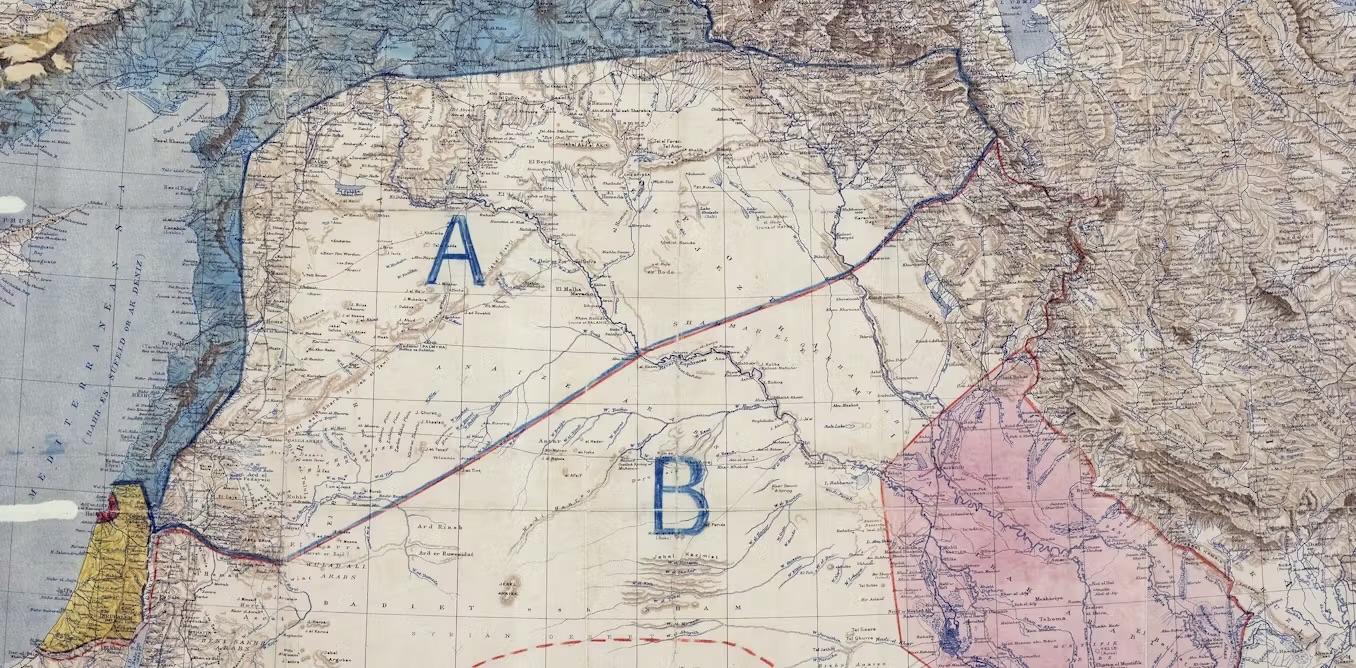
Since World War I laid down its burdens, the Middle East had been preparing for the opening of new wounds. The Ottoman defeat in the war (1918) was not merely the fall of an empire, but a historical opportunity for Western powers to redraw the map in service of their interests. Thus emerged the first poisonous seeds of what came to be known as “modern borders,” which were born not from the will of peoples, but from the ink of colonial diplomats who sat in closed rooms to determine the fate of entire nations.
The Sykes-Picot Agreement, which took place in 1916 between Britain and France, with Russian blessing, did not draw final borders but rather defined spheres of influence. Iraq was included within Britain’s “Red Zone,” but the borders we know today did not yet exist. What followed was a series of agreements and bilateral arrangements: with the emerging Saudi state (the Uqair Agreement of 1922), with France in Syria, then with Iran, Turkey, and Kuwait. The maps multiplied, but the rule remained: no borders except according to the colonizer’s interests.
The number of agreements that affected Iraq’s map reached approximately eight major agreements, the most dangerous of which were those that divided influence without reference to the will of the inhabitants. The San Remo Conference, the Treaty of Lausanne, then the 1930 Treaty—all of these established a young Iraqi state, surrounded by a network of caution and suspicion with its neighbors. Thus, Iraq’s borders were not solely the product of Sykes-Picot, but rather a compound result of war events, imperial conflict, oil interests, and shifts in the balance of power. Perhaps what most embodies the colonial mood of that time is what Churchill sarcastically recounted one day about drawing borders in the region, when he said: “I sat with a map surveyor and drew the borders of Jordan and Iraq with a straight line while sipping a glass of whiskey.” Geography was not drawn based on people’s reality, but to the rhythm of the victorious power’s mood.
However, in recent years, a saying has begun to circulate in some intellectual and religious discussions: “We are religious, and religion does not recognize borders.” This statement deserves pause, not because it is new, but because it is sometimes presented as if it carries a final solution to the complexity of political geography, while in reality it is a statement that needs calm deconstruction and careful examination, especially when placed in confrontation with concepts of state, sovereignty, and national identity.
Islam, like other major religions, does not prevent the existence of political entities and regulatory borders. The Prophet (peace be upon him) established a state with territories and borders, appointed governors, and organized relations between the Muhajirun (emigrants), Ansar (helpers), and Jews. The Caliphs after him maintained the idea of the state and established an administrative system based on regions and borders, not on chaos. There is nothing in Islam that negates the existence of the state; on the contrary, there is what obliges the preservation of order, souls, and rights.
On the other hand, Islamic political heritage harmonized—in its spirit—with the developments of the age. We live today in a world governed by concepts of the modern state: sovereignty, law, citizenship, and diplomatic representation. State borders are part of its legal personality and are an organic condition for membership in the international community. The United Nations Charter, rules of international law, and the principle of non-interference with the territorial integrity of states—all are systems that govern our world and ensure, relatively, the absence of chaos, and hold states accountable for sovereignty within their borders.
Religion, whatever it may be, does not isolate humans from their realistic context. Humans are not beings floating in the air. They are children of place, language, environment, topography, the air they breathed, the river from which they drank, and the land in which their ancestors were buried. Religion guides the spirit, yes, but it does not cut the roots. Indeed, all religions sanctify the land, connect faith with stability, giving with belonging, and responsibility with place. British political geographer Halford Mackinder expressed this when he saw that “whoever controls the heartland controls the destiny of the world,” indicating that understanding geography is not a neutral matter, but part of managing the political destiny of states.
But the question that should be posed boldly and clearly is: what idea is intended to be passed through the repetition of the saying “religion does not believe in borders”? Is the intention to demolish the concept of the modern state? To cancel national sovereignty? To fragment homelands from within in the name of brotherhood that transcends geography? This statement, which appears idealistic on the surface, is in reality a tool for penetrating national consciousness and stripping generations of any sense of rooted belonging to land, history, and society.
And if we hypothetically assumed—just hypothetically—that we accepted the idea of abolishing borders: how would we arrange social participation? How would we distribute wealth? Who manages, and who is held accountable? Who plans, and who executes? Can a state with strategic location, oil, water, and civilizational depth be surrendered merely for transcendent religious or linguistic affiliation? And would societies that have invested centuries in building their institutions, elites, and consciousness accept to dissolve into fragmented, poor, marginalized entities merely for the sake of slogans?
The question here is not about justice and equality, but about reality and managing complexity. Hypothetical talk about a “world without borders” is beautiful in literature, theater, and intellectual seminars. But in politics, it is deadly. Because it works slowly, like digging under foundations, until buildings collapse from within. Thus arise generations that feel no homeland, do not realize the value of land, do not look to the future from a collective standpoint, but drift behind loose slogans that rob them of their identity without their knowing.
Patriotism is not the opposite of religion; rather, it is a practical translation of attachment to security, responsibility, sacrifice, construction, and it is the cornerstone of any successful civilizational project. As Hannah Arendt said: “The loss of belonging to a state is the loss of the right to have rights.” A human without a state is not only without borders, but without identity and without protection. And whoever dismantles this bond between humans and their land does not build unity, but produces a lost flock, easy to lead from outside the borders, toward the unknown.
Iraq today is not the child of Sykes-Picot, but the child of bitter struggle, long resistance, and political consciousness accumulated across generations. Its geography, though shaped by an external hand, has today become part of its national identity and regional responsibility. In a world buzzing with geopolitical transformations, homelands cannot be managed with a “preaching” mentality, but with the mind of the state. And borders, however painful their history, remain part of an international social contract without whose respect the world order cannot stand.
This is how we protect our homelands: with thought, not slogans; with consciousness, not emotion; and with faith that understands reality, not one that escapes from it.