
On the fifth and sixth of this month in Paris, a Syrian delegation consisting of the Foreign Minister and the head of Syrian intelligence met with an Israeli delegation led by the Israeli Ambassador to the United States, under American supervision. They reached an agreement that by all measures constitutes normalization or “tatbee” (normalization of relations) between Syria and Israel. The terms specify that both sides will cooperate at the intelligence, commercial, and diplomatic levels and establish a special coordination center. Israel will even open a special office in Damascus to function as an embassy, though it won’t be called an embassy since this isn’t official normalization—preventing Damascus from opening an embassy in Tel Aviv.
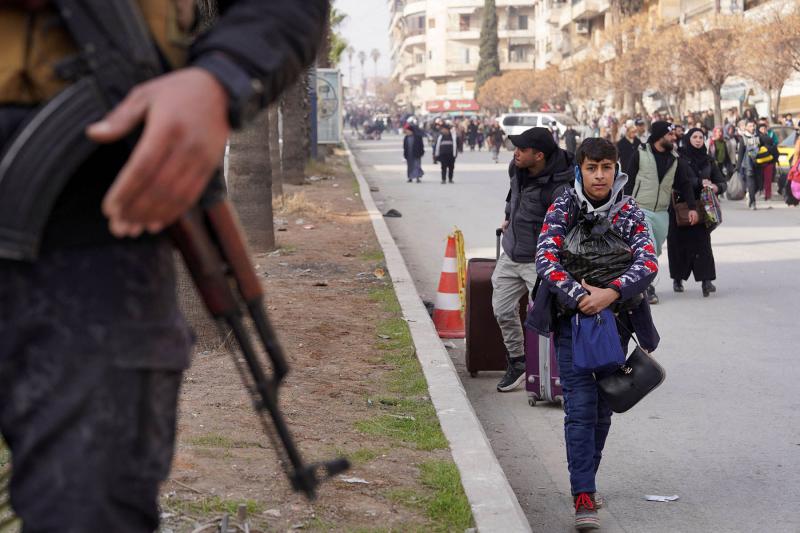
Some view this agreement as the backdrop to the attacks on Sheikh Maqsoud and Ashrafiyeh. Those who see it this way generally fall into two camps: one camp believes the attacks on Aleppo’s Kurds are an attempt to cover up the normalization deal between Sharaa and Netanyahu. The other camp sees them as a consequence of it.
Others believe the agreement between Syria and Israel, as well as the agreement between Turkey and Israel, means that Israel has a free hand in the south with Damascus’s cooperation, while Turkey has control in northern Syria. In this way, Syria becomes a sphere of influence for Israel and Turkey.
Aleppo’s attacks are a direct consequence. But they are undoubtedly a de facto consequence—an established reality. For example, when Israel agrees and then attacks on Kurds occur, Israel refrains from attacking Damascus. At the same time, from a media perspective, the attacks on Kurds serve to obscure news of the normalization. Because the armed Syrian preparations for the attack didn’t just begin in recent days. Clearly, it is common among Muslim peoples to be tyrannical toward the weak and submissive toward the strong. This is the deepest moral crisis of these peoples.
Ahmad Sharaa’s Strategy
Sharaa’s plan stems from the above logic: compromise with the powerful outside, use unlimited violence against citizens inside. This plan is known as “forced integration.” After the Druze and Alawites, this plan is now being implemented against the Kurds.
The two Kurdish neighborhoods of Aleppo are the weak point of the Syrian Democratic Forces. Because according to the agreement with Sharaa, nearly a thousand fighters withdrew from these areas. What remains is only security forces. At the same time, there is a separation of more than fifty kilometers between Aleppo and the Kurdish-controlled areas.
Sharaa wants to achieve victory against the Kurds. The Kurds want to defeat that victory, or if it happens, make it come at the highest cost.
Turkey’s Strategy
Aleppo is extremely important to Turkey. In fact, in the Turkish mindset, Aleppo is a Turkish area. If it doesn’t directly return to Turkey, then it must be a Turkish sphere of influence. If you recall, a week after Assad’s fall, Erdoğan said Turkey is greater than Turkey. He also said that as a nation, we cannot confine our vision to just 782,000 square kilometers.
For Erdoğan, dominating the region is destiny—Turkey cannot abandon it, in his words. He also said those who ask why Turkey is in Libya and Somalia don’t understand this. From this perspective, Turkey sees itself as more than a regional power. For Turkish researcher Asli Aydintaşbaş, this is nothing but a delusion. For Turkey, Aleppo is part of the process of making Syria Turkey’s backyard and strengthening Turkey’s position in the region. From this perspective, it sees Kurdish presence in Aleppo as an obstacle. It’s also part of the process of limiting Kurdish standing in Syria.
Although Turkey was not part of the agreement between Syria and Israel, Hakan Fidan met with the Syrian Foreign Minister in Paris on the sixth of the month. For both Turks and Syrians, Kurds are seen as having had no existence in the past, no role or position. Therefore, anything they have now is extra. Making a shoebox or the concept of bootblack a symbol of Kurds serves to erase any political existence from the Kurdish person—turning them into a non-political being without rights. This produces the logic that oppression creates oppression. Assad’s oppression produces Sunni tyranny. This is the great knot in state-building in Syria. When a Sunni sees himself as oppressed, he gives himself the right to oppress everyone else. When instead, the oppressed should develop the awareness of how to end oppression. But this is a higher state of humanity that doesn’t exist in everyone.
Kurdish Strategy
It appears the Kurdish situation is better at every moment. This is a good step, though limited. Because Kurdish division causes great harm. But their unity isn’t necessarily an effective force—but it’s very good. Just as the Druze and Alawites don’t compromise, Kurds shouldn’t compromise either, because the forces in Aleppo, aside from a collection of bloodthirsty gangs, possess no other values.
But at the same time, Kurds must try by all means to avoid war. In the end, Sharaa, like all dictators in the region, compromises with the powerful outside and is savage toward the weak inside.
What Are Kurds Doing in Aleppo?
In recent days, I’ve encountered this question several times. The question itself is complex and can carry several meanings. First meaning: it’s asked with the intent that Aleppo isn’t a Kurdish city, so what are Kurds doing there? Second: since Aleppo isn’t a Kurdish city, Kurds aren’t masters there. Third: at the same time, the question suggests Kurds shouldn’t fight for a place that isn’t Kurdistan.
When you look at the history and social, political, and geographical composition of the region, all these understandings and questions are gravely mistaken. Clearly, if this question is asked among Kurds, then among Arabs, Syrians, and others, the narrative war or propaganda war is an integral part of the conflict.
To understand Kurdish presence in Aleppo, we must examine the region’s history and political and social theses deeply and in detail.
First criterion: Since Kurdish presence on the land called Syria predates Syria’s existence, we cannot address Kurdish presence or absence within Syria’s framework, but rather we need long-term understanding—longitudinal—and we must think more broadly in terms of scope.
Second: If we think there’s a Kurdish area and a Kurdish area of Syria, then we’re thinking within the framework of a territorial state or nation-state, which Syria has not yet become. Syria is a space where forces are in conflict to survive or dominate.
Let’s start from distant history. The Citadel of Aleppo, by which the city is known, was built during the Zengid state in the twelfth century, during the Seljuk era. Then the Ayyubids ruled it. Then Hulagu and Timur until the sixteenth century. From the sixteenth century onwards for sixteen [centuries], the Mamluks administered it. In the sixteenth century, when the city became Ottoman, Kurds became dominant there.
In the seventeenth century, Ali Janbulat-oğlu (later known as Ali Janbulat—oğlu meaning “son” in Turkish), a Kurdish person, became the city’s ruler. During Ali’s rule, Aleppo became a commercial center and established relations with Europe. But Ali, facing opposition from officers, was sent to Europe and then killed in Belgrade in 1610. After this, the Janbulat family split into two parts: one went to Lebanon and became the foundation of today’s Druze Jumblatt family. Another went to the Jabal al-Akrad (Kurdish Mountain) area.
Kurds have always been in Aleppo, even into modern times. One of Syria’s most famous presidents, Husni al-Zaim, is from an Aleppo agha family and is Kurdish.
In the Syrian state era, Arab intellectuals say Kurds came to Damascus from the seventies onwards, and the area now known as Ashrafiyeh and Sheikh Maqsoud was an empty area. Sheikh Maqsoud who settled there was a Kurdish Sufi figure.
Generally, two factors bring Kurds to Aleppo: economic change and urbanization, along with political pressure and necessity. Most Kurds who came to Aleppo were victims of new Syrian state policies that deprived them of all rights and forced them to migrate to cities and settle on city peripheries. This phenomenon is part of post-colonial state history worldwide, known as the shantytown phenomenon.
The Arab narrative wants to say Kurds aren’t people of Aleppo. This argument is baseless at several levels. During the Ottoman era and before, Kurds existed in the area. During the imperial era, there was no territorial political consciousness. Meaning no one was specifically from one place and not from another; people moved easily and also by necessity throughout the empire’s territory. Most Janissaries in the Ottoman standing army were from the Balkans. The Mamluks were from Georgia and Central Asia. Someone like Muhammad Ali who ruled Egypt was Albanian.
After the Syrian state’s creation, Kurds are either Syrian or from nowhere, especially after the Baath came to power. In both cases, one cannot say whether they’re from Aleppo or not. After the Arab Spring, in the Afrin area and surroundings, terrorists forced many Kurds to migrate to Aleppo. In 2012, the war against Assad started from Kurdish areas. Then Assad, to reduce pressure, didn’t fight the Kurds because the Kurds’ desire was to remain. So the terrorists engaged in anti-Kurdish war, especially when the Kurdish-inhabited area was in a strategic location between Aleppo and Gaziantep. Much of this war is the revenge of those terrorists against the people of Sheikh Maqsoud and Ashrafiyeh.
Last October, I was in Amman. A Palestinian driver took me to the airport. During our conversation, he said: “We Palestinians and you Kurds, wherever we go they tell us you’re not from here.” Kurds could return from Aleppo to Afrin, where terrorists have occupied their homes. But if people have been in that city for sixty years and are citizens of that country, they have every right to be there. The problem with the majority of the region’s peoples is they have neither reason nor morals.
Originally published in Kurdish on Sardar Aziz’s social media platforms and translated into English by Harman Ahmed for Kfuture.Media.