

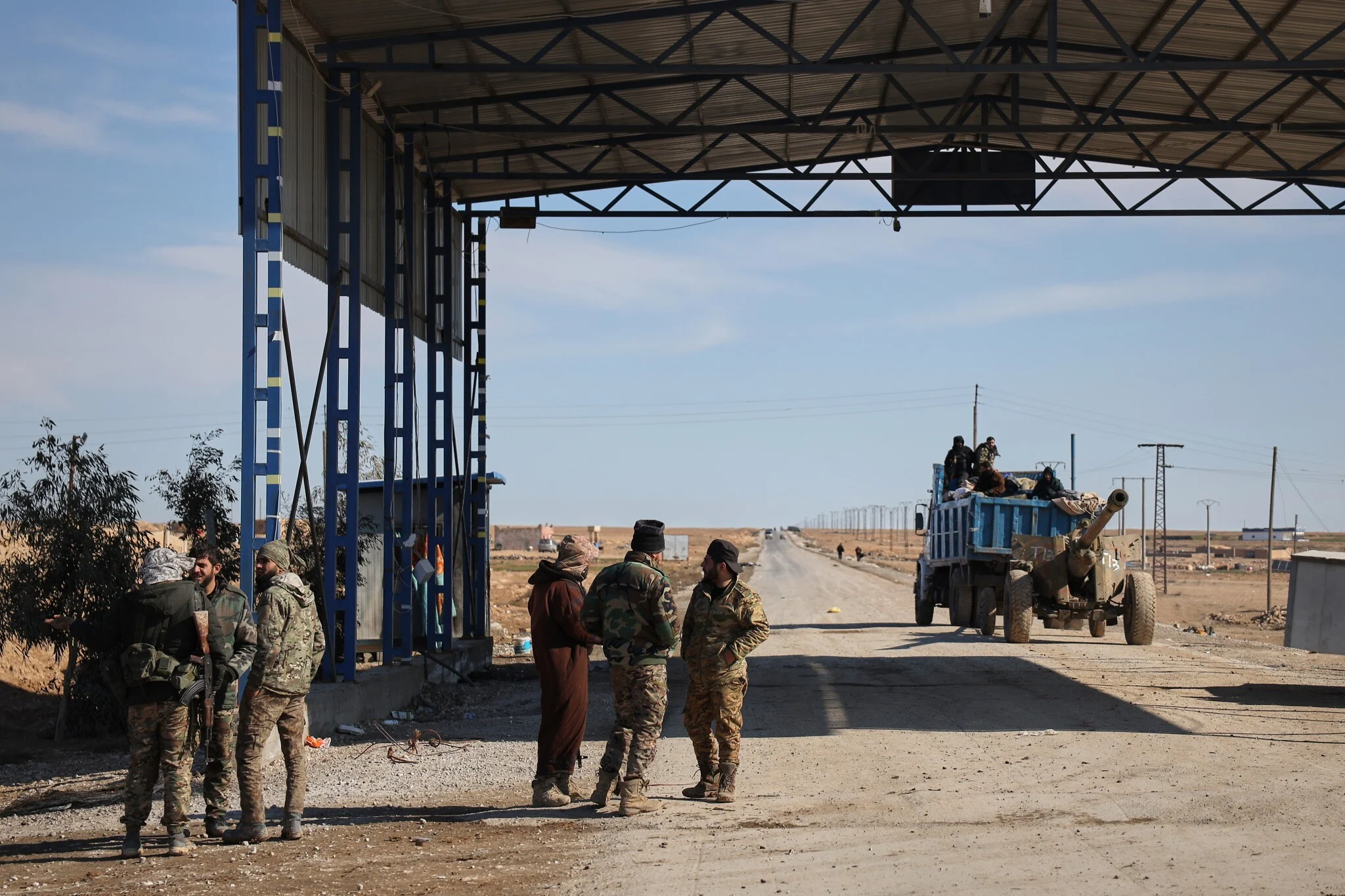
Kurdistan Region leaders have issued strong condemnations of military actions against Syrian Kurds as Damascus-backed forces seize control of northeastern Syria, ISIS prisoners escape detention facilities, and thousands across Iraqi Kurdistan demonstrate in solidarity with their embattled kin in Rojava.
Background: Ceasefire Collapses Into Full-Scale Offensive
Since August 2025, sporadic armed skirmishes have taken place between the Kurdish-led Syrian Democratic Forces (SDF) and the post-Assad Syrian Army along the internal border between the Democratic Autonomous Administration of North and East Syria (DAANES) and the Syrian transitional government .
SDF leader Mazloum Abdi and Syrian transitional government leader Ahmed al-Sharaa signed the US-backed 10 March agreement, which implemented a country-wide ceasefire and laid out principles for the integration of the DAANES into the new Syrian government . However, the agreement failed to be implemented by its December 31 deadline.
On 13 January 2026, the Syrian transitional government launched an offensive against the Kurdish-led Syrian Democratic Forces in northeastern Syria . In just a few weeks, government forces have gone from recapturing two SDF enclaves in Aleppo City to gaining huge swathes of territory in northeastern Syria, including a hydrocarbon bonanza, with barely a fight .
By stripping the SDF of the Kurdish-rights card, one of its few remaining sources of leverage, Sharaa forced the SDF back to the table. This combined strategy produced results . A new integration framework mandates the absorption of SDF fighters into the official Syrian military as individuals, rather than intact units.
ISIS Prison Breaks Spark Global Security Alarm
The crisis intensified when on Tuesday, the Syrian Interior Ministry said 120 ISIS members escaped from the Shaddadi prison in Hasakeh province . Syria’s Interior Ministry says 81 of some 120 ISIS detainees who had escaped from a prison have been recaptured , with search operations ongoing for the remaining fugitives.
The army accused the SDF of releasing ISIS detainees from the facility, while the Kurds said they lost control of the facility after an attack by Damascus . The transfer of control of the al-Hol camp, which houses some 24,000 people – mostly women and children linked to ISIS – came after two weeks of fighting .
According to recent announcements, U.S. Central Command is launching a new mission to transfer IS detainees from northeastern Syria to Iraq in order to “help ensure the terrorists remain in secure detention facilities” .
PUK President: “Acts of Barbarism” Must Stop
Bafel Jalal Talabani, President of the Patriotic Union of Kurdistan, issued a forceful statement condemning what is happening in Syria and Rojava as “unacceptable” and describing the actions against the Kurdish people as “acts of barbarism.” He stressed that the Kurdish people will not remain silent or turn a blind eye to these developments.
Talabani noted that Rojava lost thousands of its sons and daughters in the fight against ISIS, defending the world at an enormous cost, and emphasized that they deserve respect, dignity, and genuine protection. He called on the United States and the American people to act with clarity and responsibility to protect civilians and preserve stability.
In his statement, Talabani reminded the world: “We, the Kurds, are not asking the world and the great powers to protect us, but rather reminding them that this is not the first time they have supported the enemies of the Kurds, and every time, after years, it has become clear to them that they have caused harm. It is enough for them to remember a time when they supported the Ba’ath regime against the Kurds. The Kurds remained, and the Ba’ath left with a world of disasters and crimes.”
He added: “We remind every conscientious person in the world that this is not just an attack on the Autonomous Administration and Rojava, but rather an attack on the dignity and honor of Kurds everywhere, an attack on a force and people who, for more than twelve years, instead of the whole world, fought terrorism and protected the Syrian people without discrimination and with all their components.”
Kurdistan Region Deputy PM Calls for International Guarantees
Qubad Talabani, Deputy Prime Minister of the Kurdistan Region, has urged the United States and the international community to support Kurdish rights in Syria during a meeting with Tom Barak, the U.S. Special Envoy for Syrian Affairs.
In a statement posted on his X account, Talabani said he discussed the situation of Kurds in Rojava, emphasizing their demand for basic rights after a century of oppression and marginalization.
“The Kurdish people in Western Kurdistan, after enduring a century of oppression, discrimination, and marginalization, are seeking guarantees for their most fundamental rights,” Talabani stated.
He reminded the U.S. envoy that the Kurds have been instrumental allies to America and the West in defeating what he described as “the world’s largest terrorist organization,” a reference to ISIS. Talabani stressed the necessity of American and international backing to ensure Kurdish rights are protected within the framework of an independent and democratic Syria.
Talabani added: “We are proud of the feeling of solidarity and compassion of all Kurds, and this is the only guarantee of our existence and survival. We consider it our duty to make every effort to help our free sons and daughters in Rojava, to stop this difficult and complex situation, to normalize the situation, and to guarantee their rights within the permanent constitution.”
PUK Political Bureau Issues Urgent Appeal
The Political Bureau of the Patriotic Union of Kurdistan issued a formal statement expressing “deep concern about the events that have been taking place in Rojava and northern Syria for several days.”
The statement expressed solidarity with the Kurdish people in Rojava, who “heroically fought against ISIS terrorists on behalf of the world,” and condemned “the silence in the face of threats against our people, which is unacceptable.”
The PUK called on the international community and the mediators of the Damascus agreement of March 10, 2025, to “immediately stand against complications and attacks on civilians, and to pressure for the sustainability of the peace option, not the war option, whose outcome will not be in the interest of any party, especially after the escalation of raids and the escape of ISIS militants from prisons.”
The statement reaffirmed support for the Kurdish people “and for every effort that sees these dangers as they are and deals wisely with this unwanted situation.”
Territorial Losses and US Policy Shift
The SDF would have to give up the Raqqa and Deir el-Zour provinces — both Arab-majority areas — to the Syrian military and government, as well as its border crossings and oil and gas fields . With Arab-majority and oil-rich Raqqa and Deir az-Zour now fully in the hands of the government, the SDF is confined to slivers of territory in mostly Kurdish areas .
Tom Barrack, the US Special Envoy to Syria, announced that the group’s role as CENTCOM’s anti-IS partner in Syria had “largely expired”, now that Damascus had joined the Global Coalition Against Daesh . In a speech on Wednesday, President Donald Trump appeared to make this divorce official when he reaffirmed his commitment to Syrian President Ahmed Al-Sharaa as government forces encircled Hassakeh City .
Regional Solidarity Demonstrations
Reports indicate that large numbers of people from across the Kurdistan Region have taken to the streets in solidarity with Syrian Kurds. In Sulaimaniya, residents from all walks of life, including families, have gathered and begun moving toward Rojava, declaring “Rojava and Rojhilat (East) are not alone.”
Once one of the most powerful forces in Syria, and Washington’s most loyal ally in the fight against ISIS, the SDF is now facing extinction and the end of its dream of Kurdish autonomy . The crisis represents a critical moment for Kurdish aspirations in Syria and raises fundamental questions about the future of minorities in the post-Assad Syrian state.