

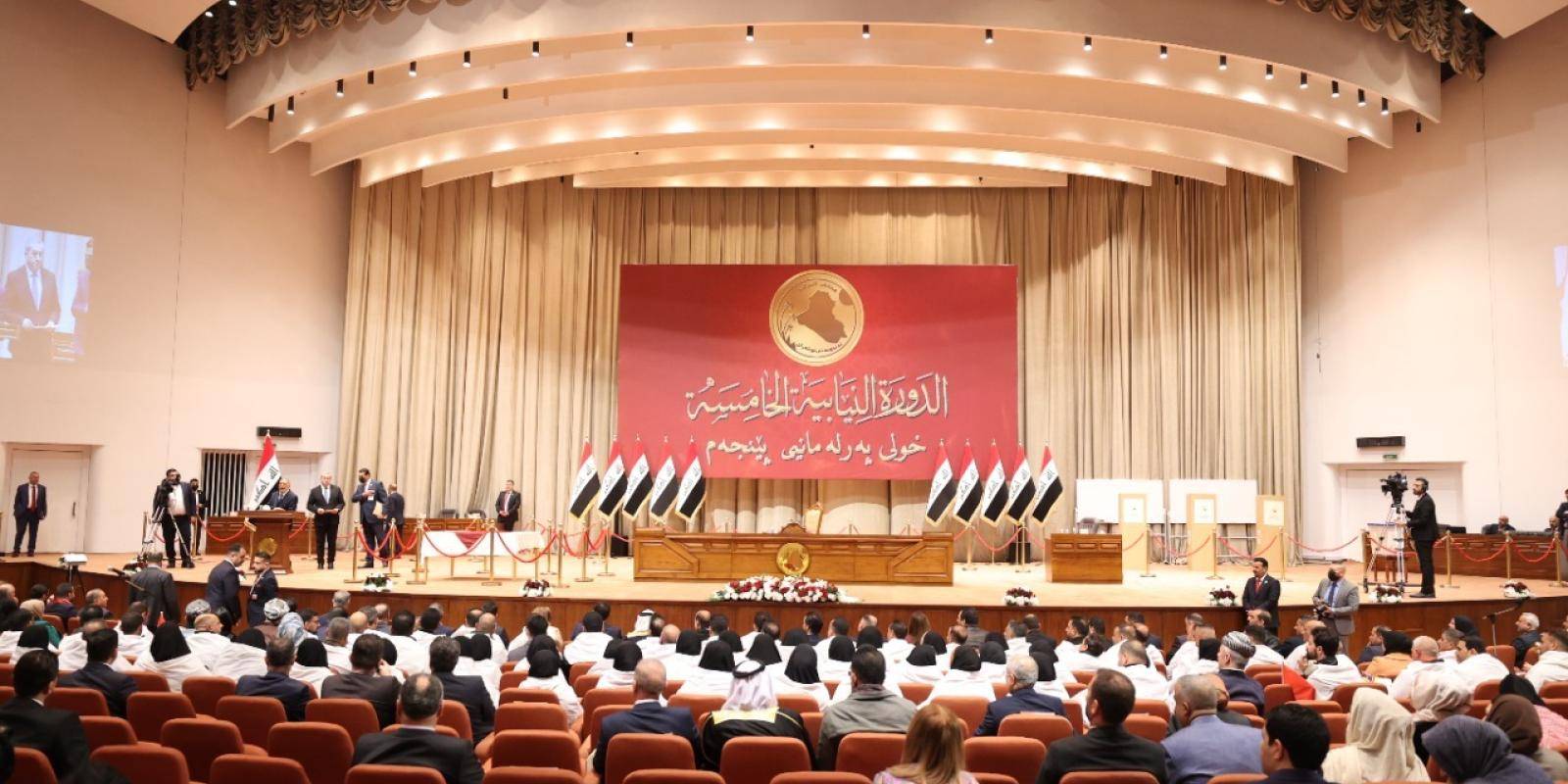
Iraq’s Council of Representatives successfully elected Speaker Haibat al-Halbousi and two deputies following dramatic negotiations, opening the constitutional path for presidential nominations. The Patriotic Union of Kurdistan played a crucial role in breaking the deadlock over the second deputy speaker position.
Historic Opening Session Convenes
The sixth parliamentary term opened on December 29 with 309 of 329 elected members present at the parliament building in Baghdad’s heavily fortified Green Zone. The session, mandated by Article 55 of Iraq’s constitution, began under the chairmanship of Amer al-Fayez, the oldest serving parliamentarian and head of the Shiite Tasmim Alliance. Following Quranic recitation and the swearing-in ceremony conducted in both Arabic and Kurdish, lawmakers embarked on the critical task of electing the speaker and two deputies—positions that reflect Iraq’s delicate ethno-sectarian power-sharing arrangement.
The inaugural session carried particular significance following the November 11 elections, which produced a fragmented parliament with no single bloc commanding a decisive majority. The successful completion of leadership elections, despite initial setbacks, offered hope that Iraq might avoid the prolonged political paralysis that has plagued previous government formation efforts.
Al-Halbousi Secures Speaker Position
In a decisive first-round vote, Haibat al-Halbousi of the Taqaddum (Progress) Party secured the speaker’s position with 208 votes out of 309 parliamentarians present. His nearest competitor, Salem al-Essawi, received 66 votes, while Amer Abdul Jabbar garnered nine votes. Twenty-six ballots were ruled invalid, and 20 legislators did not attend.
The 45-year-old political scientist from Anbar province brought considerable parliamentary experience to the role, having served three consecutive terms since 2018. His victory was facilitated by Muthanna al-Samarrai of the Azm Alliance withdrawing his candidacy to consolidate Sunni support behind al-Halbousi, who had been nominated by the National Political Council comprising most major Sunni blocs.
In his acceptance speech, al-Halbousi pledged to uphold the constitution, promote national stability, and prioritize Iraq’s sovereignty. The speaker’s position, traditionally reserved for Sunni Arabs under Iraq’s post-2003 power-sharing formula, carries significant responsibility for maintaining legislative order and building consensus across Iraq’s fractious political landscape.
Fayhan Elected First Deputy Speaker
Following the speaker’s election, lawmakers proceeded to select the first deputy speaker, a position traditionally held by a Shiite representative. Adnan Fayhan, the governor of Babil province and member of the Asaib Ahl al-Haq movement, won with 177 votes, defeating incumbent deputy speaker Muhsin al-Mandalawi, who received 107 votes. Twenty-two ballots were deemed invalid.
Fayhan’s election signaled the continued influence of Iran-backed Shiite factions within Iraq’s Coordination Framework, the largest parliamentary bloc. As a member of Asaib Ahl al-Haq—a U.S.-sanctioned, Iran-aligned group with an armed wing—his selection reflects Iraq’s ongoing balancing act between American and Iranian interests. The first deputy speaker position strengthens the Coordination Framework’s control over parliamentary operations and legislative priorities.
Dramatic Resolution of Second Deputy Speaker Contest
The election for second deputy speaker, constitutionally reserved for a Kurdish representative, evolved into the session’s most dramatic episode, requiring three rounds of voting over two days. The initial contest on December 29 featured Rebwar Karim of the five-seat National Stance Movement (Halwest) against Shakhawan Abdullah of the 27-seat Kurdistan Democratic Party (KDP), who held the position in the previous parliament.
In a stunning upset, Karim led the first round with 153 votes to Abdullah’s 119. The second round, extending past midnight into December 30, saw Karim increase his advantage to 156 votes compared to Abdullah’s 102, with 22 invalid ballots. Neither candidate achieved the required absolute majority of 165 votes, forcing Speaker al-Halbousi to adjourn for consultations with political blocs.
The tactical substitution proved immediately effective. In the third round of voting on December 30, Atroshi achieved a commanding victory with 176 votes compared to Karim’s 93, with 13 ballots ruled invalid. The dramatic reversal—transforming a 54-vote deficit into an 83-vote victory—demonstrated the KDP’s ability to consolidate Kurdish and allied Arab support when presented with a fresh candidate. The decisive outcome suggested that behind-the-scenes negotiations had successfully realigned voting blocs.
PUK’s Pivotal Role and Bafel Talabani’s Diplomatic Engagement
Patriotic Union of Kurdistan (PUK), led by Bafel Jalal Talabani, emerged as the kingmaker in the parliamentary leadership elections. Rather than fielding its own candidate for second deputy speaker, the PUK strategically positioned itself to influence the outcome while preserving its political capital for the upcoming presidential election.
Dilan Ghafoor, a PUK parliamentarian, confirmed to local media that the party voted for Atroshi in the final round, effectively ensuring his victory. This shift indicated that political understandings had been reached between the rival Kurdish parties, likely involving mutual support arrangements for the presidential contest and agreements on Kurdistan Region issues.
Bafel Talabani demonstrated diplomatic acumen by issuing congratulatory messages to all three elected leaders. To Speaker al-Halbousi, Talabani expressed hope that the new leadership would “work as a team to strengthen the relationship between the judiciary, legislative, and executive branches and unite efforts to resolve issues between the Kurdistan Region and Iraq on the basis of the constitution and partnership.”
To First Deputy Speaker Adnan Fayhan, Talabani emphasized the PUK’s commitment to cooperation, stating the party would be “keen to cooperate and assist in promoting the spirit of brotherhood and joint work, in order to serve citizens and strengthen the legislative authority and commitment to the constitution, in order to overcome obstacles and preserve stability in the country.” He also congratulated Farhad Atrooshi as the second deputy of Speaker of Iraqi Council of Representatives.
Presidential Nomination Window Opens
With the completion of parliamentary leadership elections, the constitutional timeline for government formation has officially begun. According to Iraq’s constitution, parliament must elect a president within 30 days of its first session, effectively opening a nomination window starting December 30. Candidates have three days to submit their nominations for the presidency.
The president, who must be Kurdish and receive a two-thirds parliamentary majority (220 votes), will then have 15 days to nominate a prime minister from the largest parliamentary bloc. The prime minister-designate subsequently has 30 days to form a cabinet and present it to parliament for a confidence vote.