

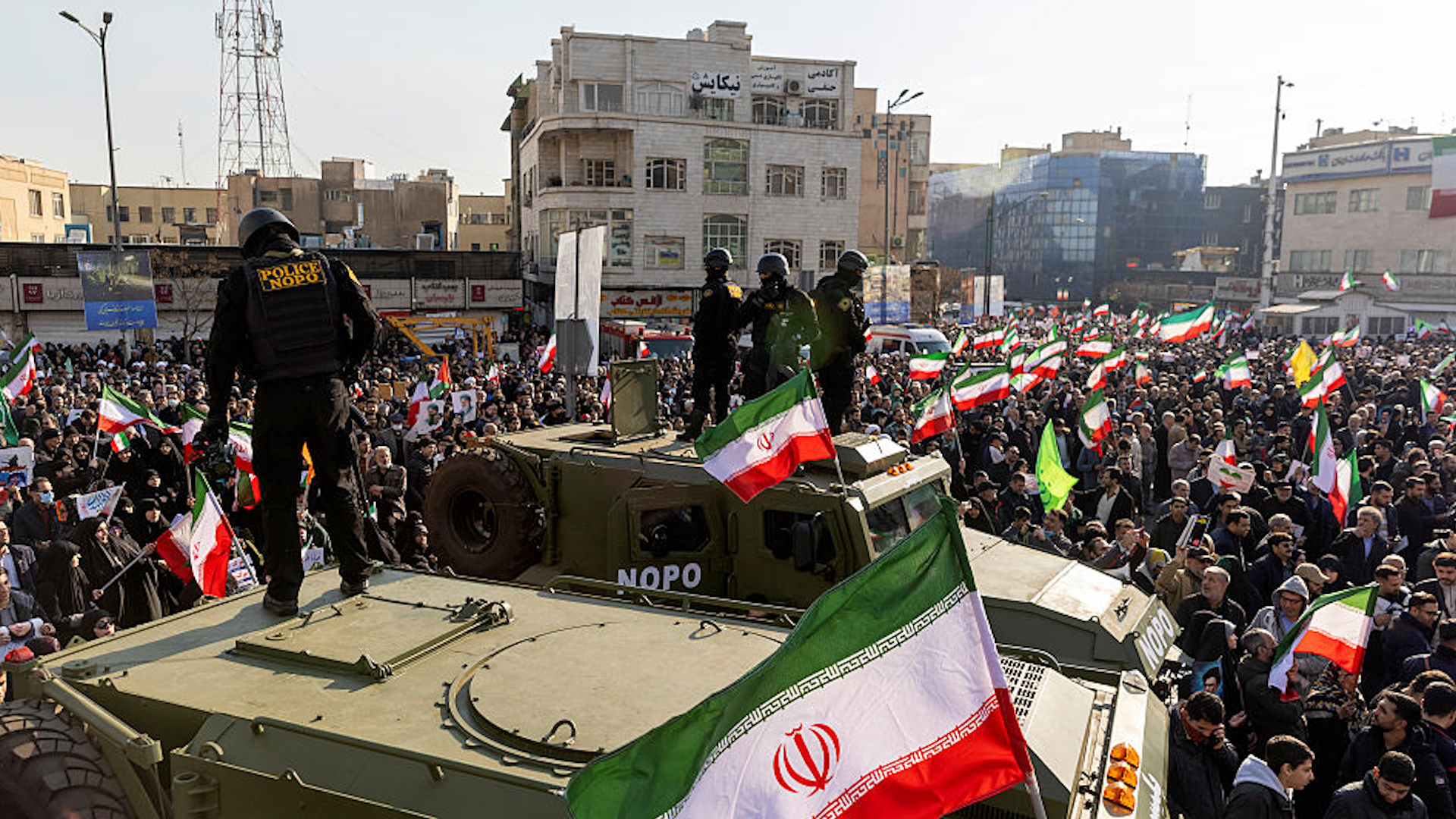
Why Has Iran Reached This State?
If we take a panoramic view of the history of mass protest movements in the Islamic Republic of Iran, it becomes clear that what is currently happening in Iranian cities represents a revolutionary situation and the beginning of fundamental change in that country. Previous discontent can be termed demonstrations, gatherings, boycotts, and strikes, or semi-reformist movements and attempts at partial change. However, now Iran and its nations and weary and discontented citizens have, in one way or another, nothing left to lose in terms of economic conditions, livelihood, and freedoms. As non-Persian components (Kurds, Arabs, and Baloch), they have been dissatisfied with the entirety of Iran’s politics throughout modern history until now, and from armed struggle to pen and keyboard, they have consistently expressed their discontent. Now, alongside the dissatisfaction of the majority Persian cities and their conditions, their wounds have been reopened once again, and a new dimension has been added to their struggle for rights, humanity, and their national identity.
To understand Iran’s situation, it is important to consider the main questions facing contemporary Iran, because from the answers to these questions, we can derive conclusive responses. These may be the questions that bring us closer to understanding this situation: Will this wave of discontent, like others, be suppressed? Will it, like the Jina movement, force or impose further involuntary changes on the government? What kind of relationship does this momentum establish with the armed and political dissident movements inside Iran, and will it move from a scattered movement to the stage of meaning-making and theorization and street consensus against power? Will it reach the stage of unity, a unified field, and create serious suffocation for the system? What are the scenarios, and in the possibilities of survival, semi-survival, the opposition’s seizure of power by Pahlavi or Mujahedin and others, what scenario awaits Eastern Kurdistan and Iran? Is this new movement revolutionary, or which of the Islamic Republic and the wave of international politics will be suffocated, and in whose favor is the situation? In the event of a strike on Iran (America-Israel) and the continuation of demonstrations, does Iran have the necessary survival and defense cards for war and confrontation?
Arranging these questions here is not so much for answering them as for helping to create a framework and window for observation. However, in light of them, a new general understanding can be presented here:
For a good answer, we can examine Iran’s capabilities and current situation from the perspective of discourse and ideology and belief, political crises, the positions and treatment of countries, dissatisfied people, and opposition forces:
An Exhausted Discourse and a Weary Sect in the Arena of Confrontation
For religious and ideological systems like Iran, discourse and the ability to create conviction and the belief of citizens—at least the elite who believe in the system and its structure—are important. The advocates and theorists of support for the Islamic Revolution of Iran believe that this state and institution that Imami Shi’ism has produced in Iran since 1979 is at least the product of four religious-sectarian and semi-sectarian movements (although this is merely a claim intended to root the Islamicization of the 1979 revolution of Iran’s nations and is difficult to prove, but let us assume it so and examine their discourse and street once more by their own standards). These four movements were not very successful in seizing the state and were not long-lived: the Tobacco Movement (tobacco) prohibiting the granting of concessions to Britain at the end of the nineteenth century, which was anti-colonial hegemony; the Constitutional Movement of 1905 to establish a constitutional monarchical government; the anti-British movement and ending its hegemony in the early 1950s; and the fourth and final movement was Ruhollah Khomeini’s movement against the White Coup and the democratic, agricultural, and land reforms of Mohammad Reza Shah in the 1960s.[i]
If these four are the foundation of the revolution and the discourse of the Islamic Republic of Iran, now this very republic has lost that position, because the goal of these movements was anti-colonial, self-governance, and popular participation. However, statistics, movements, and political indicators give us the opposite signal. As for external hegemony, Russia and China have far greater hegemony than Britain once had in Iran. As for the former desire of the people who cooperated with the movements to expel foreigners, now according to polls inside Iran itself, the majority of citizens are not only not followers of the republic’s discourse and movement, but their demand from states like Britain, Israel, and the West is to go after them and help them end this 46-year-old republic.
Therefore, that discourse and belief (which is Imami Shi’ism, Wilayat al-Faqih, and export of the revolution)[ii] has now been shaken, and economic crises and disgust with religion and turning away from the sect present detailed and rebellious signals that this discourse cannot be bread for a Shi’ite child, cannot represent the call for Ali’s justice as religion, and could not bring that prosperity to the people as promised by the Guardian Jurist and the revolution’s first leader, Ayatollah Khomeini. Now there is a republic that cannot be responsive not only to Kurds, Baloch, and Arabs, but has also failed Persians and Shi’ites inside Iran, and until now it has been good only for Shi’ites and loyalists outside itself, and only they remain with it.
Here, we present several discontent movements and demonstrations that have risen against the revolution and its excess, from the revolutionaries themselves, which are signs of the discourse crisis and the anger of the sectarian loyalists within the revolution itself: such as the discontent of the nineties, including: the poor and destitute of Mashhad in 1993, discontent against administrative divisions in Qazvin in 1994, discontent against poor living conditions in Islamshahr in 1995, discontent of Tehran University students against the closure of the pro-presidential newspaper in 1999 by the Revolutionary Clerical Court. The 2009 demonstrations of the Khatami, Mousavi, and Karroubi wing within the revolution against the power and its discourse. These were a handful of those demonstrations conducted against the economic, political, and religious discourse of the Islamic Republic[iii], which later became more widespread, and since 2018 there has been hardly a month without professional, occupational, or mass demonstrations by the middle and lower classes, existing as a continuous chain of discontent until it reached “Woman, Life, Freedom” and now.
Crisis Management Politics and Solving Crises Through Crisis-Making
Over the past thirty years, Iran has faced several fundamental crises. The state’s main problem was that instead of solving crises, it managed them and prolonged them. It happened that it solved crises with new crises, even encouraging more opposition among the revolutionaries themselves. For example, when the economic and living conditions of the people and the discontent of the revolutionary lower classes themselves caused a wave of destitute and poor loyalists among the Hezbollahis to manifest themselves at the peak of populism with slogans against the aristocracy, against family pretension, and profiteering with religion by the revolution’s leaders, and this very wave in the elections (with the support of the Islamic Republic’s Supreme Leadership) made Ahmadinejad president for two terms[iv]. However, not only did it not reduce the crisis of the rift between the people and the lower class and the power leaders and the state’s family class, but it expanded it and created another crisis in foreign policy, finance, and unrealistic, more high-flying and ambitious state discourse.
When the economic and living conditions of the people worsened and demonstrations occurred, by stirring up the issue of Kurdish, Baloch, and Arab separatism, they would make accusations, and in this they succeeded in confusing the Persian people and making them retreat from their anger, because of the survival of an Iran that fundamentally was not built on the basis of the voluntary unity of its internal components, but on an imposed discourse. Or when people like Mousavi, Khatami, and Rafsanjani would disagree internally and express discontent, it would solve it with its foreign policy crisis and dismiss it as Israeli, British, and American sedition and conspiracy. When the issue of hijab and women’s freedom came forward, which is an issue for all components, it ended with a terrorist scenario and tarnishing Iran’s external image, and instead of fundamental and constitutional solutions, it would deter Iran’s people with terror and intimidation, which planted new hatred. When a mass demonstration like that of 2018 and Jina’s 2022 occurred, instead of fundamental reform, it would incite pro-Iranians abroad to protect the republic by the exhausted discourse of destroying other countries and forcing foreign countries not to support the people inside Iran and its nations. For this, the state gave the people’s resources and money, instead of solving a crisis, to loyalists in Iraq, Afghanistan, Yemen, Lebanon, Syria, and Palestine to protect Iran, which created several new crises for the system.
When in foreign policy, instead of “positive neutrality,” it chose “negative non-alignment” and rose against the West and America, and instead of making peace, it thought that if it took the path of developing nuclear and missile atomic capabilities, it would force the world to bring it to its table. But on the contrary, since 2001 this too became an addition to other crises and further marginalized Iran’s foreign policy and relations. When sanctions were imposed on it because of the atom, by arming the armed groups of third world and Islamic countries, it created exhaustion and unrest, and to help them it produced long-range missiles.
All these steps that were initially presented as solutions all became the burden of another crisis, and the state, as always, failed in all of them and became cards of more pressure on it and became fuel for people’s discontent. Now Iran not only has a financial crisis, but other crises remain for it: diplomacy and relations, loss of proxies, military defeat and smart technology, the country’s currency, the atom issue, missile suspension, sanctions, abandonment of proxies, political and economic relationship problems, human rights issues and political participation… and so on. It must abandon all of these! Can it? Undoubtedly no, because abandoning these means the end of power and discourse and turning its back on its masses.[v]
All these crisis-making steps were arranged within a constitutional and discursive framework of exporting the revolution and presented itself as the father of the poor and oppressed of the world, and Ruhollah Khomeini at the Feyziyeh School gathering in February 1979, as the revolution’s leader, promised many times to the poor and citizens of Iran and the poor that their lives must be prosperous and they should not be satisfied with less![vi] However, now it cannot satisfy its own compatriots, and both the middle and lower classes and all non-Persian components are dissatisfied, and regional and Western countries are similarly not aligned with it.
Now, after failure in discourse, its promises and slogans of prosperity have changed to saying that if this system falls, then Iraq-ification and Syria-ification of Iran will be your fate, while it brought both those countries to that state through its proxies.
Toward Revolution
The situation of revolution always appears unclear and difficult; predicting a revolution itself contains a kind of difficulty and is not easy. This is true not only for Iran but for many revolutions and movements in the world. For example, when the Russian Tsar abdicated the throne in 1917 under popular pressure, Lenin, Trotsky, and Bukharin themselves were outside the country, and Lenin was in Zurich. That day he told his wife (Krupskaya): “It’s amazing, I simply cannot believe it,” while Lenin himself was the leader of the 1917 revolution! (Lenin: A Revolutionary Life, by Robert Service, translated by Bijan Ashtari, Thaleth Publishing, p. 327)[vii]. This is true not only for Lenin, but even more so for Napoleon, who was not a specific participant in the French Revolution, but after he returned from Egypt and left France’s occupiers and returned to Paris, he made himself the king of the revolution.
However, the very suddenness of a revolution itself is a kind of possibility and suspicion and awareness of the revolutionary situation that brings it closer, especially after the foundations of piecemeal but serial and successive anger emerge and are suppressed. Then the different perspectives of discontent, no matter how far apart, are united by one goal: rejection of the current situation. In 1979, what brought together the opposition of left and right, Islamic and secular, Persian and non-Persian, was the very policies of the Shah of Iran (Mohammad Reza Pahlavi) which, as a focal point, united all incompatible enemies with one goal: only the overthrow of that power itself was success. So it was until the last days of February, it was thought the Shah would not fall.
After the widespread Jina movement (Woman, Life, Freedom) until now, whether by the silence and cries of the street, by hand-washing and the government’s hardening against individual freedoms and human rights, or by Israel’s 12-day bombardment of Iran, the Iranian people through this movement, which many call the Jina Revolution[viii], experienced fundamental change in their own perspective and giving meaning to the movement and their own capabilities, saw an unwritten compromise and great withdrawal from the leaders and institutions and the weakening of the Islamic Republic. The Jina movement created profound change in the mentality and behavior of citizens on the one hand and in the power itself: should it return and complete the compromise, or continue the path of suppression?
The Iranian people after Jina and now are seeking to give meaning to the concepts of discontent and demands and their future visions, moving toward greater unity and self-organization, beyond the voices of parties, blocs, and assemblies that are the upper society’s leaders and the classical opposition leaders. If we consider the polls inside Iran, the movement and chain of demonstrations and discontent, the continuous migration of leaving that country, the self-criticisms of Islamic Republic leaders about themselves, and the new movement of political opposition and identity-seeking forces such as Kurds, Baloch, and Arabs over the past two years, we know that the Islamic Republic has lost the discourse of survival in the political arena, and even if there is no discontent and it is not struck from outside, the discourse itself has for years lacked the ability to respond to crises, and what it has is geography, resources, state institutions, a loyal army, and non-Iranian supporters. Can these defend the Islamic Republic?
Now more than ever, the goals of the demonstrators and the interests of America (political, commercial, and economic) and Israel’s strategy (preventing any central state in the Middle East) and the interests of regional actors such as (Iraq and the Kurdistan Region, the Gulf, Turkey, Syria, Lebanon, Jordan) are close. It is not necessary that all are with the overthrow, but all are with further weakening of Iran. If these factors are considered, then we understand that in the event of continued demonstrations and simultaneous external bombardment of the government and attacks on Iran, the situation finds itself before three scenarios:
The Iraqi scenario of 1991 and the semi-paralysis of the Islamic Republic and the revival of components to create national de facto entities and then constitutionalizing them in a future phase and moving toward decentralization.
The coup scenario: This would be dangerous for nations like Kurds, Baloch, and Arabs, and it is not unlikely that an alliance of pan-Iranists, reformists, and royal monarchists will come forward, and once again the same marginalization of components will be repeated, and they must endure another fifty years under oppression.
Total chaos and the complete fall of the regime and the re-creation of de facto entities unconnected to the centre, like the twenties and forties…
For each of these scenarios, there can be other sub-scenarios with details and complexities, and here is not the time to discuss them.