
Exactly 93 days after Bashar al-Assad’s nighttime escape and the fall of Damascus, one of the oldest knots in Syria’s contemporary political history—between the Kurds and the central government—is unraveling! This agreement has doubled the breeze of hope and raises serious questions:
Is the agreement between the Kurds and Syria’s new government another critical step toward establishing a new order in the Middle East? A new order whose foundations were laid after Hamas’ October 7, 2023, attack on Israel, resulting in the weakening and defeat of the so-called “Resistance Front” and Iran’s allies in Palestine, Lebanon, and Syria.
A Sudden Agreement Amidst Flames of Conflict
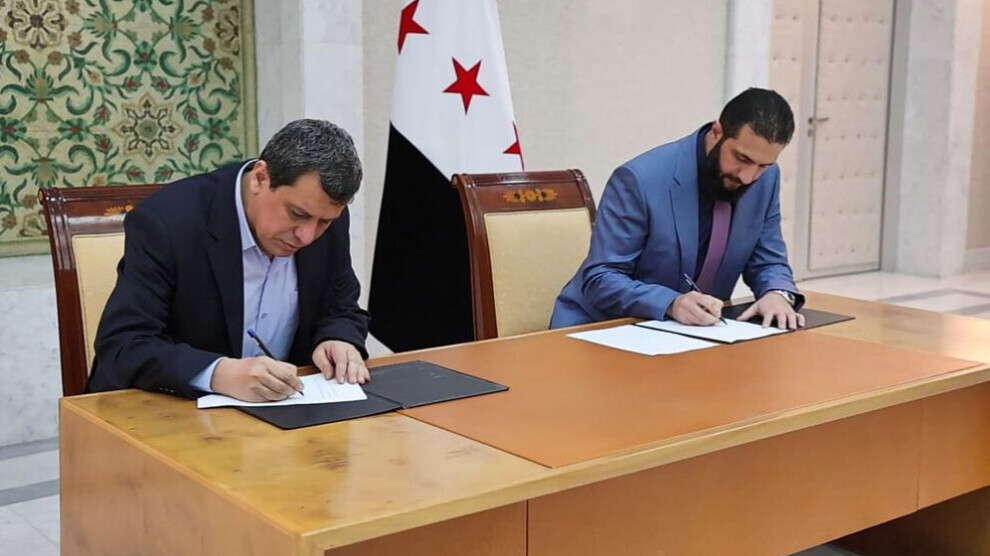
While Syrians, like the international community, were deeply concerned about escalating clashes in western Syria between Alawites and Bashar al-Assad loyalists on one side and the new central government forces on the other—and while reports hinted at clashes in the Kurdish neighborhood of Sheikh Maqsoud in Aleppo—suddenly, images emerged of Ahmad al-Shara and SDF Commander Mazlum Abdi signing an agreement and shaking hands. The news and images have since become the Middle East’s top story.
Terms of the Agreement
Though the official text has not been released, reports from media outlets close to both sides suggest the agreement includes at least eight clauses:
1. Emphasizing the right of all Syrians to participate in the country’s political processes.
2. Affirming Kurds as an indigenous community of Syria, with the government guaranteeing their citizenship and full legal rights—contrary to previous regimes.
3. Declaring and implementing a nationwide ceasefire.
4. Integrating all Kurdish-affiliated civil and military institutions in northern and eastern Syria into the state structure, including border crossings, airports, and oil and gas fields.
5. Ensuring the return of all Syrian displaced persons to their cities and villages, with guarantees of safety and security by the government.
6. Kurdish support for the Syrian government in combating remnants of the Assad regime and all threats to national security and unity.
7. Opposing national division, hate speech, and preventing discord among Syria’s political and identity-based groups.
8. Forming executive and technical committees to implement the agreement’s clauses by the end of 2025.
Key Players in the Agreement
Regionally, Turkey appears to have played a significant role in facilitating this agreement, which complements the ongoing reconciliation process between Ankara and the PKK. Internationally, the United States and France have been key supporters of both the Kurds and Syria’s recent changes. These nations have mediated tensions between Turkey and Syrian Kurdish forces. General Kobani’s arrival in Damascus via an American helicopter, coupled with U.S. security guarantees, signals the new Trump administration’s clear policy toward Syria.
The Path Ahead
While it is too early to adopt an optimistic view of Syria’s future or the Kurds’ role—especially given recent clashes in western Syria—the emerging regional dynamics and nascent order tilt the odds toward success rather than failure. However, the agreement’s viability hinges on two factors: the success of reconciliation efforts between Erdogan and Öcalan in Turkey, and the new Syrian leadership’s ability to govern effectively and establish a fresh political framework in the Levant.