

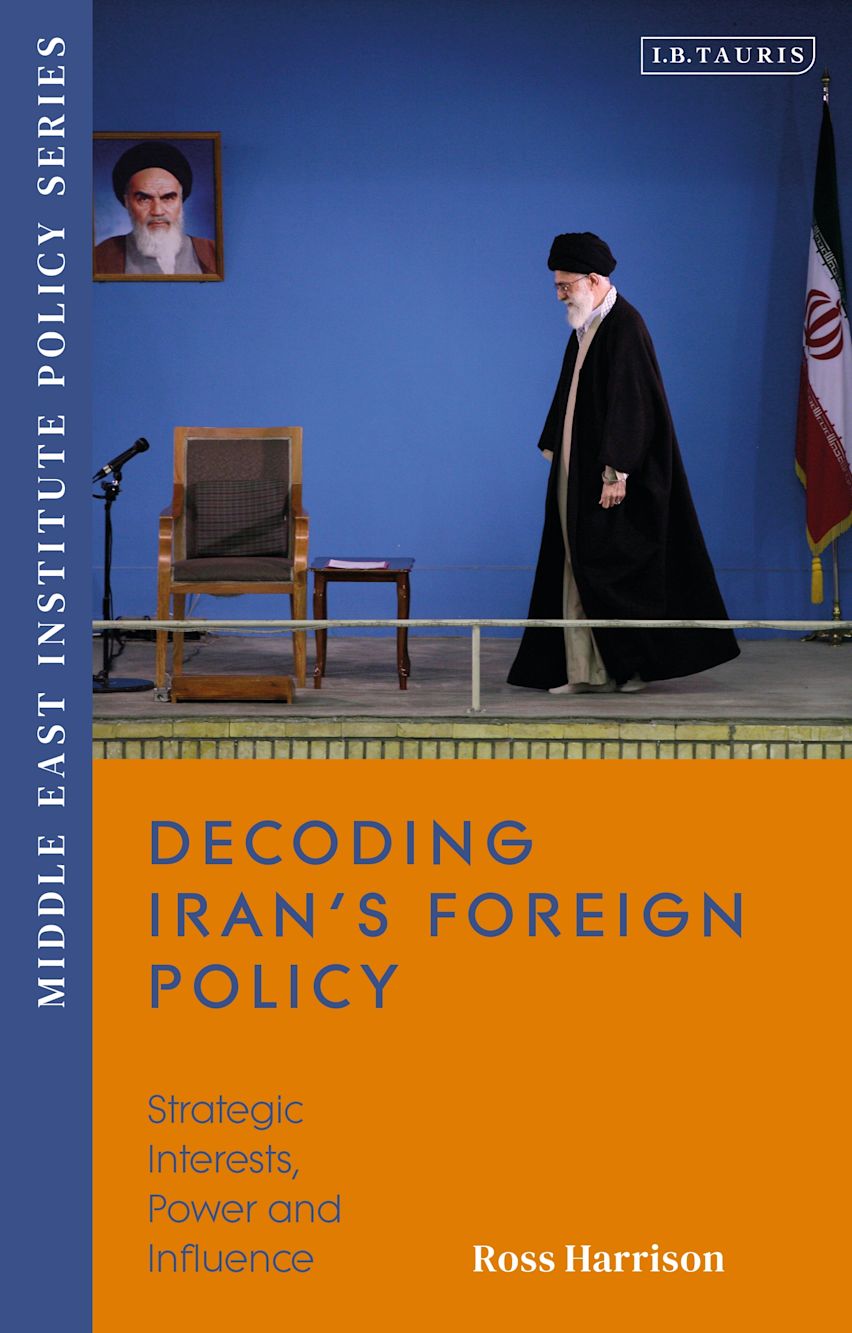
Aram Mahmoud Ahmad
This book, written by Ross Harrison and published in 2025, is fundamentally an attempt to analyze the foundations of the Islamic Republic of Iran’s foreign policy. The author seeks to answer this central question: Which forces, ideologies, and interests direct Iran’s behavior and decisions on the international stage?
The book endeavors to shed light on the fact that Iran’s foreign policy is not merely a reaction to events, but rather a complex system of strategic interests, domestic power dynamics, and regional influences.
The author has divided the book into several sections, which are examined here section by section.
Part One: Theoretical Framework and Iran’s Worldview
1.1. Interests Above Ideology
Ross Harrison begins his book by rejecting common interpretations of Iran’s foreign policy, which often view it solely through the framework of “revolutionary Shiite ideology.” He proposes a more accurate theoretical framework: Iran fundamentally behaves as a nation-state, with decisions based on classic strategic interests and the requirements of regime survival. Although ideology plays a role, it is primarily used as a legitimizer and tool for mobilizing the masses, rather than as the primary decision-maker.
Harrison’s main theses are that Iran’s foreign policy is remarkably close to the model of Offensive Realism, particularly in its efforts to achieve Regional Hegemony in the Gulf and the Middle East. He divides Iranian policy into three security axes: regime security (first priority), national interests (economic and military), and long-term regional objectives.
Iran’s Worldview: The Victim State
Harrison meticulously examines Iran’s worldview, which makes it feel constantly threatened. This worldview stems from several roots. First is the history of external intervention and British and Russian colonialism, followed by the 1953 coup (executed with American support), which created a deep sense of distrust toward great powers among Iranian leadership. Second, the eight-year Iran-Iraq War and the support of the Arab world and the West for Saddam Hussein led them to believe they have no sincere and permanent allies except themselves. Furthermore, Iran continuously feels marginalized by the international system and deprived of its rights, particularly by the United Nations Security Council and international organizations. This suspicious worldview leads to the development of an “asymmetric defense strategy,” and for self-protection, it relies on ballistic missile development, its nuclear program, and the use of proxies.
1.3. The Role of Ideology: Islamic Revolution and Strategic Depth
Ideology, particularly the principle of Velayat-e Faqih, functions as a structure through which strategic decisions are made. Harrison states, “Ideology is a powerful tool for establishing a network of allies (most of whom are Shiites in Iraq, Syria, Lebanon, and Yemen) who serve as strategic depth for Iran.”
In other words, exporting the revolution is as much a religious objective as it is a geopolitical goal for creating a protected zone around Iran’s borders.
Part Two: The Decision-Making Structure and Domestic Influences
2.1. Decision-Making
Iran’s foreign policy is managed by a centralized and complex authority, and Harrison categorizes its structure into: 1) The Supreme Leader (Ali Khamenei), who is the final decision-maker and unifier of foreign and national security policy. His decisions are primarily framed within protecting the system and implementing the revolutionary vision. 2) The Islamic Revolutionary Guard Corps (IRGC), which is the main institution for implementing Iran’s foreign policy, particularly through the Qods Force. Beyond its security role, the IRGC plays a major role in determining regional strategies, managing proxies, and the missile program. 3) The Ministry of Foreign Affairs and Government, where the Ministry of Foreign Affairs primarily handles soft diplomacy and managing official relations with countries and international organizations. Harrison emphasizes that the government often does not make the final decision on strategic issues (such as the nuclear issue or regional policy).
2.2. Internal Conflicts and Their Impact on Foreign Policy
The most important axis of this section is the discussion of the perpetual conflict between two main wings within Iran’s system: the hardline wing (the IRGC and the Leader), which believes that any negotiation with the West (especially America) is futile and that Iran must rely on internal strength and defense. The moderate/reformist wing (some presidents and the Ministry of Foreign Affairs) believes it is better to lift sanctions and normalize economic relations with the world through negotiation and limited compromise.
The author believes this internal discord (which was clearly evident during Rouhani’s era and the nuclear agreement negotiations) has made Iran’s foreign policy dual-sided: advanced diplomacy represented by the Ministry of Foreign Affairs seeking to operate according to international law, and a covert side represented by the Qods Force and the IRGC conducting regional intervention policy. The existence of these two opposing wings has made it difficult for Iran’s allies and enemies to predict Tehran’s behavior.
3.2. Economic Influence
Harrison emphasizes the impact that the economy has on Iran’s foreign decisions. Severe sanctions have forced Iran to develop a resistance economy, in which external relations are increasingly developed with countries like China and Russia to reduce dependence on oil and the West. This economic necessity was a major driver for the 2015 nuclear agreement, and the collapse of the agreement caused Tehran to turn more toward its regional strategies.
Part Three: Strategic Depth
1.3. The Objective of Regional Hegemony and Proxy Policy
The most important section of Harrison’s book is his examination of the strategy that Iran employs to achieve dominance in the region. He calls this strategy “strategic depth,” meaning the creation of a chain of defensive and pressure points across the Middle East to defend against direct attacks on Iran and threaten the interests of main competitors (Israel and Saudi Arabia), as well as consolidating its position as one of the main regional decision-makers.
2.3. Iran and Lebanon: Hezbollah as a Model of Success
Hezbollah is viewed as the successful model of Iran’s regional strategy. Hezbollah derives legitimacy from the principles of Velayat-e Faqih, which creates deep loyalty, and through extensive financial, weapons, and training assistance, Iran has made Hezbollah a major political and military force in Lebanon, which it uses as a pressure card against America and Israel and allows Iran to create influence on Israel’s borders without direct involvement.
3.3. Iraq: The Arena of Conflict and Influence
The American invasion of Iraq in 2003, from Harrison’s perspective, was the greatest gift to Iran, leading to the overthrow of Saddam Hussein, Iran’s staunch enemy, and the creation of a compatible political system in which Iran, by supporting Shiite parties and militias (such as the Popular Mobilization Forces), was able to establish deep influence over Iraq’s political process. On the other hand, Iraq became a main route for delivering weapons and assistance to Syria and Lebanon (the Tehran-Baghdad-Damascus-Beirut land route).
The author discusses how Iran operates a shadow power system in Iraq, in which its proxies (the militias) have more power than the government.
3.4. Syria: Defending Core Alliances
The Syrian civil war allowed Iran to protect its strategic alliance with the Assad regime, which actually began in the 1980s. Assad and Syria served as the main gateway for delivering assistance to Hezbollah (until Assad’s fall). The Syrian war was also the first major arena for direct military cooperation with Russia, which was important for Iran to gain an ally outside the region.
5.3. Yemen: The Houthis and Pressure on the Gulf
Iran’s support for the Houthis in Yemen is interpreted as a tactic, on one hand, to pressure Saudi Arabia—this is not merely a response to Saudi intervention in Yemen, but a mechanism for pressuring and limiting Saudi hegemony in the region. On the other hand, it is for controlling the maritime gateway, as Yemen is close to the Bab al-Mandab Strait, which has strategic importance for controlling maritime shipping routes.
Part Four: International Relations
1.4. Suspicion-Filled Relations with America
Iran’s most important and complex relationship is with America. Harrison presents Iran’s analytical framework for America as an “unchanging enemy” whose ultimate goal is to overthrow the regime. From Tehran’s perspective, all American policies, from economic sanctions to continued military presence in the region, have the ultimate goal of overthrowing the Islamic Republic. Therefore, Tehran is only ready to negotiate when it feels it is in a position of strength; otherwise, it views any negotiation as compromise and weakness.
Regarding the nuclear agreement, the 2015 agreement is interpreted as an example of temporary convergence on the interests of both sides (Iran had sanctions lifted, America controlled Iran’s nuclear program for a period), but Trump’s withdrawal from the agreement caused Tehran to have greater doubts about America’s honesty.
2.4. The Nuclear Program: For Defense or Offense?
The author indicates that Iran’s nuclear program is as much a strategic tool for defense as it is not for obtaining an atomic bomb, meaning to ensure that no force can easily launch a comprehensive military attack on Iran, and the program serves as a powerful pressure card at the negotiating table.
Here Harrison discusses how the program operates within the framework of Nuclear Latency, meaning Iran has the necessary capability to build the bomb, but does not make the political decision to build it, in order to protect itself from severe and direct military attack.
3.4. Alliance with Russia and China
In response to Western isolation, Iran has strategically strengthened its relations with Russia and China. This new alliance is based on shared interests, as both countries strongly oppose American hegemony in the world—a view shared with Iran. Additionally, China serves as the main buyer of Iranian oil and source of investment in economic infrastructure, while Russia serves as a military-technical partner and political supporter in the Security Council.
However, Harrison notes that these relationships are not comprehensive alliances. Russia and China have complex relationships with Iran’s rival countries (such as Saudi Arabia and Israel), which sets a limit to complete rapprochement between Iran and them.
4.4. Rivalry with Saudi Arabia and Israel
Iran faces regional rivalry from two main directions. First is Saudi Arabia (Sunni-Shiite and regional rivalry). The conflict between Tehran and Riyadh is fundamentally a classic regional conflict for dominance. Religious conflict is only used as legitimization for this geopolitical rivalry. This rivalry is directly visible in Iraq, Yemen, and Lebanon. Second is the security and nuclear rivalry with Israel as the greatest military and security threat to Iran. Iran’s strategy against Israel consists of ending with indirect sacrifice by using Hezbollah and Hamas, as well as developing nuclear defense to prevent Israeli attack.
Part Five: Conclusions and Proposed Solutions
1.5. Regional Changes and Iran’s Unchanging Policy
Harrison returns to his main thesis: although international and regional changes have occurred (such as the Arab Spring, ISIS’s rise, Russia’s emergence as a greater player), the foundations of Iran’s foreign policy have not changed.
Iran’s foreign policy is like a Multi-Headed Hydra: when great powers pressure Iran in one area (such as the nuclear program), Tehran produces another head in another area (such as intensifying regional influence in Syria or Yemen). Resolving only one issue (such as the nuclear issue) without resolving the regional issue only transfers the problem to another arena.
2.5. Approaches to Negotiating with Iran
The author proposes several solutions for Western and regional countries for dealing with Iran. First, rejecting Single-Issue Diplomacy: negotiations must be multi-faceted, encompassing both the nuclear issue and regional issues (ballistic missiles, proxy support). Second, it is necessary to acknowledge that Iran, like any other state, has legitimate security interests. This means that during negotiations, some security guarantees must be given to Iran to reduce Iran’s suspicions. The final point is using diplomatic and commercial tools as incentives for Tehran.
Harrison warns that the current Maximum Pressure strategy cannot overthrow the Iranian regime, but only makes Tehran more hardline and turns it toward the East (China and Russia).
The author emphasizes that great powers must acknowledge that their ability to completely change Iran’s behavior is limited; rather, soft pressure must be used, while the door remains open for diplomacy. This means that Iran must be limited economically, but a small space for international economic dealings should be left open. Additionally, allowing regional countries (such as Saudi Arabia and Turkey) to negotiate directly with Iran, without Western intervention. The author believes that achieving a Regional Settlement between Tehran and Riyadh is the key to reducing conflicts.
Conclusion
Harrison reaches the conclusion that to analyze Iran’s foreign policy, political realism must be placed above religious ideology. Iran is a country that feels constantly threatened, and all its strategies are for protecting the regime and gaining power in a world it views as incompatible. From this perspective, the only appropriate way to deal with Iran is to accept Iran’s existence as a regional power and begin comprehensive dialogue that encompasses all of Iran’s strategic issues.