

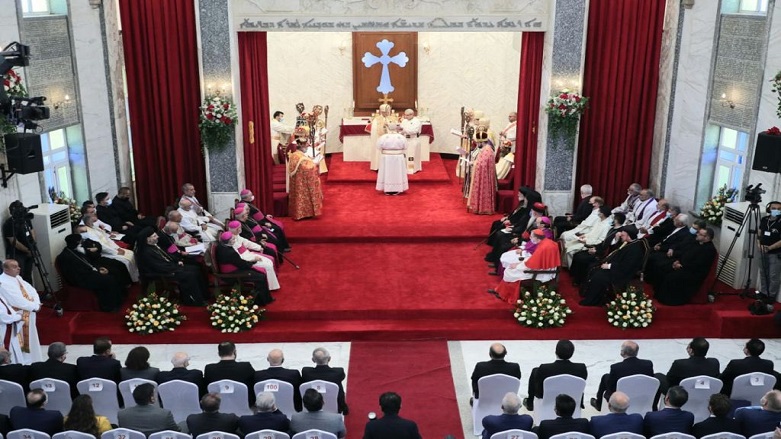
Historical Kurdistan has possessed a diverse nature in terms of religion, faith, and culture, and within these diversities, the Christian religion has held a distinct place. This Abrahamic religion, from the very beginning of its emergence and spread in the East, found its way to Kurdistan. In the regions where Kurds lived and were active, several Christian churches and monasteries were established, and prominent religious figures played a role in the development of this religion.
With the spread of Islam in Kurdish regions, Christianity entered a new phase characterized by coexistence and adaptation. This phase witnessed various rises and falls. This article provides several insights into the history of Christianity in Kurdistan and the various intersections of religion, culture, and politics from the first century CE through the medieval Islamic centuries in the Kurdish context.
The Christian Religion:
Christianity is one of the three great Abrahamic religions of the world, based on belief in the one and only God as the creator of the universe and belief that Jesus (the Messiah) came into being through the word and command of God, and was sent through his death and resurrection (al-Qiyāmah) to save humanity from evil. The primary and fundamental context for the emergence of Christianity in the first century CE was Palestine and the Jewish community, then it spread within the territorial scope of the Roman Empire, gradually becoming a global religion (McGrath, 2015, pp. 1–7).
Christian theology is based on three fundamental principles: God (the Father), the Son, and the Holy Spirit—this is called the doctrine of the “Trinity” (in Islam, this is viewed as disbelief). The fundamental text of this religion is the Holy Book: the “Old Testament,” which is shared with Judaism, and the “New Testament,” which contains the texts of the Gospels and the messages of early Christian messengers. The values of Christianity are based on several fundamental principles: love, forgiveness, justice, and compassion, which are emphasized in the teachings of the Gospel of Matthew (Hastings, 2000, pp. 120–125).
Over time, Christians became divided into several denominations, including:
The Catholic Church, whose center is in Rome and whose power base is the papacy.
The Eastern Orthodox Church, which preserves ancient traditional rituals.
The Protestant Church, which emerged in the 16th century with the religious reform movement and emphasizes the authority of the Holy Book and religious freedom (Fahlbusch, 2008, pp. 210–220).
The Emergence of Christianity in Kurdistan:
Christianity is evangelical and missionary in nature (tabshīr). In the Gospel, emphasis is placed on followers to teach all nations. Christ also commanded his disciples to guide all people (Gospel of Matthew 28:19; Gospel of Luke 9:1-6). Based on this principle, this religion spread at various rates throughout the world.
Regarding Kurdistan, the history of Christianity dates back to the first century CE and is connected to the work of “Mar Adai,” who was one of Christ’s disciples and students. It is believed that “Mar Adai,” on the instructions of one of Christ’s closest companions (Thomas), came to the city of Edessa (Ruha) in the Jazira region around 29 CE, and then to Adiabene (Hadyab), from there to present-day Kirkuk (Beth Garmai) and Sulaymaniyah (Atto, 2011: 125; Abuna, 1985: 15; Addi Sher, 1912: 2, 6). The aforementioned (Mar Adai), who was one of the first seventy disciples of Christ, reached Nisibis in his evangelical work, as well as areas around Erbil (Hadyab: Adiabene), present-day Kirkuk (Beth Karmai), and his followers reached Shahrizor (Addi Sher, 1912: 2; Sulayman, 1899: 1-2; Encyclopaedia of Islam, n.d.: 13: 420).
Among those who called for Christianity in the first century CE was someone named “Faqīdā” or “Baqīdā,” who became a bishop in Adiabene (Hadyab) (Addi Sher, 1913: 2/2-5). This signifies the establishment of the religion in these Kurdish-inhabited regions. It is believed that from Adiabene (present-day Erbil), Christianity spread to other regions (al-Khayoun, 2005: 147), such that by the second century CE, Christianity in the region had acquired standing, churches, missionary institutions, and prominent figures (see: Babo Ishaq, 1948: 7-8). From Erbil, Christian missionaries went to present-day Bahdinan (Abuna, 1985: 1/19).
Christianity is evangelical and missionary in nature (tabshīr). In the Gospel, emphasis is placed on followers to teach all nations. Christ also commanded his disciples to guide all people (Gospel of Matthew 28:19; Gospel of Luke 9:1-6). Based on this principle, this religion spread at various rates throughout the world.
The Composition and Origins of Kurdistan’s Christians:
The Christians of Kurdistan are diverse in both religious and ethnic terms, but those who have lived in Kurdistan for a long time are mostly known as “Nestorians” (Nisko, 2020: 16; Babo Ishaq, 1948: 16-19). Nestorianism is a Christian doctrine associated with the religious figure Nestorius (died: 451 CE), who was the Patriarch of Constantinople in the fifth century CE. The belief of this doctrine makes a distinction between two natures in Christ: the first being divine and the second human. They do not consider it proper to call the “Virgin Mary” the “Mother of God” on the grounds that she is the mother of Christ’s human nature. For this reason, they were condemned in 431 CE by the Ecumenical Council of Christians, which subsequently led to a schism in the Church. Nestorius’s supporters increasingly turned toward the borders of the Sassanian Persian Empire and became the core of what later became known as the “Church of the East” (Baum & Winkler, 2003, pp. 12–18).
The Nestorians separated from the Catholic Church and are accused of having tampered with the Gospel. Because of this, their teachings were prohibited, and they migrated to the regions between Rome and Persia in present-day Kurdistan (Abuna, 1985: 80; Atiya, 2005: 291-295). However, they were later known more as Assyrians (Ashuri) and Chaldeans. The story of their naming is the subject of much controversy, because some Christian researchers emphasize that the Christians of this region are Aramaic and Syriac, not Assyrian and Chaldean, and their evidence for this is ancient documents and manuscripts in various languages from the first century CE to modern history, all of which refer to them as Aramaic and Syriac. Accordingly, the Christians of Mesopotamia, both east and west of the Euphrates, are Syriacs, not Chaldeans and Assyrians, and their lineage goes back to the tribes of the Children of Israel who were transferred to Iraq, not the ancient inhabitants of Iraq (see Nisko, 2020: 16-20). Regarding the reason for this name change, accusations are directed at colonial and sectarian policies, particularly as the head of the English Church, through a delegation (1876 CE), persuaded these Christians to change their name to Assyrian to make their historical standing more recognized (see: Nisko, 2020: 19; Sykes, 2007: 30; Edmonds, 1971: 7).
Christian sources mention that the Christian community in Mesopotamia had long been encouraged by the Persians to adopt Nestorian beliefs. Because of this, their church was called Persian, and from the late fifth century CE (479 CE), they separated from the Christians of the West. However, from the sixteenth century onward, missionaries and religious groups encouraged them to change their names and find titles for themselves from the ancient civilizations of Iraq: those who became Catholic were called Chaldeans, and those who remained Nestorian became Assyrians (Nisko, 2020: 18). This change also affected Kurdistan, as it was part of the homeland of the spread of the Syriacs (see Nisko, 2020: 10).
Regarding their fundamental origins, there is one view that believes they are Kurds who became Christians (Mark Sykes, 2007: 30; Zand, 1971: 62; Zaki Beg, 1961: 121). Another view suggests that if not all of them, then some or the majority of them are Kurds (Yusuf, 2002: 2/252; Ahmad, 1984: 101-102), especially considering the deep historical relationship between the Christian churches of Kurdistan and the Kurds or Medes. In the sacred sources of Christians, the name of the Medes is mentioned, but there is no reference to Assyrians and Chaldeans (see: Nisko, 2020: 631-632). In Christian records, there is also evidence indicating that Kurdish people were taught by Christian missionaries and benefited from them (Anonymous, 2010: 2/87, 95).
In addition to the Nestorians, a proportion of Kurdistan’s Christians followed “Jacob Baradaeus” (originally from Nisibis), who had his own particular doctrine in Christianity and became Bishop of Constantinople in 542 CE. Their belief is that Christ has a dual nature consisting of two essences: one divine and the other human. This figure played a significant role in reorganizing the Syriac Orthodox Church and reviving it (see: Britannica, 2025; Atiya, 2005: 221). These Jacobites spread around Mosul (Marco Polo, 2002: 1/56) and during the medieval Islamic period were the majority in Diyarbakir (Murad, 2001: 350), but compared to the Nestorians, they were a minority (Babo Ishaq, 1948: 16), particularly as the Sassanians supported the Nestorians against the Romans (Segal, 1990: 255; Kamil and others, 1987: 1/).
The Christians of Kurdistan During the Islamic Conquests
The division of Kurdish regions between the two empires of Sassanid and Byzantine had cultural and political impacts on the population, as the Sassanid axis was the zone of influence and dominance of Zoroastrianism, while the Byzantine axis was that of Christianity (see: al-Ya’qubi, n.d.: 1/159). As for Byzantine Rome and its Christians, around 627 CE during the reign of “Heraclius,” they had taken control of the Jazira region (al-Dinawari, 1960: 107). It is natural and logical that from that time, Christian religion and beliefs developed in those areas, and this is somewhat evident in the construction of churches and Christian monuments and their survival through the Islamic period and later to the present day.
During the Islamic conquests in the grip of the Kurdish-inhabited Jazira region and northern Syria and Iraq, the Muslim attack began around 17-18 AH / 638-639 CE after the control of Syria and Egypt. The campaign was carried out by the direct order of Caliph ‘Umar ibn al-Khattab and under the leadership of ‘Iyad ibn Ghanm al-Ash’ari, with the participation of eight thousand soldiers (al-Waqidi, 1989: 2/89). In this vast expanse between the Tigris and Euphrates rivers, there were major Kurdish-inhabited cities, such as: Harran, Edessa (Ruha), Ra’s al-‘Ayn (Sari Kani), Nisibis, Sinjar (Shingal), Mardin, Amid (Diyarbakir), and Mosul (al-Hamawi, 1995: 2/134). From this direction, compared to the areas under Sassanid control and the mountainous region, the population resisted less; instead, they chose peace and agreements. In this context, historical information indicates that the people of “Jazira” agreed with ‘Iyad ibn Ghanm (d. 20 AH / 641 CE), who was one of the Companions, to pay “jizya” (poll tax) and “kharaj” (land tax). For this reason, it was said: Jazira came to terms more easily with the Muslim army than other places like Iraq, Syria, and Persia, agreeing to pay “jizya” and “kharaj” and not to fight the Muslim army (al-Hamawi, 1995: 2/135).
The fundamental and clear example of the “jizya” and “kharaj” agreements in exchange for remaining on their previous religion, which was mostly Christianity, began in the city of “Edessa” (Ruha). According to historical accounts, the people of this city provided food, clothing, and provisions to defend the walls of “Edessa,” but when they heard the takbir (Allahu Akbar) and tahlil (La ilaha illa Allah) from the Muslim army, they became frightened and believed there were about twenty thousand of them. After nearly two weeks of resistance and self-defense, the Christian patriarch of the city (Mītūs) ordered negotiations with the invading army to reach an agreement similar to the city of Raqqa. Accordingly, ‘Iyad ibn Ghanm entered into dialogue with them and wrote them a letter (al-Kufi, n.d.: 252). The text of ‘Iyad ibn Ghanm’s letter to the people of “Edessa” (Ruha) guaranteed protection of: lives, property and children, women, the city, and even their churches, provided they “give what is due upon them, repair the walls, and show the way.” On this basis, “God, the angels, and the Muslims bear witness” (al-Baladhuri, 1988: 175).
According to the accounts, ‘Iyad ibn Ghanm in his campaigns went deep into the Kurdish interior regions and made the per capita agreement of “jizya” and “kharaj” for the city of “Edessa” (Ruha) the basis for dealing with the population, including: the people of “Samosata” near Malatya and present-day Muş, as well as “Saruj, Rās Kayfā, Tall Mawzan, Amid, Mayyāfāriqīn, the fortress of Kafartuta, Nisibis, the road to Zuzan, the highlands of Abdin, the fortress of Mardin, Dara, Karda (Jazirat Botan), Bazbdā, then he went to Bitlis and Ahlat until he reached the sulfur springs of the Armenian region, which was Kurdish-inhabited” (see: al-Baladhuri, 1988: 176, 184; Ibn al-Faqih, 1996: 179). In a city like Mayyāfāriqīn, the population had their patriarch of the city (Fatūs / Aslaghoros) negotiate an agreement for them with three thousand dinars in ready cash (al-Kufi, n.d.: 259).
Not all the campaigns in Jazira ended with agreements; there were also battles and resistance. For example, in “Ra’s al-‘Ayn” (Sari Kani), the population defended somewhat, closed the city gates, killed some Muslims, and fought fiercely. However, in the end, after their defeat, they submitted to the agreement and entered the process of tribute and taxation. The content of the agreement was that their lands were returned to them, protection of their women and children was guaranteed, and in return, a “jizya” of four dinars was imposed per person (al-Baladhuri, 1988: 177). After controlling the city, the Arab Muslims stayed in the city for a month, converted a Nestorian church and several other churches into mosques, and appointed someone named “‘Ajrafā ibn Māzin” as governor of Ra’s al-‘Ayn (al-Waqidi, 1997: 2/141).
Despite the battles, internal Christian correspondence indicates that the Arab Muslims respected their religion, were kind to priests and monks, and were good to “men of God” and their churches and monasteries (see: al-Yuzbaki, 1983: 64). This account is logical because a Quranic text explicitly states: Those who call themselves Christians love the believers most. Because among them are monks and priests, and they are not arrogant (al-Ma’ida: 82).
The Spread of Kurdistan’s Christians Under Islamic Hegemony
Seventh-century CE accounts indicate that Kurdistan’s Christians, at the beginning of the emergence and spread of Islam, established several monasteries and churches in the Hakkari mountains east of Mosul (al-‘Azzawi, 1995: 83). In this regard, al-Mas’udi (d. 346 AH / 957 CE) mentioned that the Kurdish tribes of Jacobites and Goran (al-Jurqān) north of Mosul were Christian (al-Mas’udi, 1409 AH: 2/101). This statement by al-Mas’udi is supported by the large number of Christian churches and monasteries in those areas, some of which remained inhabited until the 7th century AH / 13th century CE (see: al-Hamawi, 1995: 2/530; al-Shabushti, 1951: 196-199).
Ibn al-Athir (1997: 6/36), in the events of 315 AH / 927 CE, mentions the apostasy of one of the Kurdish tribal leaders from Islam (Ibn Zuḥāk) and his subsequent affiliation with Christians in Jazira. They, in return, rewarded him and ordered him to return to his fortress as commander. However, on the way, he fell into a Muslim ambush and was killed. This incident indicates the familiarity of some Kurds with Christianity in that era when al-Mas’udi spoke about Christian Kurdish tribes (4th century AH / 10th century CE). The same thing appears in the accounts of the Italian traveler “Marco Polo” (2002: 1/56), who passed through the Mosul region in the 7th century AH / 13th century CE and saw Christian Kurds there.
Despite all of the above, still a very large proportion of Kurds had not become Christians, and this widespread religion did not spread much among Kurds (see: Zaki Beg, 1961: 288; Bedlian, 60). Nevertheless, according to historical data, Christians were the largest non-Muslim community in Kurdistan (Zaken, 2011: 31); they can be considered the second religious community in Kurdistan. Evidence for this is the large number of old churches and Christian monuments in Jazira and around Mosul, Bashiq, Qaraqosh, and Bartella, which include a mixture of Kurds, Arabs, and other communities (see: al-Hamawi, 1995: 2/316, 324-325).
The Christians of Kurdistan mostly congregated in the Jazira region and around Mosul because these areas were zones of influence and extension of Byzantine rule. However, in those Kurdish regions that were zones of Sassanid influence in the mountainous region (al-Jibal), Zoroastrians were the majority (see: al-Maqdisi, n.d., 84).
The most famous Christian church in Kurdistan was in the city of Edessa (Ruha), which contained the largest church within the borders of the Abbasid territories (al-Istakhri, 2010: 54), such that in its time it was called one of the most amazing places in the world (al-Maqdisi, n.d.: 141). In Jazira itself, there were dozens of Christian monasteries and places of worship, some of which remain to this day (al-Maqdisi, n.d.: 141; Shamsani, 1987: 355). One of the great churches of the region was in the city of Amid (Diyarbakir), which was decorated with ornaments and entirely built of precious stone. Regarding its architecture, the traveler “Naser Khosrow” (1993: 51) says, “There was nothing like it in the world.” In addition, there were 12 other churches in Amid (see: al-Duski, 2012: 22). Also in Nisibis and Hisn Kayfa, many churches and monasteries were observed in the 4th century AH / 10th century CE (see: al-Istakhri, 2010: 52; al-Maqdisi, n.d.: 141). These churches extended to Sinjar (Shingal), and throughout the Islamic period, Christian religious activity existed there (see: Shamsani, 1987: 253-255).
The Jazira region was so significant for Christians that the Patriarch of Syriac West took refuge in Amid in 425 AH / 1034 CE and then settled permanently near Mardin (Abuna, 2002: 227). At a time when the churches of Iraq were heading toward ruin and collapse due to war and turmoil, the churches of northern Mesopotamia remained intact (Haddad, 1994: 268). Some of these churches in Jazira were built beside mosques without anyone attacking them (Khosrow, 1993: 151).
Outside Jazira, Christianity had followers and places of worship in Shahrizor (Boladyan, 2013: 78). In the regions of Armenia and Azerbaijan, they were the largest non-Islamic community because they were neighbors of Christian Armenia, particularly in the city of Dvin, which is the first homeland of the Ayyubids on the border of Azerbaijan. In the mountainous region, their concentration was in Hulwan and Hamadan (see: Addo, 2011: 61).
The Status of Kurdistan’s Christians Under Authorities and Principalities
Generally speaking, the Abbasid era in the medieval Islamic centuries was open to Christians, and they were given some roles (see: Babo Ishaq, 1948: 73; Ara Bedlian, 59). However, this era was not without some persecution resulting from political tensions (Fihah, 1990: 383), particularly as Christians themselves were diverse and varied. Due to their settlement in the border regions between Rome and the Caliphate state, they were places of suspicion (Abuna, 2002: 206). Sometimes in their internal disputes, they accused each other of treason and espionage for Rome while they were at war with the Muslims. This actually happened in the city of Edessa (Ruha) in Jazira (571 AH / 1176 CE) (Fihah, 1990: 348).
Regarding the Kurdish principalities, the situation varied and was not always the same. For example, one of the most famous Kurdish emirs, “Abu al-Asawir,” of the Shaddadid principality (441-459 AH / 1049-1066 CE) married the daughter of the Armenian king “Ashod Bagratuni.” However, he had a harsh and tough policy toward Christians because he turned against the Armenians and resisted the attempts of this state to expand into his principality (see: Marjuna, 2010: 200; Addo, 2011: 138). In contrast, in the Rawadid principality in Azerbaijan, which bordered the Shaddadids (437-543 AH / 1046-1139 CE), Christians lived in good conditions, and the emirs respected those Christians who were the majority in some of the region’s cities (Addo, 2011: 138).
Regarding the territorial scope of the Marwanid state in Jazira (371-477 AH / 981-1084 CE), Christians had importance and good standing and rose to administrative positions in the principality, to the extent that a contemporary historian believed that Christians were dominant and decision-makers in this principality (al-Fariqi, 1959: 357). The reason for this goes back to the fact that they held these positions in the principality:
The administration of endowments (awqaf), which was entrusted to “Ibn Shalita” in 425 AH / 1034 CE (al-Fariqi, 1959: 164).
The administration of capital affairs (general secretariat) was entrusted to a Christian physician named “Abu Salim” (472-489 AH / 1079-1095 CE) (al-Fariqi, 1959: 206).
The assignment of tax collection and other affairs to Christians (Murad, 2001: 357).
The leadership of Christians in medical affairs throughout the principality (Yusuf, 2002: 2/171).
Regarding the city of Erbil, which was a small principality (586-630 AH / 1190-1232 CE), many positions and standings were given to Christians (al-Saqqar, 1980: 176-177), to the extent that some poets made this the subject of satire and criticism, including the Hazbani poet “Taha ibn Ibrahim al-Hazbani,” who said: “May God not make Erbil where cross-worshippers rule” (al-Yunini, 1992: 10124). This city was so significant for Christians that they held several positions and standings in it, and sometimes they were accused of oppressing the people (see: Ibn al-Athir, 1997: 7/492; Fihah, 1990: 256). Perhaps the two lines of poetry by the Syriac poet “al-Hajiri al-Arbili,” Isa Sinjar (d. 632 AH / 1234 CE), which he sent to the caliph’s governor and speak about the emptiness and desolation of mosques and the coverage and prevalence of Erbil’s churches, provide the best description of the Christians’ situation in this city (see: Salih, 2009: 208). Christian officials were so dominant that it was said they controlled the administration of Erbil, particularly the city’s ruler, Muzaffar al-Din Gökböri (al-Saqqar, 1992: 176). There were even cases where Christian figures from Damietta, Egypt, took refuge in Erbil (al-Saqqar, 1992: 177). During the Mongol turmoil, Christians saw Erbil as a secure fortress over Mosul and turned to it (7th century AH / 13th century CE) (Ibn al-‘Ibri, 282-283).
Conflicts Between Kurds and Christians
In addition to those positive examples mentioned regarding the situation of Christians in the Islamic period, some reports are available about tensions in coexistence and their relationship with Muslims in the Kurdish context, including:
The harassment of Christian Jacobite Kurds and their subjugation by the Turkish commander “Ibn Kundajiq” in 266 AH / 897 CE because they supported his rival (Ibn al-Athir, 1997: 6/289).
The occupation of monasteries by some of those Kurdish tribes that had risen with the Buyid campaigns around the city of Amid in 367 AH / 977 CE (Fihah, 1990: 241).
The destruction of Armenian churches in the Shaddadid principality and the killing of those who would not become Muslims due to the principality’s war with the Armenians and Byzantines (441 AH / 1049 CE) (Marjuna, 2010: 200).
The looting of Christians’ property in Mayyafariqin during the Seljuk invasion (478 AH / 1085 CE) (Murad, 2001, 357).
The conversion of one of the monasteries in the Mardin mountains into a mosque by the Kurds (565 AH / 1170 CE) after its monk became a Muslim (Fihah, 1990: 348).
Kurdish participation in the mass attack of Malik Salih Lu’lu’ against Christians during the Mongol invasion in the second half of the 7th century AH / 13th century CE (Ibn al-‘Ibri, 283).
Comparing this situation of Christians with other examples of coexistence reveals a truth that Muslims and Christians in the Kurdish context were sometimes united and together, and at other times, under the influence of political events, they were opposed. However, due to religious affiliation, they rarely entered into major wars and conflicts. The tensions between them were the result of political circumstances in which Muslims and Christians alike paid the price.
Conclusion
In light of the above information, the following main conclusions can be drawn:
The Ancient History of Christianity in Kurdistan: The history of Christianity in Kurdistan dates back to the first century CE and was spread by Christian missionaries who were contemporaries of Christ. Particularly in this region, there was a trend of Kurdish Jews who were fertile ground for receiving Christianity, as Jews were the first circle of interest.
Controversy Over Christians’ Origins: There is controversy and disagreement about the origins of Kurdistan’s Christians. Religiously, the majority were Nestorians and then Jacobites. Originally they were Aramaic-Syriac, then under the influence and encouragement of European missionaries, they changed to Assyrians and Chaldeans.
Kurdish Identity of Some Christians: A proportion of Kurds were Christians, and prominent Kurdish figures appeared in Christian evangelism.
Coexistence with Islam: Kurdistan’s Christians remained on their religion after the emergence of Islam. In the medieval Islamic centuries, their relationship with surrounding Muslims had ups and downs, but very rarely did they encounter war and conflict on a religious basis.
The Largest Non-Muslim Community: Kurdistan’s Christians were historically the first non-Muslim religious community in Kurdistan.
Christians’ Distinct Position in Kurdish Principalities: Christians had many achievements under the shadow of Kurdish principalities, particularly in the Marwanid principality in Jazira (371-477 AH / 981-1084 CE) and the Erbil principality (586-630 AH / 1190-1232 CE). In these principalities, they had good standing as ministers and holders of diwans (administrative offices), and they played a role to the level of controlling the principalities.
- Originally published in Research Section by the Center for Future Studies and translated by Nawroz Mohammed for Kfuture.Media.