

Introduction
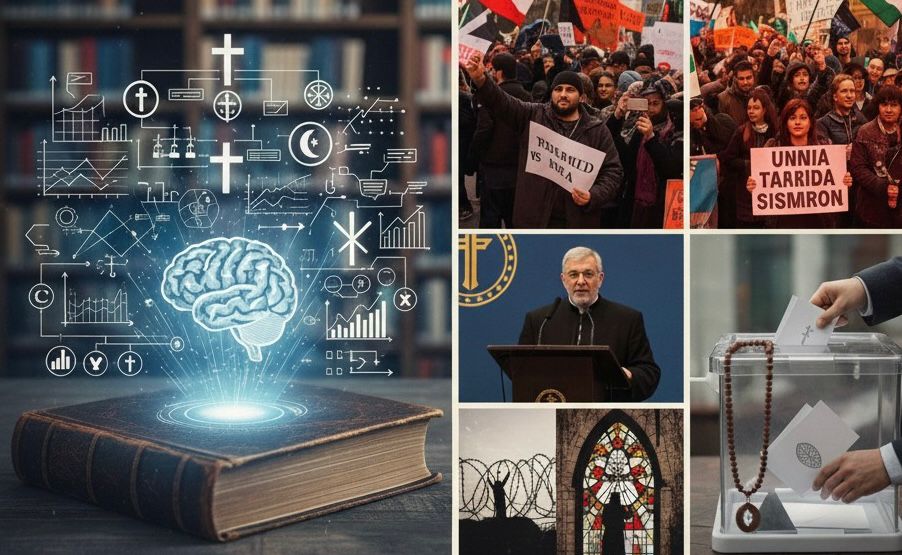
It is evident that the beginning of the twenty-first century has witnessed, globally, a remarkable resurgence of religion in public and political life. This development challenges the hypotheses derived from the history of modern society, which suggest that the triumph of modernity, according to the prevailing discourse of modernity itself, means the end of traditional and archaic matters, including religion. This phenomenon—the resurgence of religion and its return to influence political spheres—is often termed the process of “politicization of religion,” wherein the influence of religion extends beyond the behaviour of individuals or cultural norms to the advocacy and integration of religious elements into political discourse, political institutions, and governance strategies. This article pursues an examination of the theoretical frameworks of this complex phenomenon, the mechanisms of its implementation, and the forms of its manifestation across various religious traditions worldwide, along with an analysis of the profound impacts of this phenomenon on society, its groups, and the relationships among them.
Section One: Defining the Theory of Politicization of Religion
Before defining the theories of this phenomenon, it is necessary first to present a general understanding of the concept of politicization, and then to define the concept of politicization of religion, as follows:
- The Concept of Politicization
According to most renowned dictionaries worldwide, this concept linguistically refers to “the act of giving something a political character” or “imparting a political nature to something.” However, beyond this simple dictionary definition, the concept of politicization scientifically relates to the very concept of “politics.” If politics in its traditional sense consists of the art of governing the state, or in its modern sense consists of the act of power relations (striving for power, competing over power, obtaining power, and exercising power), then politicization consists of loading any non-political idea, issue, or institution with the actions of state governance and power relations. For example, when inherently non-political subjects (such as health, sports, art, science, religion, climate and environment…) become subject to state intervention or are mixed with political power struggles, they become “politicized” subjects. Simultaneously, the process of integrating these subjects with politics and political matters (state and power) is called “politicization.” Here, it is necessary to distinguish between two types of politicization:
First: resulting from the development of the modern welfare state and the expansion of state functions from political tasks to social, cultural, and economic tasks, along with the spread of democracy as a desired model of governance and institutional interaction between government and opposition. Under these two factors, nearly all social, cultural, and economic issues are treated as political problems requiring state intervention and government response to resolve them.
Second: this consists of the process of transforming any inherently non-political idea, issue, or institution into a subject connected to politics and integrating it into political debate and making it a site of political competition. Or using any non-political thing (an idea, an activity, an institution) to achieve political gain and reach power and compete over it. Therefore, some observers indicate that this second type of politicization sometimes mixes with other phenomena such as populism and mass mobilization. In any case, what concerns us in this research is primarily this second type of politicization, although we do not exclude benefiting from aspects of the first type.
- The Concept of Politicization of Religion
Among researchers, many definitions of this concept have been made. According to British historian Karen Armstrong, the politicization of religion is the moment of religion’s integration with state interests, when political elites and governments use religious symbols and concepts for their own private benefit, or redefine them to legitimize the use of violence, consolidate their dominance, and control their subordinate societies. According to American sociologist Mark Juergensmeyer, the politicization of religion consists of equating the religious system with the political system, such that religion becomes a justifying force for power, a tool for gathering and mobilizing masses, a normative reference for governance, and even violence. According to Ghaidan al-Sayyid Ali, the politicization of religion means transforming religion from its sublime and higher purposes to achieving the private political interests of certain groups, and changing religion into a tool for obtaining sectarian gains and ambitions, with the aim of reaching power, glory, wealth and possessions, or elevating ordinary worldly things to the level of sacredness and exempting them from doubt and questioning. According to Bassam Tibi, the politicization of religion consists of the instrumental use of religion by transforming it into a political ideology through propaganda and mobilization, with the aim of legitimizing political power.
Therefore, in general, the politicization of religion refers to that process by which religious beliefs, institutions, and figures are drawn into the sphere of political action, whether as a tool for competing over power and obtaining it, or as a source for obtaining legitimacy, or for gathering mass support. However, it is important here to distinguish between the narrow concept of “politicization of religion” and the broader concept of “religion’s influence on public life.” While according to the latter, religion has historically been an important social and cultural force, has shaped human and moral values, and has guided social structures, the former (politicization of religion) specifically refers to the active employment of religious symbols, narratives, and institutions within political discourse, which is most often carried out by political actors. This is also different from “religionizing politics,” which refers to the broader influence of religion on political life. Therefore, from the perspective of this distinction, the politicization of religion refers to the instrumental use of religious elements by political institutions, political personalities, or political forces and movements.
In reality, the historical relationship between religious authority and political authority has always been complex and often contentious, such as the dual authority system in Sunni Islam, which was clearly evident during the Abbasid period and later during the Ottoman period, where the authority of jurisprudence (scholars and jurists) was somewhat independent from political authority (caliphs, sultans, emirs). However, this relationship was stricter in Christianity, which prevailed in pre-modern Europe between church and state. Although this historical background paved the way for the politicization of religion in the contemporary era, they are not entirely identical.
This continuation of religion’s role in the political sphere directly contradicts the thesis of secularism, which as a theory of social change hypothesized the regression of religion’s public importance with modernization, rationalization, and industrialization of societies. This theory predicted that religion would become confined to the private sphere. However, the current global scene shows that religion continues to perform its effective political role, even in the most secular regions of the world. This continuation of religion’s role requires a reconsideration of modernization and reform theories, such that it must be recognized that social development does not directly and automatically lead to the “privatization” of religion or the reduction of religious practice’s role. Instead, new theoretical analysis is needed to understand this continuing and developing influence of religion, which manifests itself in various forms, such as the emergence of transnational cross-border religious networks, or global non-governmental organizations formed on the basis of religious belief, or non-state sectarian groups.
Section Two: Mechanisms of Politicization of Religion
For the politicization of religion, various and complex mechanisms are employed, from transforming religion into political ideology and national identity, to using it for political organization and party work and directing the state and governance regime. Below we present some of them:
- Religious Ideology
The first step in politicizing religion consists of transforming it into a political ideology, especially since it can effectively frame fundamental political agendas in the name of religion and make them more acceptable or legitimate among the general masses. This is in addition to playing an important role in social education and instilling norms in youth and new generations. For this reason, religious organizations often target these groups through education and civil activities. For example, most Islamic movements engaged in advocacy work operate in this manner, and Christian parties in Europe pay more attention to social issues of family and morality.
In this framework, perhaps the most apparent example of politicizing religion as ideology is “religious nationalism,” in which religious and national identity are deeply mixed together, such that it is emphasized that a nation is fundamentally established on the basis of a specific religion, or adherence to a dominant religious belief is considered very important for national belonging. This mechanism is often employed by a dominant group or by a majority to create a selective narrative that legitimizes state power and targets minorities. There are several global examples of this, including: Zionism, which presents itself as a secular nationalist movement but works according to a Torah-based narrative to establish Israel as the national state of the Jewish people in Palestine, while institutionally disenfranchising other citizens of this country. Hindutva is another example of religious ideology and nationalism, which desires to establish India as a mono-national Hindu country and portray other religious minorities, especially Muslims and Christians, as threats to the national identity of that country. Similarly, Buddhist nationalism in both Myanmar and Sri Lanka have emerged as another form of religious nationalism to defend Buddhism against the perceived threat of Muslim minorities in Myanmar, or to protect the Sinhalese and Buddhism from the threat of Muslims and Christians in Sri Lanka. In both countries, the development of this religious nationalist ideology has led to increased social division and political violence.
- Religious Parties
Religious political parties are an additional effective mechanism for politicizing religion, whether directly through their explicit religious programs or indirectly through lobbying efforts and integrating religious values with the agenda of governments they participate in as allies. Catholic parties in some European countries and Islamic parties in some Middle Eastern countries are prominent examples, in a situation where there is some degree of freedom of party and parliamentary work and elections in these latter countries (Middle East); otherwise, some Islamic parties and organizations have resorted to arms and violent action to achieve their goals, with Al-Qaeda and ISIS being two clear examples of this situation.
- Religious State
The relationship between state and religion is not merely a simple duality between being secular or being religious, but rather comparative studies present various models of participation and influence between them. While the Vatican, Iran, and Saudi Arabia are currently models of “fully religious states,” China, Cuba, Vietnam, and North Korea are models of “fully anti-religious states.” In between these, there are several other models, such as the model of “state committed to a specific church or official religion”: England with the Anglican Church, Greece with Orthodox Christianity, Denmark, Norway, and Iceland committed to the Lutheran Church are examples of this model, wherein the church receives support and protection from the state, although it may provide reciprocal treatment and privileges. Similarly, countries such as Bhutan, Cambodia, Myanmar, Sri Lanka, which are committed to Buddhism, and Tuvalu, which is committed to the Calvinist Church, are other examples of this model. Also, according to some, Israel can be placed in this model, although according to others it should be placed in the first model (fully religious state), which has designated Judaism as the official religion of the state. After these comes the model of “cooperative separation,” wherein although there is formal separation between state and religion, in some areas the state, as cooperation, collects taxes for recognized religions or provides budgets for social services or religious education under specific conditions. Germany is an example of this model. Then there is the model of “strict separation,” which aims to achieve complete state neutrality toward religion, under which the government neither supports nor hinders religion, but emphasizes individual freedom of conscience. France and America are two examples of this model. Nevertheless, there are notable deviations from this last model, which, despite formal secularism, have varying degrees of religious influence or state control over religious affairs. For example, in France, the government, under the pretext of protecting neutrality, strictly prohibits the use of religious symbols in public education. In America, the influence of evangelical groups on some dominant parties (Republican Party) at certain historical stages, especially during election campaigns, is noteworthy. Also in Turkey, which is considered a secular state, the government has had a prominent role in appointing mosque imams from the beginning. These examples help us avoid excessive generalization and understand each country and model in its own specific context.
- Religious Regime
This mechanism is completely connected to the existence of the previous mechanism (religious state), which refers to the coupling of state authority with religious institutional authority, or at least making religious law (such as Sharia) the basis of governing the country. Simultaneously, in this system, religious men or religious authorities have significant political power. As we previously mentioned, the Vatican, Iran, and Saudi Arabia currently operate with this mechanism, along with Afghanistan, Mauritania, and Yemen. However, in several other countries, work is based on the principle of “official state religion” or “official state church.” For example, among all countries in the world, 83 countries have designated an official religion for the state in their constitutions, or prefer a specific religion. Specifically, 43 countries have an official religion; among them, 27 countries have officially designated Islam in general or a specific Islamic sect, 13 countries have officially designated Christian religion or a specific church, 2 countries have designated Buddhism, and 1 country has officially designated Judaism. Although designating an official religion for the state does not mean creating a “religious regime,” it paves the way for that official religion to become a source of legislation and a condition for appointing rulers. For example, among those countries that have designated Islam as the official state religion, 25 countries have designated this religion as a source of legislation or the primary source of legislation. Among the 13 countries that have designated Christianity as the official state religion, although it is not specifically stipulated that this religion must be made a source of laws, the principles and guidelines of this religion may be relied upon in personal status laws, education, and ethics. In Israel, only Jewish law (Halakha) must be followed for personal status. Along with all these, specifically in 30 countries worldwide, it is required that the head of state (president or king) belong to the official state religion.
Generally, according to some from a comparative legal perspective, a religious regime in all its aspects is an incompatible mechanism with the principles of democracy and rule of law. However, when religion itself and religious belief generally constitute a primary component of what is called “prevailing legal thought” in a society, it is difficult to prevent the process of politicizing religion from proceeding toward the country’s legal system and governance regime.
Section Three: Practical Examples of Politicization of Religion
The politicization of religion is a phenomenon not only connected to one specific religion, but most religions in different countries worldwide have faced this treatment, albeit in different ways and according to one or more of those mechanisms we previously mentioned. Of course, the reason for these returns to the fundamental political, economic, social, and cultural differences of countries and the differences in the issues they have faced, in addition to the differences between the nature of the religions themselves and their degree of suitability for politicization. For this, below we present examples of politicizing several religions:
- Politicization of Judaism (Jewish Religion)
Jewish religious nationalism in Israel, which is embodied in Zionism, is currently the most common form of politicizing this religion. Simultaneously, Israel itself is the most apparent instrument of politicizing this religion. The strong integration of religious and national identity is evident. Although Zionism was initially largely a secular nationalist movement, it strategically established Judaism as an inseparable component of Jewish nationalism. This integration was very important for legitimizing the state through a Torah-based narrative of the promise of return to the motherland or “promised land,” which later granted significant authority to Orthodox rabbinical courts in granting Jewish identity to anyone based on maternal lineage or religious conversion to Judaism. It is evident that the Rabbinate institution is the central institution for managing official Jewish religious affairs in Israel and plays a primary role in politicizing religion, having been granted extensive legal authority over aspects of citizens’ lives. The most apparent forms of this politicization consist of integrating Jewish religious symbols and rituals into the state structure, such as Shabbat, designating Saturday as the weekly rest day, and Kashrut, which pertains to determining permissible foods in Judaism. Also, the Law of Return encourages the return of Jews from around the world and their resettlement in Palestine, in addition to the process of “Hebraization” of Arabs upon their return to Israel, with the aim of distancing them from Palestinian Arabs. Also, the Jewish Nation-State Law of 2018 further strengthened the definition of Israel as the national state of the Jewish people and further legalized discriminatory policies against non-Jewish citizens. This reflects an evolving alliance between right-wing political parties and those religious movements dominant in Jewish settler camps.
Historically, acts of violence against Jews in ancient times (such as the suppression of Jews and prohibition of their religion by the Seleucid Greeks in 168 BCE, as well as the mass killing of Jews after the Alexandria uprising in 115-117 CE and early Byzantine Roman period) are other forms of politicizing Judaism, but against the Jews themselves. For example, the Greeks accused Jews of being anti-social and criminals or cannibals, using them as sacrificial lambs to divert attention from Roman imperialism, or depicting the destruction of the Second Temple in Jerusalem by the Romans in 70 CE as a sign of God’s decision to establish Christianity as a replacement for Judaism. After the legalization of Christianity, the Catholic Church subjected rival Christian groups and then Jews to widespread oppression, and also legally restricted the rights of Jews, which aimed at their greater subjugation.
Medieval Europe witnessed thousands of incidents of mass expulsion of Jews from various cities, which were often connected to economic crises and used as scapegoats. Gradually, along with this oppression and political use of Jews, in the 14th and 15th centuries, the concept of “Jew” or “Jewish” was transformed from a religious identity to a national-racist identity, such that anti-Jewish opposition known as “anti-Semitism” continued even in the absence of Jews themselves, which served as an ideology for politicizing Judaism, especially as in the contemporary era, this ideology is used as a political tool by various state actors. For example, in America, Democrats and Republicans accuse each other of involvement in anti-Semitism. Also in the same country, federal and state government laws pertaining to preventing anti-Semitism are used to target university student activities as part of the conservative currents’ assault on progressive ideas in this country’s education. Another example consists of political use by politicians, such as Donald Trump’s use of the discourse of “dual loyalty” along with using common stereotypes about Jews and their wealth and their connection to white supremacists, as well as the use of similar discourse by Ilhan Omar regarding the “Jewish lobby” and their “dual loyalty.” Anti-Semitism is a fateful ideological tool for advancing radical white supremacist nationalism and uniting them, such that the “Great Replacement Theory” and conspiracy theories regarding Jewish hegemony over the world connect the various groups of this current together.
As we see, the politicization of Judaism has most often been carried out in the form of external exploitation by other groups (such as Greeks, Romans, Christians, contemporary politicians, and white racists) as a sacrificial lamb or political tool. This points to a unique characteristic where religious identity is used as a weapon against the group itself, instead of being primarily used by the group itself to achieve internal goals and power. This conveys that the politicization of religion is not always an internal process for a group or religious component seeking power, but can also be an external process of demonization and scapegoating, wherein a religious group’s identity is distorted and shaped by external political actors for specific political and party purposes, or for gathering mass support, or for misdirecting societal discontent, or as justification for discriminatory policies. This points to a deep danger when manipulation of a component’s religious identity is allowed for political gain, as it can lead to serious violation of human rights and systematic harassment against the component itself or its use for the benefit of other components and groups.
- Politicization of Christianity
Historically, the complex relationship between spiritual and worldly authority has subjected Christian political theology to profound struggle. Augustine’s masterpiece “The City of God” was a response to the sack of Rome in 410 CE by drafting a philosophy that distinguished between the City of God (which focuses on divine truth and eternal salvation) and the City of Man (which is connected to temporal affairs). This philosophical framework influenced later Western thinking about the different spheres between church and state, although they sometimes intermingled, such as Martin Luther’s doctrine of the “Two Kingdoms,” which similarly presented two complementary ways that God governs: the Spiritual Kingdom (which manages inner faith) and the Temporal Kingdom (which manages external affairs through law and government). Similarly, John Calvin, while emphasizing Christians’ obedience to civil authority, simultaneously emphasized the necessity of secular authority to restrain human evil. These theological perspectives shed light on the various interpretations of authority within Christianity and ongoing debates about the legitimate boundaries between religious and secular authority.
In the contemporary era, Christian nationalism, particularly developed in America, attempts to define national identity through Christian values and often calls for pressure and direct influence of religious belief on laws and political leaders. This political ideology attempts to incorporate elements of racism, scapegoating, and eschatological views to portray a nostalgic image of a past wherein the American nation was governed by white Christians. These movements demonstrate the clear politicization of Christianity to achieve specific political, national, and social goals.
The roots of Christian nationalism go back to the role of this religion in establishing some American colonies (such as Puritans who fled from oppression), whose effects on the American Revolution remain debated to this day. Some of America’s founding fathers had Deist inclinations (such as Jefferson, Franklin, Washington), while others were active Protestants. Protestantism has had a profound influence on American history and culture. African Americans actively formed their own Protestant churches to assume moral and political leadership roles. Also, as Max Weber says, the Protestant work ethic had a great influence on the development of capitalism.
In the 1960s, opposition to secularism and desegregation and measures of church-state separation (such as prohibiting prayer in schools) energized the religious right, and in the 1980s became active in Republican election campaigns (such as Reagan and Bush). Often candidates’ personal beliefs have strongly influenced their public standing (such as Jefferson’s Deism in 1800, Mitt Romney’s Mormonism in 2012, and Jeremiah Wright’s liberationist theological statements in 2008). Also, the broad waves of Catholic immigration to America, especially Irish, German, and Italian immigrants in the 19th and early 20th centuries, were a source of Protestant opposition to Catholics due to how their loyalty to the Pope was portrayed.
In Yugoslavia’s civil wars, Slobodan Milošević, although not religious, embraced Serbian Orthodox Christianity to advance radical nationalism and the idea of creating a “Greater Serbia.” He revived the “Kosovo myth” and used the Serbian Orthodox Church to gather mass support, presenting his struggles as a “holy cause” and targeting religious sites.
In Africa, religious extremism has been a factor in violence, such as sectarian violence between Christians and Muslims in the Central African Republic, as well as the use of Christ’s image by the Lord’s Resistance Army in Uganda to justify their brutal acts. Similarly, religious racism in Nigeria has led to deadly clashes between Christians and Muslims.
Therefore, the politicization of Christianity ranges from subtle cultural and ideological influence to election campaigns and gathering mass support (in America) to direct exploitation of religion to advance ethno-nationalist violence (in Yugoslavia and parts of Africa). This reveals that religion’s centrality or historical relationship with state power can shape the tools and methods of its politicization. The examples presented show a spectrum of politicization. In America, it often relates to exploiting cultural values and gathering the vote of certain specific segments of voters through methods such as examining Protestant work ethic, the religious right, investigating candidates’ beliefs for election. As for Yugoslavia and parts of Africa, the situation proceeded toward direct instrumental use of religion for ethno-nationalist conflicts and violence, where leaders actively played with religious myths and institutions (such as Milošević and the Kosovo myth and the Lord’s Resistance Army). These various examples show that the prevailing context of countries (such as democratic regimes versus oppressive regimes, historical national tensions, legacy of colonialism) significantly shapes how Christianity is politicized and the severity of its outcomes. This means that “politicization of religion” is not a monolithic phenomenon, but rather its manifestations are deeply rooted in prevailing history, political system, social and cultural foundation. In this way, the same religious tradition can be used for very different political purposes, from advocating for social reform to justifying mass violence.
- Politicization of Islam
Fundamentally, the theological roots of Islamic political theology go back to the principle of divine sovereignty, meaning that judgment belongs only to God, emphasizing that absolute authority in all matters, both natural and legal, returns to God. This fundamental belief, after the final migration of Prophet Muhammad (PBUH), sparked a fateful question about who assumes political leadership after the Prophet (PBUH). The Sunni majority traditionally emphasized the role of the Ummah (community of believers) in selecting the Caliph, viewing the Caliphate as a religious duty to govern by God’s law (Sharia) rather than a necessary救济 requirement. In contrast, Shia emphasize the concept of infallible Imams from the Prophet’s (PBUH) sacred lineage, whom they believe possess esoteric knowledge and the exclusive right to political leadership. These different interpretations of obtaining power in Islam reveal that religious legitimacy of power has been very dependent on prevailing political conditions and has come under intense pressure from internal theological and historical competitions.
According to some researchers, Islam was a political religion from the beginning, so the relationship between religion and state in Islam goes back to the beginning of this religion’s advent, when the Prophet (PBUH) established a state in Medina and initiated a unique integration of these two spheres. Particularly as the Medina Charter established the foundation for a multi-religious political framework under his leadership and quickly expanded through early Islamic conquests. However, later the institution of the Caliphate, as we previously mentioned, became the primary axis of politicizing Islam, when it became the cause of sectarian division (Sunni, Shia) and the creation of political struggle and competition over obtaining religious authority. Although often debate occurred over using the concept of Shura for governance, sometimes it was marginalized in favor of autocratic rulers, just as during the Umayyad period, they used the concept of predestination (al-Qadr) to legitimize their rule and considered any rebellion against their authority a sin.
Political Islam, which is a modern example of politicizing Islam, emerged as a reaction to Western imperialism and the dissolution of the Ottoman Empire. Prominent figures such as Hassan al-Banna, founder of the Muslim Brotherhood, Sayyid Qutb, and Abu A’la Maududi called for Muslim unity under the authority of Sharia, often rejecting Western democracy in favor of their own interpretations of Shura. In this framework, the concept of divine sovereignty, previously used by Ali ibn Abi Talib, was re-politicized in the twentieth century by Maududi and Qutb as justification for obtaining political power and establishing an Islamic state. The 1979 Iranian Revolution, led by Khomeini, was a major turning point in the Twelver Shia sect toward politicizing Islam, when Khomeini declared that “Islam in all its aspects is the religion of politics.” According to him, his theory of Guardianship of the Jurist (Wilayat al-Faqih) embodies the principle of divine sovereignty, when a qualified Shia jurist manages the state and society according to Sharia. This directly contradicts the theory of democratic sovereignty, even sometimes conflicting with the concepts of Shura and sovereignty of the Ummah within Islam itself.
Generally, establishing a religious state and implementing Sharia are among the primary tools of politicizing Islam in the contemporary era, with the most prominent examples being: Iran, which after the 1979 Revolution established a theocratic regime where Shia jurists assume the legislative role in most spheres. Also, Saudi Arabia, which has made Islamic Sharia the law of the country and generally follows the Hanbali school of thought. During the Arab Spring revolutions, using religion to support and direct some demonstrations and mass protests are other modern examples of politicizing Islam, which often started after Friday prayers and were exploited by organized Islamic parties and forces to achieve party agendas. In some cases, this led to intense conflict and social polarization and even the outbreak of civil war. Of course, here the question is not about the legitimacy of those revolutions, demonstrations, and mass protests, which were most often against oppressive and undemocratic Arab regimes, but rather the intention is to point out cases of some of those demonstrations being exploited by Islamic parties and organizations to achieve party and non-religious political goals as examples of politicizing Islam. Despite this, the development of some movements calculated on political Islam into armed groups and organizations within what is known as “Salafi Jihadism,” such as Al-Qaeda and ISIS, are other contemporary examples of politicizing Islam.
The historical development of political Islam demonstrates a continuous effort to reconcile religious doctrine with political authority, which has often occurred through reinterpretation of fundamental texts and concepts (such as Shura, predestination, and sovereignty). The emergence of modern political Islam is a direct response to geopolitical changes (the advent of Western imperialism, the collapse of the Ottoman Empire, the support of some Western powers, especially America, for some oppressive regimes in Arab and Islamic countries). All this sheds light on using religion as a political ideology capable of being reinterpreted and adapted to contemporary challenges. Therefore, understanding political Islam as a modern form of politicizing Islam should not be only by analyzing its declared goals, but must also include careful analysis of the strategic interpretations used to legitimize those goals. Here, the various internal debates and interpretations within Islamic political thought, such as rationalists versus textualists, are very important, as they reveal the contentious nature of religious authority and the continuous effort to impose ideological hegemony in the name of religion, which directly affects current examples of politicizing Islam today.
4. Politicization of Buddhism
Although Buddhism emphasizes asceticism and non-violence (Ahimsa), there are historical and contemporary examples of its use to justify violence as an example of politicizing this religion, which are often carried out by political and nationalist forces. Similarly, some Mahayana texts provide justification for “killing to save lives.” During the Buddhist kingdoms belonging to the Theravada school, which is among the oldest major schools of Buddhism, kings were traditionally defenders and protectors of Buddhism, especially in South and Southeast Asia. The collapse of these kingdoms during the colonial period led to Buddhist believers deeply feeling the creation of danger to their religion, such that they were encouraged to develop Buddhist nationalism. Particularly in some of those countries that were formed in these regions in the contemporary era and have designated Buddhism as their official religion and have provided state support and protection for it, such as Bhutan, Cambodia, Myanmar, Sri Lanka…
In Myanmar (Burma), the military regime (State Peace and Development Council) from 1988-2011, to legitimize its rule, advanced Burmese Buddhist nationalism and encouraged violent alteration of minorities’ religious identity. Currently, most human rights violations in Myanmar are carried out on the basis of ethnicity and in the name of Buddhism, and monks of this religion are supporters. The 969 Movement and Ma Ba Tha and Buddhist monks such as Wirathu openly encourage anti-Muslim nationalist movements. This is completely inconsistent with the so-called democratic transition process in Myanmar. In Sri Lanka, the historical chronicles of Mahavamsa were the source of advancing Sinhalese Buddhist nationalism, which portrayed Sri Lanka as a “Buddhist sanctuary” and legitimized violence against Tamils (such as the narratives of King Dutugamunu). After independence, discriminatory policies and the participation of Buddhist monks in politics led to civil war and violence against Tamils and Muslims. Groups such as Bodu Bala Sena (BBS) encourage anti-Muslim agitation. In Thailand, state representation of Buddhism as the de facto official religion has led to tension with followers of other religions. In Japan during World War II, Japanese Buddhist literature supported war efforts and suicide actions against enemies, legitimizing the statement “Kill one so many may live” in the name of establishing peace. Nearly all Buddhist temples at that time were aligned with Japan’s militarization trend.
The politicization of Buddhism, particularly in Southeast Asia, reveals a form of politicizing religion wherein a traditional and non-violent religion is interpreted to justify nationalist agendas and violence against minorities. Often this occurred when a dominant religious group felt its identity or sacred land as “under threat,” thus arousing passion among believers, especially for doctrines such as sanctifying pure lineage and purifying superior land. This conveys that no religion is fundamentally protected from politicization or exploitation for political violence purposes. Often the process involves redefining the boundaries of “sanctities” and reimagining the identity of the “enemy,” wherein the “other” is dehumanized so that justification can be brought for belligerence against them. This phenomenon is particularly concerning when it leads to human rights violations and ethnic cleansing. This points to how religious narratives are used in political discourse as an important tool of politicizing religion.
- Politicization of Hinduism
The most apparent form of politicizing this religion consists of the emergence of Hindu nationalism (Hindutva), which as a political ideology attempts to make India a completely Hindu nation (Hindu Rashtra). This ideology is built on the ideas of a “unified Hindu self” and “converting other religious minorities to Hinduism,” especially Muslim and Christian minorities, which often portrays these minorities as threats to Hindu national identity.
The roots of Hindutva go back to the impacts of European fascism during the colonial period, Hindu fundamentalist revival movements, and the intellectual development of the Hindu concept by thinkers such as Vinayak Damodar Savarkar. Due to all these, it developed from a social-religious movement to a political force. Currently, it is the founding and driving political ideology of the Bharatiya Janata Party (BJP), which is now the largest political party in India and is the ruling party in this country under the chairmanship of Prime Minister Narendra Modi. The increase in this party’s mass standing in recent years is attributed to the decline of the Indian National Congress party and the closing of democratic avenues, which created a vacuum for the benefit of advancing Hindu nationalist ideology. Hindutva has embraced India’s secular institutional foundations, especially what is called interventionist policy and unified civil law, to stir concerns about citizenship in India. This party works very carefully on politicizing Hindu identity by exploiting the idea of a “threat” to that identity, supposedly the source of this threat is the policies of “false secularism” that gives too much [favor] to minorities. Similarly, Hindu nationalism has very carefully adapted itself to modernity through using mass media (video, audio tape, government television) to spread its ideological principles and nationalize indigenous Hindu issues (such as the Ayodhya temple issue). Also, it carefully deals with users’ desires and market expansion.
Hindu nationalism during Narendra Modi’s period is compared to the Jim Crow laws period in the 1880s in America, which aims to marginalize Indian Muslims on the basis of religion, similar to the marginalization of Black Americans on the basis of race. Forms of marginalization consist of discriminatory laws (such as the law revoking Kashmir’s autonomy, the citizenship amendment law that excludes Muslims from this right, laws preventing love jihad and interfaith marriage for the purpose of religious conversion), along with encouraging communal violence (such as extra-judicial lynching of Muslims and destruction of property by state order). This is in addition to circulating very widespread discourse in opposing Muslims and Christians, and using several myths such as “respecting the cow” to oppose minorities and support Hindus and divert attention from current internal social issues. Besides this, Hindutva religious organizations, some of which are organized on a semi-military basis, ignore democratic procedures, and some call for rewriting India’s constitution based on traditional Hindu texts. Simultaneously, they have been involved in several acts of agitation and sectarian violence, which have had a profound impact on destroying social cohesion in India. Generally, both the Jim Crow laws period in America and the Narendra Modi era in present-day India, the judiciary has often been lax in protecting minority rights against the authority of the majority and its violations.
The politicization of Hinduism reveals how a dominant religious identity can be transformed to create a state according to the majority’s national-religious identity, which leads to systematic discrimination and violence against minorities. The similarity of this experience with the Jim Crow laws experience sheds light on a global pattern of how identity (religious or ethnic) is used to create second-class citizenship, even within a democratic framework. This conveys that when the politicization of religion combines with majority rule, it creates a significant danger to liberal and democratic values, human rights, and social harmony. It also shows how the democratic process can be subverted to institutionalize discrimination and harassment, and also sheds light on the fragility of religious minority rights when the majority’s religious identity is used as a weapon of political control. All these are dangerous consequences of politicizing religion, wherever it may be.
Conclusion and Results
The politicization of religion is a complex, ongoing global phenomenon that has challenged many simple understandings of modernity. This phenomenon is not merely the sublime influence of faith on public life; rather, it is most often the strategic and deliberate manipulation of religious beliefs, institutions, and identities to achieve specific private goals and consolidate political power. The historical interaction between religious and political authority, along with modern concepts such as “weaponization of religion” and “political religion,” emphasizes a deep human need for meaning and salvation, which can be distorted by political forces and redirected toward other non-religious and political purposes through several tools such as religious ideology, religious parties, religious states, and religious regimes.
The various implementations of this phenomenon across most religions (Judaism, Christianity, Islam, Hinduism, and Buddhism) reveal common converging points about this phenomenon, such as using religious symbols and concepts for political benefit and gathering mass support and reaching power and legitimization, justifying violence, consolidating majority dominance against minorities, and so on. However, at the same time, it reveals the differences between the various experiences of this phenomenon, such that it confirms that the process of politicizing each religion is completely affected by the political, economic, social, and cultural context of that region and country where this process is implemented, due to differences in historical heritage, political system, and social and cultural dynamics of countries.
Through practical examples, it became clear to us that the politicization of religion has a paradoxical nature, because while it can be a primary driver of violence, polarization, human rights violations, and democratic regression, at the same time in some circumstances it can be a force for social unity, moral guidance, and confronting political injustice and oppression. However, most often its negative consequences have exceeded its positive consequences.
The profound negative cultural and social consequences of the politicization of religion, from encouraging violent discourse to widespread conflict, discrimination, and harassment, to fundamental challenges to democratic principles and human rights, require careful understanding and cautious handling. When religion is used as a political tool, its natural capacity for social unity can be converted to advancing division, marginalization, and violence.
In this complex scene, promoting international frameworks such as human rights and achieving global justice, educating society on the values of mutual acceptance and forgiveness, and establishing continuous dialogue among religious components, political institutions, and civil society—all these may have an impact in reducing the negative aspects of politicizing religion, in order to leave religion as a motive for achieving peace and justice, not a tool for fomenting conflict and oppression.
- Originally published in Publishing Section by the Center for Future Studies and translated by Nawroz Mohammed for Kfuture.Media.