

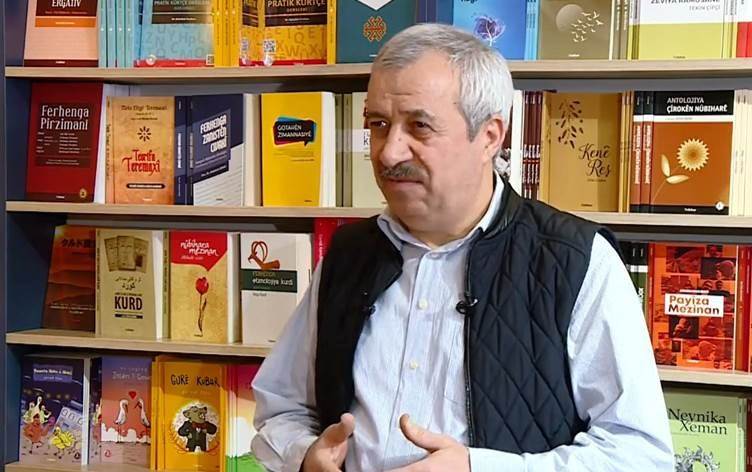
Süleyman Çevik: Out of 20 Million Kurds in Turkey, Only 50 Thousand Read Kurdish Publications
Interview: Turkish Studies
Books, publishing, and dissemination are considered among the most important areas for preserving the language, literature, and culture of any nation. In this edition of Turkish Studies’ interview, it was deemed necessary to examine the state of the press and the dissemination of books and magazines in the Kurdish language in Northern Kurdistan and Turkey. For this purpose, in this issue of Turkish Studies, an interview was conducted with Mr. Süleyman Çevik, General Director of Nubehar Center.
Süleyman Çevik is a writer, journalist, and Kurdish public figure in Turkey, born in Diyarbakır in 1956. After completing his university education, he began writing and became even more involved in Kurdish publishing. He is currently the General Director of Nubehar Publishing House (Nubehar Yayınevi) and, at the same time, the editor-in-chief of Nubehar magazine, which is an academic journal published in Kurdish/Kurmanji by Nubehar Publishing House.
In this interview, Mr. Süleyman Çevik shed light on the state of the Kurdish language and the publishing of books, magazines, and journalism after the establishment of the Turkish Republic. Along with revealing several important pieces of information about Kurdish publishing centers and journalism in Turkey and Northern Kurdistan, Çevik addressed the latest developments in Turkey, the peace process, and their impact on expanding the scope of freedom of expression and journalism for Kurds and writing and publishing in the Kurdish language.
The importance and uninterrupted value of this interview lies in the fact that an academic dialogue in the sweet Kurdish language was conducted between Turkish Studies and Süleyman Çevik.
Turkish Studies: What was the state of the Kurdish press and journalism in Turkey and Northern Kurdistan after the establishment of the Turkish Republic?
Süleyman Çevik: As you know, at the end of the Ottoman Empire, all the subjugated nations of that state began publishing newspapers and books in their own languages. The Kurds also published their first newspaper, “Kurdistan,” in 1898. After that, until the fall of the Ottoman Empire and the establishment of the Turkish Republic, several newspapers and magazines such as “Jin, Roji Kurd, Hetawi Kurd, Istiklal, etc.” were published in Kurdish by Kurdish writers and intellectuals who had come to Istanbul. At the same time, a number of books were published in Kurdish, including “Mewludname” by Mela Huseyni Bateyî in 1899, and the Zazaki Mewludname written by Mela Ahmedi Khasî, which was published in Diyarbakır—a remarkable achievement at that time. Also, in 1918, Mem u Zin was published by Hamza Muksi, and the Diwan of Mela Ahmedi Jiziri was published by Shafiq Arwasi. More importantly, before the fall of the Ottoman Empire, the Bible was published in Kurdish/Kurmanji and in Armenian script. This was because a large number of Armenians lived in Kurdish areas but had forgotten the Armenian language and learned Kurdish. Also, the Diwan of Mawlana Khalid al-Baghdadi (Sharazuri) was published. After the establishment of the new Turkish Republic, all activities and publications in Kurdish were prohibited. Despite the uprisings of Sheikh Said of Piran, Sheikh Riza of Dersim, and the movement of Sheikh Said Kurdi (Nursi), there was no cultural, journalistic, or publishing activity in Kurdish in Turkey and Northern Kurdistan until the end of the 1950s. In 1959, a newspaper called “Al-Sharq” was published by Musa Anter in Diyarbakır, but on the pretext of the prohibition of publishing newspapers in a prohibited language other than the state’s official language, Musa Anter was taken to court and the newspaper was closed. After the military coup of 1960, the “Basic Law of Turkey” was issued in place of the constitution, and this basic law is considered the best constitution after the establishment of the Turkish Republic. Within this framework, six or seven newspapers and magazines were published in Kurdish. For example, the newspaper “Deng” was published in 1965. Then the Kurdish issue began to be discussed in Turkish media. In the late 1960s, Mem u Zin and Sharafnama were translated into Turkish by Muhammad Amin Bozarslan and published. A Kurdish-Turkish dictionary was published by Musa Anter. Thus, in the shadow of the 1960 military coup, a relative degree of freedom came to the Kurds. From the early 1970s, the Turkish Workers’ Party was established, and because this party had a leftist ideology, several Kurdish figures joined the party. Within this framework, the Kurdish issue was more frequently discussed, and even some Kurdish parliamentarians of the Turkish Workers’ Party spoke about the Kurdish issue in parliament. From there, talk about the Kurdish issue and language spread more and reached university and school students. After problems arose between Kurdish figures within the Turkish Workers’ Party and the party’s senior officials, the Kurds established their own political parties. Until the early 1980s, approximately ten parties and organizations were established by Kurds, and these parties and organizations tried to publish their own newspapers and press in Kurdish. Of course, along with Kurdish, Turkish was also used in those publications. The coup of September 12, 1980, once again brought a dark era for the Kurds and their press and language. The coup leaders issued a decree in which only newspapers, magazines, and publications in the state’s (first) official language, which is Turkish, were permitted. This decision stemmed from the danger perceived by the coup leaders that Kurdish had become the second language in Iraq. Also, all Kurdish figures, intellectuals, and activists were either imprisoned, silenced, or fled abroad. Nevertheless, particularly those Kurdish writers and intellectuals who fled to Sweden were able, until the end of the 1980s, to provide good service to the Kurdish language and make a great revolution in that field. In 1991, Turgut Özal, President of Turkey, suspended the coup leaders’ decree, and once again newspapers, books, and publications in Kurdish were issued. At the beginning of the twenty-first century, after Turkey’s opening to the world and the coming to power of the Justice and Development Party (AKP), and the efforts to join the European Union and the peace process, freedom of expression, journalism, and the press became greater and broader for Turkey in general and for Kurds in particular. Although in recent years some difficulties and obstacles have been placed before Kurdish journalism and press in Turkey, compared to the past, good progress has been made.
Turkish Studies: Can we make a classification of Kurdish publishing centers in Turkey and Northern Kurdistan?
Süleyman Çevik: Currently, approximately 35 Kurdish publishing and distribution centers are active in Turkey and Northern Kurdistan. Some are large and some have limited activities; some only publish books, others have books, magazines, and various publications, and still others, in addition to these publications, conduct cultural and linguistic activities such as “conferences, seminars, and panels.” From an intellectual and ideological perspective, we can divide Kurdish publishing centers in Turkey into “leftist, liberal, and conservative centers.” Another classification for newspapers and magazines is based on subject matter and language. Some newspapers and magazines are established and managed by Kurds, and all or most of their published content is related to the Kurdish and Kurdistan issue, but they are published in Turkish. Another section of newspapers and magazines is entirely Kurdish in terms of ownership, subject matter, and language. All Kurdish publishing centers publish content in Latin script, but Nubehar Publishing House (Nubehar Yayınevi) publishes approximately 30% of its publications in Kurdish/Arabic script. Those Kurdish publishing centers that have a conservative orientation give importance to using Arabic script instead of Latin script.
Turkish Studies: At what level is the readership of Kurdish books and publications in Northern Kurdistan and Turkey?
Süleyman Çevik: We do not have data available on the number of people who read Kurdish books and publications. Unfortunately, until now, the rate of readers of Kurdish content compared to the number of Kurds in Northern Kurdistan and Turkey is very low. In general, perhaps out of a total of nearly 20 million Kurds, only approximately 50 thousand people read Kurdish books and publications. These figures are not precise data, but rather only our estimate based on the sales of Kurdish books and publications by Kurdish publishing houses. Unfortunately, this is the result of a set of problems and difficulties facing the dissemination of the Kurdish language in Turkey. When the Kurdish language is not the language of marketplace conversation, not the language of education, not the language of authority and governance, not the language of the majority of the country’s media or Kurdish regions, not the language of religious and cultural activities, then reading books and publications in that language will be at a very weak level. On the other hand, due to writing, publishing, and reading Kurdish books and publications, several people have been prosecuted, dismissed from work, sentenced to prison, and subjected to pressure and threats.
Turkish Studies: If you could clarify better for us, what are the obstacles to reading Kurdish books and publications in Turkey and Northern Kurdistan?
Süleyman Çevik: We can classify the obstacles into state obstacles and internal obstacles. By state obstacles, I mean those difficulties and impediments that the state places before the use of the Kurdish language through legal, political, security, social, and cultural means, but internal obstacles are those problems whose source goes back to the Kurdish citizens themselves. Until now, the state has not been willing to purchase books from Kurdish publishing centers, and it has not even consented to keeping a copy of Kurdish books and magazines in the National Archives Institution, municipal archives, or any state institution. Also, until now, the political situation has not created the groundwork for normalizing reading in Kurdish; citizens cannot read Kurdish books freely and without fear in a state institution, public center, or on the metro or bus. From here, an economic obstacle arises, because people do not buy printed Kurdish books as needed, so Kurdish publishing centers face financial difficulties, which in turn becomes a reason for the lack of specialists in various fields of Kurdish publishing and distribution, because there is neither the necessary financial support from the state or parties and organizations, nor can those Kurdish publishing centers survive on the income from their printed books and magazines. Therefore, perhaps in a Kurdish publishing center, one person does the work of several people at the same time. Also, because the necessary compensation for writers of Kurdish books and articles is not provided, those writers are not willing to spend their time writing an article that does not have the necessary readership and from which they do not obtain the necessary income. Another problem is the confusion of words, tone, and content of the Kurdish language due to the continuous use of Turkish in state institutions, schools, markets, and even within some Kurdish families. This has led to the forgetting or reduction of the use of the Kurdish language and, ultimately, the disruption of Kurdish vocabulary and grammatical structures. This in turn has become a reason for the disruption and loss of Kurdish literary and folklore history, and more dangerously, its replacement with Turkish terms, grammar, and literature.
Turkish Studies: What is the role of civil society organizations and Kurdish political parties in encouraging people to read in the Kurdish language?
Süleyman Çevik: Unfortunately, political parties have not been successful in encouraging people to use the Kurdish language and supporting centers dedicated to Kurdish publishing. This is because either the state has not allowed it, or they themselves have not understood the importance of the mother tongue and believe that in Turkish they can more easily and better make their call. Also, the presence of Zazas and Alevis among the Kurds and those political parties has been another reason for preventing support for the Kurdish language by Kurdish political parties. However, religious schools have played a role in preserving the Kurdish language, because their teachers in the hujras (religious study rooms) explain Arabic books to students in Kurdish. Nevertheless, due to state pressure and the legal restrictions imposed on the education system and religious schools, they too have withdrawn to some extent from using Kurdish and explaining lessons in the mother tongue, and Turkish has replaced the Kurdish language. Along with all this, the book publishing and distribution centers themselves play an important role in disseminating and supporting the use of the Kurdish language. Approximately 400 new books are published annually in Kurdish in various fields in Turkey and Northern Kurdistan. Some of those books are reprinted for the second and third time. There are also a number of civil society organizations dedicated to raising citizens’ awareness and encouraging them to use the Kurdish language. For example, the Kurdish Language Movement (Hêz Kurd) is one of the influential organizations in the field of supporting the Kurdish language. Annually, there are several activities in various fields related to the Kurdish language, and this is in addition to its important role in encouraging parents and their children to choose the Kurdish language elective course in schools.
Turkish Studies: Kurds in Turkey and Northern Kurdistan use the Latin alphabet, but in the Kurdistan Region of Iraq, the Arabic alphabet is used. According to your experience, is it better for Kurds to use the Latin alphabet or the Arabic alphabet?
Süleyman Çevik: In my opinion, the importance does not lie in the type of alphabet used, whether Latin or Arabic; each of these two types of alphabet has its positive and negative aspects. However, what is important is the content of the articles and, at the same time, unity in the use of script, sentence structure, and standard language.
Turkish Studies: To what extent do Kurdish publishing and distribution centers in Turkey participate in book fairs in Turkey and outside the country, particularly in Iraq, Iran, and Syria where there are Kurds, as well as in countries whose official language is Turkish?
Süleyman Çevik: At the annual book fair in Diyarbakır, all Kurdish publishing centers in Turkey participate, but in other cities such as Batman, Van, and Mardin, several centers participate. Unfortunately, in Istanbul and major Turkish cities, only two or three Kurdish publishing centers can participate, and this is due to the high cost of renting the spaces given to publishing centers at those fairs. Regarding outside Turkey, only a few Kurdish publishing centers can participate in the International Book Fair in the Kurdistan Region. At this year’s International Book Fair in Erbil, only the centers “Avesta, Nubehar, and Sitav” participated. Some bookstores also participate in the book fair in Syria and Western Kurdistan. Unfortunately, sometimes difficulties are created for some Kurdish publishing centers in Turkey and Northern Kurdistan to participate, and distinctions are made among Kurdish publishing centers. Unfortunately, these distinctions are made by the municipalities and governorates of Western Kurdistan cities.
Turkish Studies: As you know, the municipalities of some cities in Northern Kurdistan are in Kurdish hands. Do those municipalities support Kurdish publishing centers?
Süleyman Çevik: If those municipalities are in the hands of Kurds, they organize large book fairs and invite Kurdish publishing and distribution centers. Although they make little distinction in terms of invitations, it is not significant enough to be worth mentioning. The real problem of Kurdish publishing centers is actually with those municipalities for which trustees have been appointed. These do not give importance to book fairs and cultural activities on Kurdish language and culture. Well, if they do conduct any activity, they do not invite Kurdish centers.
Turkish Studies: For approximately 13 years, an “elective Kurdish language course” has been established in Turkey and Northern Kurdistan, and students can study it. In your opinion, is this course sufficient, or does it need to become a “compulsory course,” or does education need to be entirely in Kurdish in Northern Kurdistan?
Süleyman Çevik: In no country is the mother tongue course an “elective course”; rather, in all stages of education, the mother tongue course is a “compulsory course.” Foreign language courses should be “elective courses.”
In Turkish schools, since 2012, only one course for teaching the Kurdish language has been taught in the fifth, sixth, seventh, and eighth grades, but this course is elective and many problems and difficulties are created for it both by the state and by some Kurds. From the state side, the course has been placed in the education system as an “elective course”; the condition for selecting this course has been set by ten students to open a class dedicated to the “elective Kurdish language course.” State educational and media institutions do not help encourage students and their families to choose this course. Also, the Ministry of Education does not train the necessary Kurdish language teachers. In some schools, teachers of other courses teach the Kurdish language course, or volunteers, or organizations related to the development and revival of the Kurdish language provide teachers for the Kurdish language course in state schools. Unfortunately, from the Kurdish side as well, steps have not been taken as necessary in the direction of supporting this course. Particularly, Kurdish political parties do not provide the necessary support for choosing the course; in fact, the children of most officials of Kurdish political parties in Turkey do not choose the “elective Kurdish language course.”
Despite these problems and difficulties, the rate of students who choose the “elective Kurdish language course” is increasing annually. For the current academic year (2025-2026), approximately 60 thousand students have chosen this course. This figure is encouraging compared to previous years.
Turkish Studies: Has this course had an impact on the dissemination of the Kurdish language and the increase in the readership rate of Kurdish books and publications?
Süleyman Çevik: Certainly, it has a very good impact, because those students who choose this course, along with their lesson and its book at school, resort to those Kurdish books, stories, and novels that are published by Kurdish publishing centers. Also, some students participate in training courses and strengthening the Kurdish language, which are held by publishing centers and language teaching centers. This is in addition to the fact that this course is an encouragement and preparation for students to choose the Kurdish language department, which has been opened in several universities in Northern Kurdistan. Particularly, the opening of the Kurdish language department at Fırat University in Elazığ, Artuklu in Mardin, and several other universities has had a very good impact on the sales of Kurdish publishing centers’ products, because students of the Kurdish language department need scientific sources in the field of Kurdish language and literature in the language itself. At the same time, the provision of master’s and doctoral chairs in the Kurdish language department of these universities has created an even greater impact.
On the other hand, Kurdish publishing and distribution centers, writers of books and publications, and some merchants and wealthy people cover the costs of providing a number of books, stories, and novels for those students who choose the “elective Kurdish language course” in schools. This again is a source of happiness and hope and has an impact on the sales and dissemination of Kurdish publishing centers’ products in Turkey.
Turkish Studies: Do Kurdish publishing centers in Turkey and Northern Kurdistan have coordination and joint work?
Süleyman Çevik: Yes, certainly, there is coordination and joint work. For example, Avesta Center prepared a joint program at the book fair in Van. Several Kurdish publishing centers participated in it, and we, as Nubehar Center, also participated. Also, in Amed (Diyarbakır), the “Union of Kurdish Publishing Centers” was established, and all Kurdish centers are members of it. This union has done very good work, and on some general issues, the unified position of Kurdish publishing centers is conveyed through this union. There are connections among all Kurdish publishing centers; their writers write articles and research for each other. Last year, several meetings and visits were organized among several centers regarding the situation of Kurdish publishing centers and the difficulties facing them in Turkey.
Turkish Studies: What is the relationship of Kurdish publishing and distribution centers in Turkey with publishing centers and media institutions in the Kurdistan Region of Iraq?
Süleyman Çevik: There is a normal relationship, but it is not very strong. Sometimes when we come to the Kurdistan Region, a member of a publishing center or media institution in the Region guides us. Some media institutions broadcast news and television programs about our work and activities; from here, we thank them, but joint coordination and collaborative work have not been done until now. The Kurdistan Regional Government has also not provided any financial assistance to Kurdish publishing and distribution centers in Turkey until now.
Turkish Studies: Do any writers or researchers from the Kurdistan Region publish articles in the magazines of Kurdish publishing centers in Turkey and Northern Kurdistan?
Süleyman Çevik: Yes, some writers and researchers send us articles, but unfortunately, due to the linguistic and cultural separation that has occurred between Northern and Southern Kurdistan—which is a result of the establishment of a geographical and political border after the establishment of the Turkish and Iraqi republics and the difference in Kurdish writing script between North and South—it is not easy for Southern writers to write articles in Kurdish/Kurmanji. In Northern Kurdistan and Turkey, as necessary, linguistic experts and specialists have not been developed who can translate the articles of Southern writers from Sorani into Kurmanji.
Turkish Studies: As you know, the peace process in Turkey has restarted and has made good progress. Do you think the process will have any impact on freedom of speech and writing in Kurdish and the establishment of Kurdish media and publishing institutions in Turkey?
Süleyman Çevik: Certainly, in peace, the opportunity for greater freedom becomes available. Wherever there is war, freedom of expression, journalism, and writing does not exist, or becomes restricted. If peace is established, the Kurds can better develop and use their language and culture. Then, instead of weapons, politics speaks, and through political struggle, the Kurds can also obtain their linguistic and cultural rights. At the same time, the state also takes steps toward opening up and further providing freedom of expression, writing, and publishing in Kurdish; in fact, books in Kurdish are published and distributed by the state. In the previous stages, several such steps were taken by the state. Also, education in Kurdish in schools and universities would be allocated more time. More importantly, the state would no longer have an excuse to prevent the dissemination of the Kurdish language or to narrow the scope of freedom of expression, journalism, and writing in Kurdish on the pretext of the existence of war and instability in Northern Kurdistan.
- Originally published in Publishing Section by the Center for Future Studies and translated by Nawroz Mohammed for Kfuture.Media.