

*In collaboration with Dr. Fereshteh Bahrami Pour, this article was co-authored.
Israel’s extensive attack on Iran’s nuclear and military facilities in June 2025 can be considered one of the most shocking security events in the Middle East in recent decades. These attacks not only disabled parts of Iran’s defensive and industrial infrastructure but also sent a clear message to both Tehran and the region: Iran’s deterrence is not as invincible as previously believed. Iran’s response with missile and drone launches demonstrated that it still possesses offensive capabilities, but simultaneously exposed weaknesses that cannot be ignored. In other words, Iran’s missiles can have significant psychological and operational impact on the military decision-making of adversaries, but limitations such as relative accuracy, infrastructure vulnerabilities, and the possibility of severe retaliatory responses reduce their deterrent effect. Therefore, Iran’s missile deterrence can be effective in short-term conflicts, but it cannot be considered the sole factor in preventing escalation.
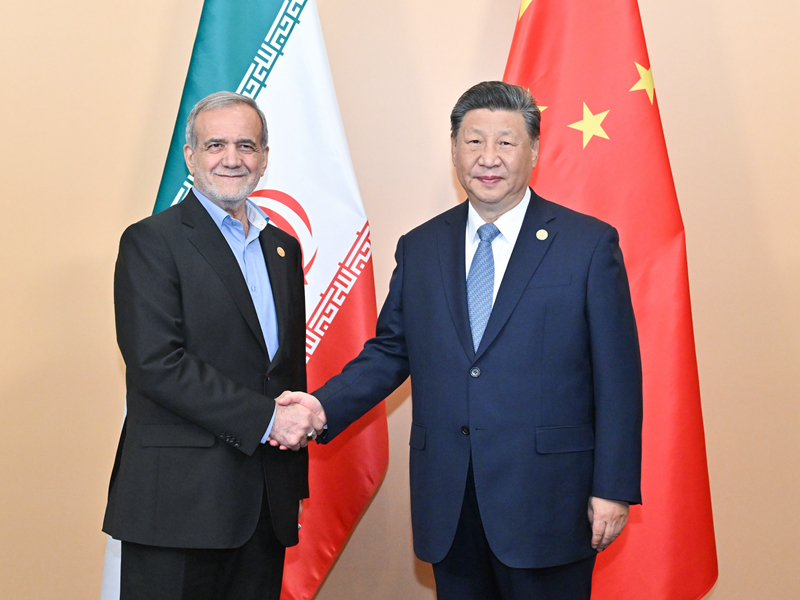
In the post-crisis atmosphere, the main question for Tehran was how it could both compensate for the damage inflicted and once again project an image of its deterrent power. Under such circumstances, it was natural for Iran’s attention to turn eastward more than ever before—where China, as a major economic and technological power and simultaneously a cautious player in the geopolitical arena, could fill some of the emerging gaps. The proximity between Tehran and Beijing intensified after these attacks, but the closer we examine the dimensions of this cooperation, the clearer it becomes that this relationship, despite its importance for both sides, is shaped within the framework of limitations, considerations, and cautious calculations.
Iran’s Urgent Need for Reconstruction
After the Israeli attacks, Iran had an urgent need to rebuild its deterrent capabilities. Reports indicate that Iran has purchased significant quantities of raw materials from China, including ammonium perchlorate (Iran, through the company “Pishgaman Tejarat Rafi Novin,” has purchased considerable amounts of ammonium perchlorate from Lion Commodities Holdings Ltd based in Hong Kong), which plays a key role in ballistic missile fuel and could significantly increase Iran’s missile production capacity. These are signs of Tehran’s efforts to quickly fill defensive gaps, which has created international concerns. China can be a valuable source for meeting Iran’s needs in this area, but this cooperation has a clear ceiling. Due to Beijing’s extensive relationships with America, Europe, Israel, and Arab countries, it does not want to openly provide Iran with advanced defense systems or strategic technologies. In reality, China remains mostly limited to restricted and covert support in the military sphere. Conversely, Russia is more operationally active and has more open cooperation with Iran in the areas of drones, missiles, and defense systems. Therefore, the roles of China and Russia should be seen as complementary: China primarily serves as a supplier of technology and materials, while Russia acts as a closer security partner.
Economic Cooperation: Tangible but Unequal
In the economic sphere, Iran-China cooperation is more tangible. For years, China has been Iran’s largest oil buyer and exports diverse industrial and consumer goods to the Iranian market. However, the composition of this trade reflects an unequal relationship: Iran primarily sells crude oil and buys manufactured goods. The 25-year cooperation agreement between the two countries ostensibly promises major investments, but in practice, China remains cautious and rarely invests in projects that would increase the risk of American and European sanctions. From Beijing’s perspective, Iran is more of a source for cheap energy supply and a market for exports than an equal strategic partner. For Tehran, however, this relationship represents a vital opportunity to overcome economic pressures and continue oil sales.
Geopolitical Dimensions: Cautious Engagement
From a geopolitical perspective, Iran-China proximity has gained new importance after the Israeli attack. Tehran hopes Beijing will play a more prominent supportive role in international institutions such as the UN Security Council and the International Atomic Energy Agency, creating barriers against American and allied pressures. However, China’s foreign policy is inherently cautious and pragmatic. Beijing has never been willing to enter direct confrontation with Washington or Tel Aviv for Iran’s sake, and it is unlikely to accept such risks in the future. China maintains a more balanced policy in the Middle East: it preserves its relations with Iran while maintaining extensive cooperation with Saudi Arabia, the UAE, and even Israel. Therefore, China’s cooperation with Tehran will never be such that it endangers Beijing’s broader interests in the region.
Internal and Regional Implications
This relationship also has internal consequences for Iran. After the Israeli attacks, the security atmosphere within the country intensified sharply; widespread arrests and even executions on charges of spying for Israel were part of the government’s internal response. In such an atmosphere, relations with China for Tehran are not just economic and military but also represent a form of legitimacy display and exit from isolation. This message is the same for both domestic and foreign audiences: Iran is not alone and can still cooperate with a global power.
At the regional level, Iran-China proximity has created new concerns for Arab countries. Saudi Arabia and the UAE, which are themselves key economic partners of Beijing, do not want to see China simultaneously establishing closer relations with their regional rival. This contradiction causes China to always move with caution and attempt to maintain balance between the two sides of the Persian Gulf. At the global level, Iran-China cooperation is part of the broader trend of the world moving toward multipolarity. Beijing uses Tehran as one of its tools for balancing against America, but this tool is only one of the options available in China’s foreign policy toolkit, not all of it.
Conclusion
Overall, Tehran-Beijing cooperation after the June 2025 attack is real and meaningful, but it should not be considered a full-fledged strategic alliance. For Iran, this relationship is a vital opportunity for power reconstruction and overcoming sanctions, and for China, it is a tool for influence and balance in global equations. However, limitations remain: China is cautious, Russia plays a more prominent role in the security sphere, economic relations remain unequal, and regional equations are more complex than a simple Tehran-Beijing axis can explain. The future of this relationship depends on Beijing’s risk tolerance, Iran’s ability to manage its domestic economy, and the reactions of America and regional countries. Cooperation will continue, but more as an opportunistic and temporary partnership than a stable, long-term alliance.