

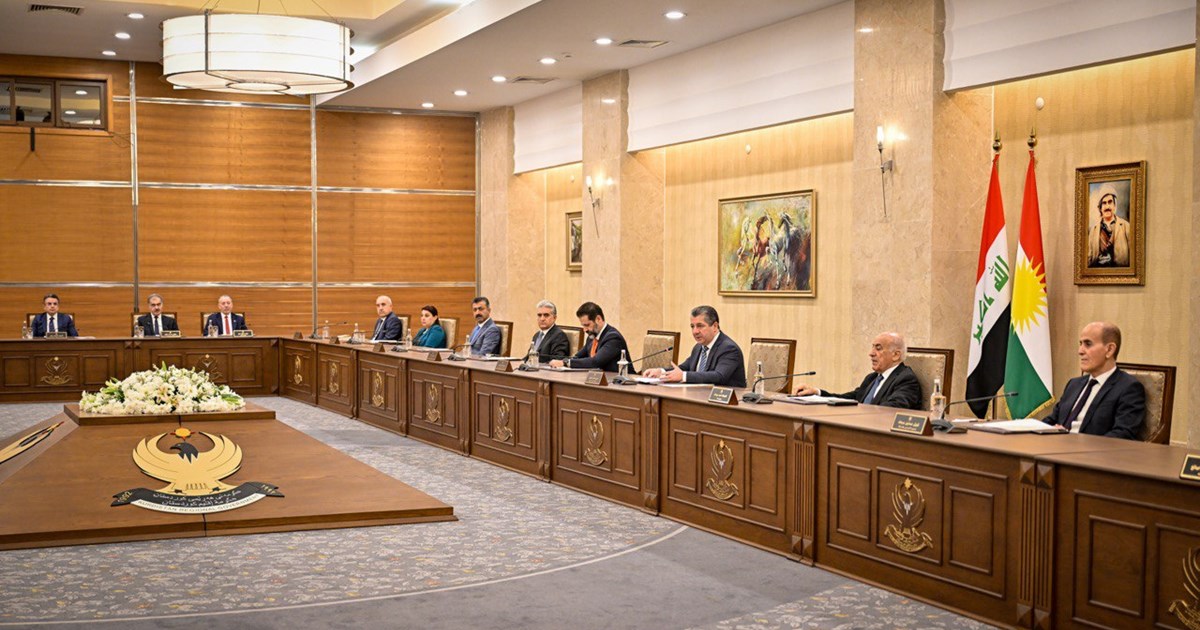
The Kurdistan Regional Government filed a federal court petition challenging Baghdad’s salary cut while affirming its unwavering commitment to regional peace and stability during Wednesday’s cabinet session.
Prime Minister Announces Legal Action Against Salary Suspension
Prime Minister Masrour Barzani led the Kurdistan Regional Government’s Council of Ministers meeting on Wednesday, June 18, 2025, with Deputy Prime Minister Qubad Talabani in attendance. Opening the session, Barzani addressed the pressing issue of salary and financial entitlement cuts imposed by Baghdad on the Kurdistan Region.
The Prime Minister announced that the government has submitted a formal petition to the Federal Court within the past few days, challenging what he described as the illegal and unconstitutional decision by the Federal Ministry of Finance to suspend the Kurdistan Region’s salaries and financial entitlements. Barzani emphasized the government’s continued efforts through all available channels to resolve this critical issue affecting public sector employees across the region.
Expressing cautious optimism, the Prime Minister stated his hope that the Federal Court would deliver a fair ruling in favor of the Kurdish people. He highlighted that the Kurdistan Regional Government has fulfilled all its constitutional obligations and expects reciprocal respect for its constitutional rights, particularly the transfer of its rightful financial allocations from the federal treasury.
Regional Stability Commitment Amid Rising Tensions
The cabinet extensively discussed recent developments and escalations in regional conflicts, analyzing their potential implications for the Kurdistan Region. During these deliberations, the Council of Ministers emphasized the Kurdistan Region’s consistent and unchanging position on regional affairs.
The government reaffirmed that the Kurdistan Region has always opposed war, conflict, and destruction, positioning itself as a crucial factor for peace, tranquility, and stability in the region. The cabinet stressed that the Kurdistan Region poses no threat to any neighboring country or party, maintaining its principled stance as a stabilizing force rather than a source of regional tension.
The Council of Ministers reiterated the Kurdistan Region’s support for all diplomatic efforts aimed at resolving disputes and problems through dialogue and negotiation. This commitment extends to preserving peace and security throughout Iraq, the Kurdistan Region, and the broader Middle Eastern region, reflecting the government’s dedication to peaceful coexistence and conflict resolution.
Administrative Measures and Healthcare Sector Development
In additional business, Interior Minister Reber Ahmed presented a proposal regarding traffic violation penalties. The initiative calls for a 20% reduction in traffic violation fines for an extended six-month period, running from July 1 through December 31, 2025. The Council of Ministers unanimously approved this citizen-friendly measure aimed at providing financial relief to motorists.
The session concluded with Health Minister Saman Barzanji and Council of Ministers Secretary Amanj Rahim presenting a proposal concerning the appointment of general medical college graduates. After thorough discussion, the cabinet approved the appointment initiative and delegated implementation responsibility to the Health Ministry.
The Council directed the ministries of Finance, Economy, and Health, along with the General Civil Service Council, to undertake necessary arrangements for processing these medical professional appointments. This decision demonstrates the government’s commitment to strengthening healthcare services by integrating qualified medical graduates into the public health system.
The move addresses dual objectives: providing employment opportunities for recent medical graduates while enhancing healthcare service delivery capacity across the Kurdistan Region. These appointments represent part of the government’s broader strategy to develop human resources in critical sectors despite ongoing financial challenges with the federal government.