
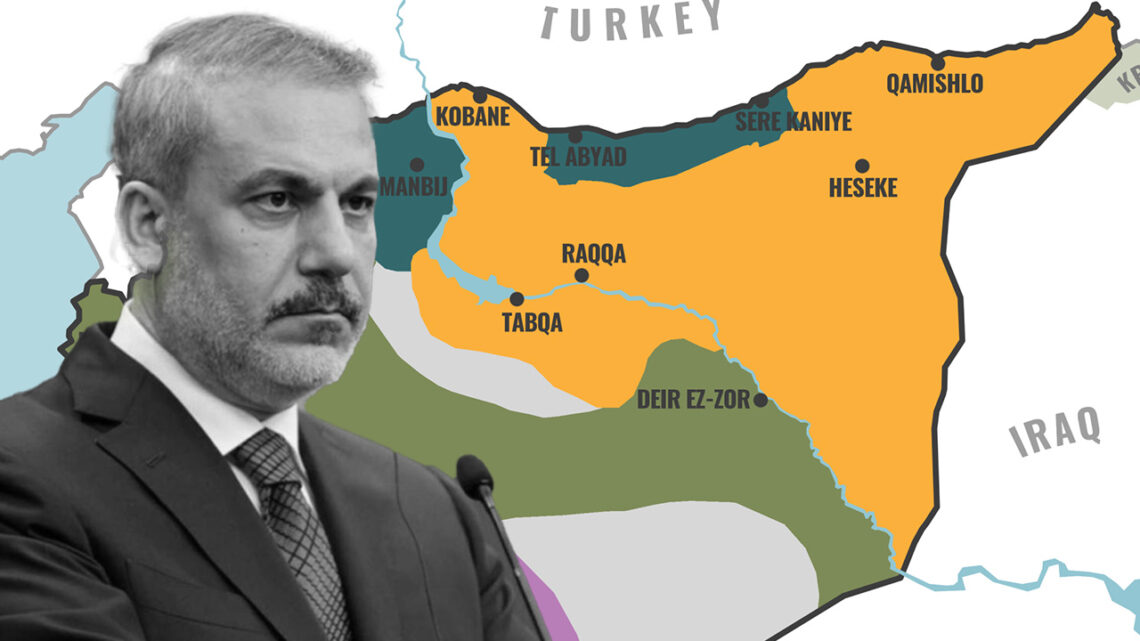
Following the “Arab Spring”, from the onset of the events in Syria until the fall of the Assad regime in late 2024, Turkey has continuously focused its attention on the northern and northeastern regions of Syria. From Afrin to Qamishlo—an area known as “Western Kurdistan”—this region, defined by Kurdish influence within Syrian geography, has been subjected to pressure and threats from Turkey over the past 14 years for various reasons, all of which carried a security dimension. Turkey approached every issue related to this region and the Kurdish question in Syria through a security lens.
The main question is: why does Turkey treat West Kurdistan this way? What are the motives behind its pressure, and what are the prospects—especially in light of the opportunities and scenarios emerging after the fall of the Assad regime in late 2024?
West Kurdistan and the Autonomous Administration
West Kurdistan is the smallest part of Kurdistan, which has been divided among four states. It covers an area of 700 square kilometers and stretches from Derik to Afrin. The majority ofthe population is Kurdish, alongside Armenians, Assyrians, Arabs, Turkmens, and Druze. According to unofficial statistics, its population is around 5 million. Since early 2016, the Turkish government has begun constructing a wall along its border with West Kurdistan. This wall, measuring 688 kilometers in length, is considered the third longest in the world. Turkey’s aim is to sever the link between North and West Kurdistan.
West Kurdistan lies along the Turkish border, and most of the border crossings between Turkey and Syria pass through Kurdish regions. As a result, Turkey has continually attempted to blockade West Kurdistan by closing many of these crossings.
West Kurdistan operates under a system of self-governance known as the Democratic Autonomous Administration, which consists of three cantons: Jazira, Afrin, and Kobanê. Each canton has its own legislative, judicial, and executive council. Decision-making begins at the level of municipalities, neighborhoods, and regions, then proceeds to city councils and finally to the cantons. For example, Qamishlo, which is part of the Jazira Canton, is divided into six regions, each containing several municipalities. Each canton has its own constitution, government, parliament, courts, laws, and municipalities, all functioning in a decentralized manner.
The areas governed by the autonomous administration are rich in natural and agricultural resources, and are well known for the cultivation of grain and cotton. Three of Syria’s largest oil fields—Sweden, Ramlan, and al-Omar—are located in the region, along with 10 other fields spread across Hasakah and Deir al-Zour, the most significant of which are al-Tank, al-Jafro, and Konikun.
The autonomous regions rely economically on trade in real estate, automobiles, and food, as well as currency exchange. Due to the closure of the border with Turkey, the Simelka border crossing in the Kurdistan Region remains the only gateway through which West Kurdistan can access the outside world.
Turkey’s Military Pressure on the West
Since the onset of the Syrian conflict, Turkey has consistently maintained a presence in West Kurdistan, alongside its political, economic, and diplomatic pressure on this part of Kurdistan. Militarily, it has not hesitated to carry out attacks from both land and air. In addition to thousands of civilian casualties, dozens of cities, towns, and villages have been destroyed, leading to significant and dangerous demographic changes in these areas. Some of Turkey’s most prominent military actions include:
Operation Euphrates Shield:
On August 24, 2016, Turkey launched its first military operation in Syria, named “Euphrates Shield.” The first phase of the operation saw the Turkish army cross the Syrian border, marking the beginning of the operation. This phase ended with the capture of the city of Jarablus and surrounding villages near the Turkish border.
On the 27th of the same month, the second phase of the operation concluded with the announcement of control over the cities of Azaz and Jarablus in the Aleppo countryside, backed by the Free Syrian Army and Turkey. The third phase began on August 16, 2016, and concluded on February 23, 2017, with the capture of Al-Bab, located east of Aleppo.
The operation, which lasted for seven months, aimed to expel ISIS fighters and prevent the Syrian Democratic Forces (SDF) from connecting the cities of Kobani and Afrin. It also sought to create a safe zone from Syrian and Russian airstrikes targeting Ankara’s allied groups and residents in these areas.
Operation Olive Branch
On December 20, 2018, Turkey launched a new military operation called “Olive Branch.” The operation aimed to seize control of the town of Afrin. It lasted for three months. On March 3, 2018, Turkish forces and their allied armed groups entered the town of Raju, located in northwestern Afrin, after facing strong and extensive resistance from Kurdish forces. A few days later, the forces involved in the Olive Branch operation took control of Afrin’s most strategic town, Jindires. On March 18, Turkish President Recep Tayyip Erdogan announced that his forces, with the help of Syrian armed groups, had taken control of the center of Afrin.
As part of this military operation, thousands of Kurdish civilians living in Afrin and its surrounding areas were displaced, and their properties were looted by Syrian armed groups. Hundreds of civilians were killed or injured, and the infrastructure of the region was severely damaged.
Operation Peace Spring
On October 9, 2019, Turkish President Recep Tayyip Erdogan announced the launch of Operation Peace Spring in northern Syria. Turkey’s goal in the operation was to remove Kurdish forces near its borders, which Ankara had labeled a terrorist organization.
“Turkish forces have launched Operation Peace Spring against the Kurdistan Workers’ Party (PKK) and the People’s Defense Units (YPG) in northern Syria,” Erdogan stated. “Our duty is to prevent the establishment of a terrorism corridor along our southern borders,” he added. The operation was carried out in three phases. Turkish forces entered the northeastern areas of Serekaniye and Tel Abyad, with the support of their allies in Syria. As a result of this operation, and following agreements with both the United States and Russia, on October 22, the Syrian Democratic Forces (SDF) withdrew 30 kilometers deep into the border area, along a 120-kilometer stretch.
Operation Peace Spring was seen as the continuation of Operation Olive Branch, which Turkey had launched in 2018, targeting the Afrin region in northwestern Syria.
According to human rights organizations, the operation resulted in war crimes and serious violations, including indiscriminate shelling of Kurdish areas, extrajudicial killings, and notably the execution of Hevrin Khalaf. More than 200,000 people were displaced during the operation.
Ankara’s main goal and strategy in its military operations is to transform the autonomous administration of northern and eastern Syria into a “Swiss cheese” model, meaning the division of the region. This approach seeks to prevent the Syrian Democratic Forces (SDF) from having a unified and continuous border area with Turkey. This is particularly significant since Damascus is opposed to Kurdish independence, much like Ankara. Both governments (Ankara and Damascus) seek to ensure that, once the situation stabilizes, Damascus can easily and forcibly regain control over the separatist areas of West Kurdistan.
Political, Economic, and Diplomatic Pressures
With the establishment of the autonomous administration in West Kurdistan, Turkey has exerted political and diplomatic pressure on Western countries, Russia, and Iran to sever their relations with the administration. These efforts were clearly visible during the early stages of the Geneva and later Astana talks.
Ankara laid out its conditions during the first Geneva meetings, calling for the creation of a peace zone in northern Syria along its southern border. It repeated these demands at the beginning of the Astana talks. In late 2016, President Erdogan publicly declared that he would not participate in any meetings if representatives of what he called “terrorist” groups—referring to the Kurdish forces in Western Kurdistan—were invited.
Economically, Turkey imposed a severe embargo on the eastern Euphrates. It began tightening border controls in 2013. Between 2015 and 2018, as the conflict along the Turkish border intensified, Ankara built the world’s third longest wall—after the Great Wall of China and the wall between the United States and Mexico.
As mentioned earlier, Turkey has established dozens of military bases inside Syria to restrict the movement of Kurdish forces, particularly in the areas of Jarablus, Azaz, al-Bab, and Afrin. Unlike the eastern Euphrates, Turkey has transformed its border crossings west of the Euphrates into economic and commercial strongholds, facilitating trade between its territory and Syria, while completely suspending traffic from the eastern border and sealing it off.
Since the summer of 2012, when Kurdish forces filled the administrative vacuum in the northeastern border region of the Euphrates, Turkey has kept this section of the border closed and has tightened security measures. Since 2019, Turkey has cut off the water supply to Hasakah and surrounding villages more than 18 times, depriving nearly one million people of clean drinking water. This has had a major impact on agriculture and food production, which form the backbone of the economy and livelihoods in West Kurdistan.
Autonomous Administration in the Face of Pressures
In the face of ongoing Turkish pressure on West Kurdistan, Kurdish forces have managed to resist and defend against many military attacks—particularly in the cantons of Jazira and Kobani. However, this defense has been constrained by the scale and intensity of Turkish assaults, especially given the vast disparity in military capabilities between the two sides.
One of the main factors limiting the escalation of Turkish offensives has been international pressure—especially from the United States and France—which on several occasions has prevented military developments in West Kurdistan from escalating into major humanitarian disasters.
Despite this, the prospects for gaining international legitimacy—such as political recognition of West Kurdistan as an autonomous or independent region similar to the Kurdistan Region in Iraq—remain limited. The leaders of West Kurdistan are aware that their current support from Western powers is temporary and tactical, not permanent or strategic. They also understand that the continued presence of Western forces helps deter full-scale displacement and demographic changes in their territories.
U.S. and Western military support for Kurdish forces is primarily based on their effectiveness in the fight against ISIS, which aligns with the security priorities of those countries. The greatest challenge for officials in West Kurdistan is how to leverage this military cooperation into broader political recognition. However, Turkey’s strong opposition to the project stands as a major barrier.
Turkey views the West Kurdistan model as a threat that could inspire similar aspirations among its own Kurdish population. As a NATO member, Turkey’s stance significantly influences the alliance’s overall position—most NATO members, aside from France, are reluctant to support the political aspirations of the autonomous administration.
Therefore, if the leaders of West Kurdistan seek broader international support for their political project, they must first offer Turkey concrete assurances that its southern border will remain secure. They must also strengthen domestic political legitimacy through improved public services, enhanced security, and greater diplomatic engagement.
Pressures After the Fall of Assad
Following the fall of Bashar al-Assad’s regime on 8 December 2024, Turkey saw a golden opportunity to revive and complete its long-stalled projects in Syria. Under Assad, the regime’s military presence had posed an obstacle to Turkey’s ambitions; however, with his departure, Ankara quickly ramped up its political and diplomatic activities inside the country. Just weeks after Assad’s fall, senior Turkish officials arrived in Damascus, aiming to influence the direction of the new Syrian administration and to help design a political roadmap that would incorporate Turkish interests into the new national agenda.
From the outset, Turkey began pressuring the new authorities in Damascus to preserve Syria’s territorial unity and to reject any alternative governance projects—particularly those led by Kurdish groups.
During a visit to Damascus on 22 December, Turkish Foreign Minister Hakan Fidan stated that the People’s Defense Units (YPG) have no place in the future of Syria and must be dismantled. He also urged Syria’s new president, Ahmed Shara, to uphold the country’s territorial integrity and political sovereignty. Similarly, Turkish Defense Minister Yaşar Güler expressed Ankara’s belief that the new Syrian leadership—especially those forces supported by Turkey—would be capable of expelling the YPG from all areas under their control.
These statements represented early diplomatic pressure from Turkey on the newly formed authorities in Damascus, particularly the Syrian Liberation Council, to take concrete action against Kurdish forces.
Turkey’s Multi-Level Strategy Against the Autonomous Administration
After the fall of Assad, Turkey has been acting on three fronts—political, military, and international—to dismantle the project of autonomous administration in West Kurdistan. On the military level, Ankara aims to shrink the territory held by the Syrian Democratic Forces (SDF) and recapture strategic areas by backing and mobilizing its proxy forces—especially since Assad’s departure.
One of the most critical targets has been the Tishrin Dam. Turkey, alongside its proxy group known as the “National Army,” has resumed a large-scale offensive to seize control of the dam. Ankara views the Tishrin Dam as a strategic gateway to controlling the Euphrates River, a lifeline for both Syria and Iraq. Gaining control of this dam would provide Turkey with a powerful leverage point over water resources, allowing it to exert pressure on its southern neighbors—particularly given its extensive dam-building projects on Turkish soil.
In addition to controlling water flow, Turkey is also targeting energy resources. By capturing the Tishrin Dam and the electricity it generates, Ankara would be in a position to impose political and economic conditions on the political forces in northern Syria—especially the autonomous administration, which depends heavily on the dam to provide electricity and essential services to the population. In this way, Turkey seeks to weaken the administration’s governance capacity by undermining its ability to meet the basic needs of the communities under its control.
In addition, Ankara is seeking to establish its presence in strategic parts of Syria as part of a broader policy aimed at expanding its regional influence and pursuing the borders it refers to as the “National Pact.” On the international level, Turkey has intensified diplomatic efforts—led by Foreign Minister Hakan Fidan—to persuade regional countries, as well as Russia, the United States, and Western powers, to withdraw their support for Kurdish forces in Syria. At every international forum and meeting, Turkey links the Syrian Democratic Forces (SDF) to the Kurdistan Workers’ Party (PKK). “The PKK issue is not only Turkey’s concern, but also a problem for Iraq, Syria, and even Iran,” Fidan said at the conclusion of the Syria Neighbors Conference held in Jordan on March 9. At the Munich Security Conference in mid-February, he added, “No one denies that the PKK occupies one-third of Syria’s territory.” He also stated that the new Syrian administration is now addressing this issue and that combating the PKK is among its top priorities
Turkey’s efforts are aimed at pressuring the international community to treat the Kurdish forces in West Kurdistan the same way it treats the PKK. However, these attempts have largely failed, as the international community continues to recognize and value the sacrifices made by Kurdish forces in the fight against ISIS. Officials in West Kurdistan have also consistently denied having any organizational ties with the PKK. The PYD acknowledges that some individuals involved in the military campaign against ISIS previously fought with the PKK and possess years of combat experience, but stresses that these individuals are no longer affiliated with the party and have no organizational links with the Kurdistan Communities Union (KCK) or PKK-related structures.
Turkey is also pushing to transfer responsibility for ISIS detainees from the Syrian Democratic Forces (SDF) to the new Syrian administration. Turkish Foreign Minister Hakan Fidan has repeatedly stated that Syrian authorities should take control of the military bases and detention centers where ISIS members are held—and that Turkey is willing to assist with this process. During a quadrilateral meeting of Syria’s neighboring countries held in Jordan, Fidan emphasized that the issue of ISIS prisons is a matter of national security and concerns the entire region, including Iraq, Syria, and Jordan.
Turkey’s broader goal is to remove control over the ISIS detainees from the hands of the SDF and thereby undermine one of the key justifications for continued international support to the Kurdish-led forces. However, this remains a sensitive matter for the international community, which continues to trust the SDF more than any other group when it comes to managing ISIS-related security and detention operations.
Turkey and the Agreement between the Syrian Government and the SDF
Turkey continues its attacks on West Kurdistan through its allied armed groups and regularly issues threats of new military operations. At the same time, it exerts pressure on the new Damascus authorities to reassert full control over northeastern Syria and prevent any forces from operating outside the framework of the central government.
Meanwhile, through American mediation, Mazloum Abdi, commander of the Syrian Democratic Forces (SDF), traveled to Damascus and signed an eight-point agreement with Syrian President Ahmed Shara. The agreement, announced on March 10, outlines several provisions that are highly significant for West Kurdistan and could play a crucial role in stabilizing the region.
One of the key points—particularly the fourth—calls for the integration of all civilian and military institutions in northeastern Syria into the Syrian state’s administrative system. This includes control over border crossings, airports, and oil and gas fields. Such integration would counter Turkey’s long-standing justification for intervention—that these areas lie outside Damascus’ authority and must be brought back under central control.
Another important provision addresses the return of territories previously occupied by Turkey and its proxy forces, including areas like Afrin, Gri Spi (Tal Abyad), and Serekaniye (Ras al-Ain), from which large numbers of residents were displaced. Article 5 of the agreement guarantees the return of all Syrian refugees to their towns and villages and affirms the Syrian state’s commitment to ensuring their safety.
The seventh point of the agreement stresses the rejection of any division of Syrian territory and reaffirms the commitment of both parties to Syria’s territorial integrity. This clause is particularly notable, as Turkey has often used the claim of separatism as a pretext to justify its military presence and political ambitions in northern Syria.
While the long-term implications of this agreement for West Kurdistan remain uncertain—especially since delays are expected in the implementation of its provisions—it may, for the time being, help reduce some of the ongoing military and political pressure that Turkey exerts on the region.
Conclusion
The relationship between the Turkish state and West Kurdistan is unstable and imbalanced, leading to a range of military, political, and economic consequences. Turkey has consistently approached the Kurdish region from a security standpoint, viewing it as a threat to its national security and seeking to eliminate this perceived threat by any means necessary. In contrast, West Kurdistan, or the autonomous administration, remains in a defensive position. It strives to convince Turkey that West Kurdistan will not be a threat but instead can contribute to regional stability, relying on the support of the international community and the United States to communicate this vision to Turkey. This belief also plays a role in protecting the region and ensuring its continued existence. This was evident in the recent agreement between the Syrian Democratic Forces (SDF) and the Damascus government, where the primary concern of the administration was to avoid war and military conflict. This reflects the enduring illusion Turkey has maintained through its own historical and conservative perspectives.