
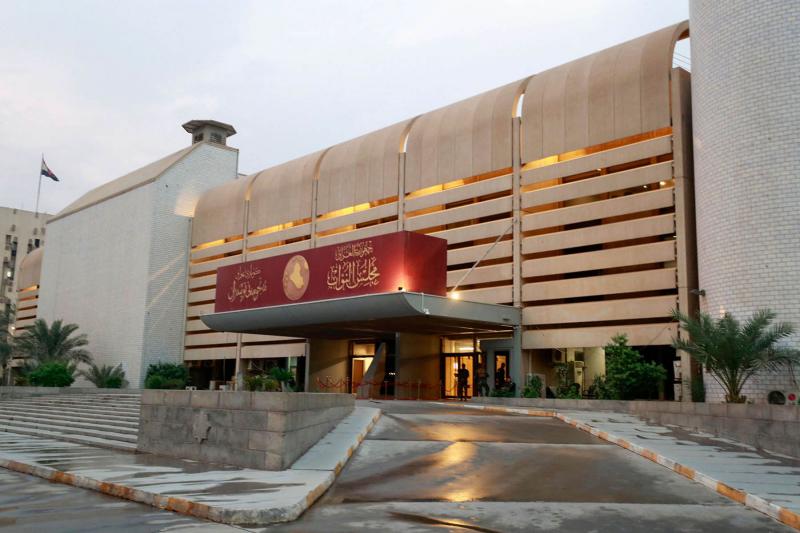
Iraqi Parliament passed the first amendment to the Federal Budget Law for 2023-2025 on Sunday, despite boycotts by opposition lawmakers and legal disputes over the session’s legitimacy. The amendment, which affects oil revenue allocations between Baghdad and Erbil, was supported by 176 MPs, though critics argue quorum was not met. The Central and Southern Front bloc has vowed to challenge the decision in court, while the Coordination Framework sees it as essential for economic planning and reconstruction efforts.
Boycotts and Disputes Over the Vote
The session, chaired by First Deputy Speaker Mohsen Al-Mandalawi, was attended by 176 MPs. However, members of the Central and Southern Front bloc, which boycotted the vote, claim that the quorum was not met, casting doubts on the vote’s constitutionality. Independent MP Ahmed Majid told Shafaq News that the session violated parliamentary regulations, asserting that “the number of MPs present did not exceed 140.”
Majid added that opposition lawmakers plan to challenge the decision before the Federal Supreme Court. MP Raed Al-Maliki also criticized the budget amendments, calling for greater financial oversight and a joint financial management framework between Baghdad and Erbil. He highlighted concerns regarding transparency in oil contracts and key budget provisions, particularly Article 14 and the budget deficit.
Al-Maliki further stressed that the Central and Southern Front bloc seeks to ensure equitable financial allocations for the central and southern provinces and secure government funding for contracted companies operating in those regions.
Approval of the Amendments and Political Negotiations
Despite opposition from certain factions, the Shiite Coordination Framework (CF) confirmed that political groups had reached a consensus to pass the amendments. MP Mohammed Radi, a Coordination Framework member, stated that the vote was a necessary step to resolve ongoing disputes between Baghdad and the Kurdistan Regional Government (KRG). He emphasized that the amendment is crucial for expediting the 2025 budget process and ensuring the continuation of major reconstruction projects.
Dr. Bryar Rashid, a member of the Patriotic Union of Kurdistan (PUK) bloc, told PUKMEDIA that the amendment had been postponed multiple times due to political disagreements but was finally approved in Sunday’s session. Rashid confirmed that the Kurdistan Region’s oil production and transportation costs were set at $16 per barrel under the amendment.
According to Rashid, this amount will be provided as an advance to the KRG until the actual value of oil production and transportation is determined separately by advisory bodies. This assessment is expected to take place within 60 days of implementing the Federal General Budget Law.
Key Budget Amendments and Legal Implications
The amendment changes how oil revenues are managed between Baghdad and Erbil. It stipulates that the production and transportation costs of oil in the Kurdistan Region will be determined based on verified expenses reviewed by an advisory body. If the federal and regional governments fail to reach an agreement on these costs, the Iraqi Ministry of Oil will appoint an independent party to determine them.
Previously, the Iraqi government had set oil extraction costs at $6 per barrel, a figure criticized as unrealistically low. KDP MP Jiay Timor argued that foreign companies operating in the Kurdistan Region face costs as high as $26 per barrel. Following negotiations, the amendment raised the figure to $16 per barrel.
The amendment process was set in motion on November 5, 2024, when the Iraqi Council of Ministers approved a proposal to amend paragraph (c) of Article 12 of the Triennial Budget Law No. 13 of 2023. The first and second readings of the amendment were completed in Parliament, but opposition from certain blocs delayed the vote, initially scheduled for January 13.
Despite the boycott and anticipated legal challenges, parliamentary sources indicate that the vote will likely stand. The government is expected to proceed with its budget allocations and continue planning economic strategies for 2025.
Meanwhile, before his official visit to Tehran, Parliament Speaker Mahmoud Al-Mashhadani announced that the budget amendments would move forward, highlighting ongoing negotiations between Baghdad and Erbil over resource management and fiscal policy. As the legal battle unfolds, the implementation of these amendments will play a crucial role in shaping Iraq’s economic and political landscape.