

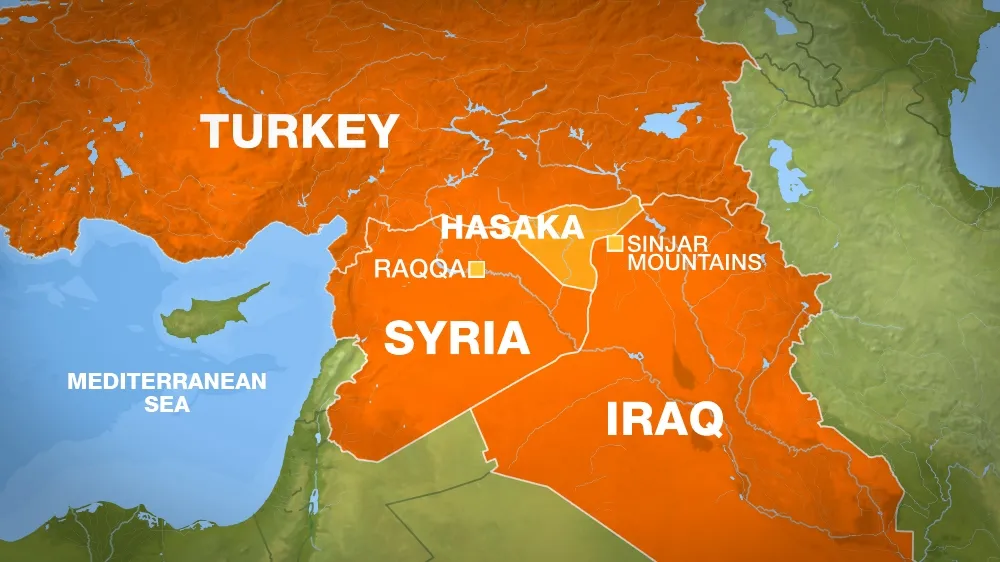
Turkey’s involvement in the political and military affairs of Iraq and Syria has become increasingly significant since the U.S. invasion of Iraq in 2003. The resulting instability in both countries, compounded by internal conflicts and the rise of extremist groups like Al-Qaeda and ISIS, has led Turkey to adopt a proactive approach to safeguard its interests in the region. This article explores Turkey’s evolving policy towards Iraq and Syria, focusing on its security concerns, relations with Kurdish groups, and broader regional ambitions.
Security Concerns and Regional Instability
The chaos following the U.S. invasion of Iraq and the subsequent rise of ISIS, as well as the Syrian Civil War, created a volatile environment that directly affected Turkey’s security. The Kurdistan Workers’ Party (PKK),, has been operating along Turkey’s southern border, particularly in northern Iraq and parts of Syria. Turkey has consistently sought to control the border regions to prevent the PKK from gaining a foothold in these areas, while also addressing the threat posed by ISIS.
The instability in Iraq, particularly in areas bordering Turkey, has been a primary concern for Ankara. The emergence of Kurdish autonomy in northern Iraq, as well as the growing influence of Kurdish forces in Syria, has raised alarms for Turkey. As a result, Turkey has taken military action in both countries to maintain control over its borders and counteract the influence of groups it deems hostile to its national security.
Turkey’s Strategy in Syria: The Fight Against YPG and PKK
Turkey’s policy in Syria has been shaped by its desire to eliminate the Kurdish YPG (People’s Defense Units), which it views as a Syrian extension of the PKK. The YPG’s alliance with the U.S. in the fight against ISIS has complicated Turkey’s relations with Washington. Despite this, Turkey has maintained a hard stance against the YPG, launching multiple military operations in northern Syria to push back Kurdish forces and prevent the establishment of an autonomous Kurdish region along its southern border.
Turkey has also supported Syrian opposition groups in their fight against the regime of Bashar al-Assad, with a focus on countering both Kurdish forces and ISIS. However, the shifting dynamics of the Syrian conflict have forced Turkey to reevaluate its alliances and goals. Although Turkey initially sought to topple Assad, its position has evolved, with recent discussions indicating a willingness to negotiate with Damascus under certain conditions, particularly regarding the control of northern Syria.
Diplomatic Engagement and the Role of the U.S.
Turkey’s role in Syria and Iraq has been closely linked to its relationship with the U.S. and other NATO allies. Despite differences, particularly over the YPG, Turkey has cooperated with the U.S. in the fight against ISIS. However, the gradual withdrawal of U.S. troops from northern Syria in recent years has given Turkey more room to operate militarily. The shifting U.S. presence in the region has also led Turkey to strengthen its own position in northern Syria, with the goal of establishing a safe zone free from Kurdish control.
Ankara’s diplomatic efforts have also been focused on securing the return of refugees, both from Syria and Iraq, particularly the millions displaced by the ongoing conflicts. Turkey hosts approximately 3.6 million Syrian refugees, and its policy on repatriation has become a key aspect of its negotiations with both the U.S. and the Assad regime. Turkey seeks to create conditions conducive to the return of refugees to northern Syria, where it plans to establish long-term zones of influence.
Economic Interests and Regional Hegemony
In addition to security concerns, Turkey’s foreign policy in Syria and Iraq is driven by economic interests and the desire to assert regional hegemony. Iraq, with its rich oil reserves and strategic location, is of vital importance to Turkey’s economic and energy security. Turkey has deepened its economic ties with the Kurdistan Regional Government (KRG) in northern Iraq, facilitating oil exports and energy infrastructure projects.
Similarly, Syria’s geographical position makes it a key player in Turkey’s vision of a more influential regional presence. Turkey has invested in rebuilding parts of northern Syria under its control and has sought to integrate the region into its economic sphere. Turkey’s involvement in these areas is not only a matter of security but also a strategy to project power and influence across the broader Middle East.
Challenges and Future Prospects
Turkey faces numerous challenges in its policies towards Syria and Iraq. Its relations with the Assad regime remain tense, and the future of Kurdish autonomy in the region is still uncertain. The presence of U.S. and Iranian forces in Iraq, as well as the shifting allegiances of regional actors, further complicates Turkey’s position. Additionally, the humanitarian situation, particularly in Syria, poses both a moral and logistical challenge for Turkey as it balances security interests with the management of millions of refugees.
Looking ahead, Turkey will likely continue to pursue a multifaceted strategy that includes military, economic, and diplomatic efforts to secure its interests in Syria and Iraq. While Ankara may engage in negotiations with Damascus, it is unlikely to abandon its focus on curbing Kurdish influence in the region. Turkey’s future in Syria and Iraq will depend on the balance it strikes between these competing priorities and the evolving geopolitical landscape.
In conclusion, Turkey’s policy in Syria and Iraq is shaped by a combination of security concerns, regional aspirations, and diplomatic maneuvering. Its approach will remain fluid, adapting to the complexities of the Middle Eastern conflicts, while maintaining a strong stance on issues of national security, particularly regarding Kurdish autonomy and the threat of terrorism.